Custom Software vs. Off-the-Shelf: How to Make the Decision That's Right for Your Business
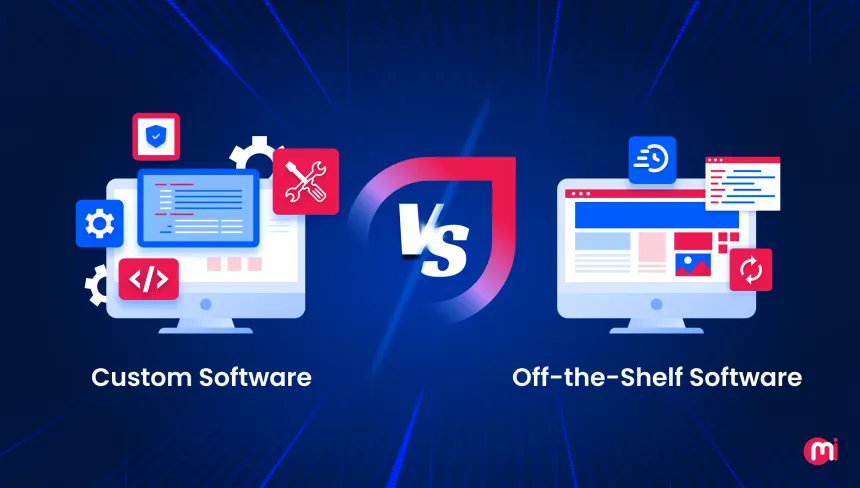
Custom Software vs. Off-the-Shelf: How to Make the Decision That's Right for Your Business
Every growing business eventually hits the same wall. Spreadsheets and shared documents stop scaling. Manual processes that worked at ten employees are breaking at fifty. Customer information lives in three different places and no one is sure which is current. You need a system — and the debate begins.
The options look straightforward: buy an established platform (Salesforce, HubSpot, Zoho, SAP, Odoo, Microsoft Dynamics — the list is long) and configure it to your needs, or build something custom that works exactly the way your business works. In practice, this decision is anything but simple, and getting it wrong in either direction has significant financial consequences.
We have seen businesses spend hundreds of thousands on enterprise licenses they barely use, and we have seen others sink development budgets into custom projects that delivered half what was promised. Both failures are avoidable with the right decision framework.
Why This Decision Is Harder Than It Looks
The off-the-shelf vs. custom debate is complicated by a few factors that are easy to underestimate:
The true cost of off-the-shelf is not the license fee. Enterprise software license costs are often the smallest part of total cost of ownership. Implementation, configuration, data migration, customization (and most platforms require some), training, ongoing support contracts, and eventual migration costs all add up. A platform that looks affordable at $500/month frequently costs $80,000–$150,000 to implement properly and generate meaningful business value.
Custom development is not infinitely expensive. The perception that custom software always costs multiples more than buying a platform was more true ten years ago. Modern development tools, frameworks, and cloud services have dramatically reduced the cost of building well-scoped custom systems. A precisely scoped custom solution for a medium-complexity business problem may cost less over five years than the license and maintenance fees of a major platform.
Neither option is inherently superior. The right answer is always contextual. Businesses that succeed with off-the-shelf platforms are not making inferior decisions — they have correctly assessed that the platform's fit is good enough to justify its trade-offs. Businesses that invest in custom development are not being extravagant — they have correctly identified that their competitive differentiation requires systems that cannot be purchased.
When Off-the-Shelf Is the Right Answer
There are many situations where buying an established platform is genuinely the best decision. Here is when the case for off-the-shelf is strong:
Your Needs Are Genuinely Standard
Many business functions are commodity processes — accounting, basic HR, standard project tracking, email marketing. For these functions, established platforms have invested years and millions into solving the same problems you face, and they solve them well. There is no strategic value in building your own invoicing system from scratch when QuickBooks or Xero does it competently.
The key question is: does the process you are trying to support have meaningful differentiation in your business, or is it table stakes that every company in your industry handles the same way? If it is the latter, buy.
Speed to Deployment Matters More Than Perfect Fit
Off-the-shelf platforms can typically be configured and launched in weeks. Custom development for a non-trivial system takes months. If your business has a critical operational need — you are growing fast, entering a new market, or your current system is failing — deploying an imperfect platform quickly may be far more valuable than deploying a perfect custom system later.
This is a legitimate trade-off, not a compromise. The business value of having something working in six weeks often exceeds the long-term benefit of a perfectly tailored system available in six months.
The Platform Has Deep Domain Expertise
The best platforms in their category embody years of domain knowledge. Accounting software understands tax compliance. HR platforms have built-in workflows aligned with employment law. Healthcare management systems have integrated compliance frameworks. When a platform has mature domain expertise that is directly relevant to your problem, you are buying the accumulated knowledge of hundreds of domain experts — not just software.
Your Team Cannot Support Custom Infrastructure
Custom software requires ongoing technical care: security updates, dependency management, infrastructure monitoring, feature development. If your organization does not have — and does not plan to have — the internal or contracted technical resources to maintain custom systems properly, off-the-shelf platforms with vendor-managed infrastructure are significantly lower risk.
When Custom Development Is the Right Answer
Custom development delivers superior long-term value in specific, identifiable situations:
Your Workflow Is a Competitive Advantage
Some businesses have developed processes — for client management, service delivery, quality control, or proprietary methodologies — that genuinely differentiate them in the market. These processes are, by definition, not standard. Forcing a differentiated process into a generic platform either changes the process (losing the differentiation) or requires such heavy customization that you are effectively paying for a custom system anyway, just built on top of an expensive platform.
If your way of doing things is meaningfully better than how your competitors do it, that advantage should be built into your software — not constrained by what a platform vendor chose to support.
Integration Requirements Are Specific and Complex
Most organizations use multiple software systems, and the integrations between them are frequently where the highest-value automation lives. Off-the-shelf platforms have integration marketplaces and APIs, but they are built for the most common integration patterns. When your business requires integrations with industry-specific systems, legacy infrastructure, proprietary data sources, or unusual external APIs, the customization cost of a platform approach often approaches or exceeds the cost of a custom solution.
Long-Term Total Cost of Ownership Favors Custom
Do the five-year math. A platform costing $2,000/month in licensing is $120,000 in fees before any implementation, customization, or support costs — and enterprise software pricing reliably increases annually. A custom system has a development cost that is amortized over its lifetime, after which the ongoing cost is maintenance only.
For business-critical systems that you will use intensively for five or more years, custom frequently wins on total cost — especially at mid-market scale, where platform pricing is highest relative to the value delivered.
You Need Genuine Multilingual or Localization Requirements
Off-the-shelf platforms support multiple languages, but the depth of support varies enormously. For businesses that need high-quality user experiences in specific languages — including languages with complex scripts, right-to-left layout requirements, or significant regional variation — custom development provides complete control over the linguistic experience. A customer-facing system in a language that is clearly an afterthought for the platform vendor is a customer-facing system that communicates that the customers who speak that language are also an afterthought.
The Hidden Costs Nobody Warns You About
Hidden Costs of Off-the-Shelf
Shelfware: Enterprise platforms are bought with high hopes and frequently used at a fraction of their capability. Every feature you pay for and do not use is pure cost.
Customization debt: Many businesses start with a vanilla platform and gradually build customizations to accommodate their actual workflow. Over time, this customization layer becomes a fragile, expensive maintenance burden — one that makes every platform upgrade a potential breaking event.
Data lock-in: Moving your data out of an established platform, especially after years of accumulation, is expensive and time-consuming. This lock-in gives vendors pricing power and leaves you with limited negotiating leverage at renewal time.
User adoption costs: A platform that does not fit the natural flow of your team's work will be used reluctantly and incompletely. The cost of partial adoption — data entered inconsistently, workflows partially followed — is high and rarely shows up in ROI calculations.
Hidden Costs of Custom Development
Scope creep: Custom projects expand. Requirements that seemed simple at the start reveal complexity during build. Without disciplined scope management, custom projects routinely run 30–50% over initial budget.
Documentation and knowledge transfer: Poorly documented custom software becomes a liability. When the original developers are unavailable — and this happens — undocumented custom systems are expensive to maintain and nearly impossible to hand off.
Ongoing maintenance underestimation: Custom software needs security updates, compatibility maintenance, and ongoing feature work. Businesses frequently budget for development but underestimate the cost of keeping a custom system healthy over time.
The Decision Framework
Here is a practical matrix for making this decision:
| Dimension | Favor Off-the-Shelf | Favor Custom | |-----------|-------------------|--------------| | Process uniqueness | Standard industry practices | Differentiating workflows | | Time pressure | Need it in weeks | Can invest months for the right fit | | Team size | Small (under 20 users) | Larger scale | | Technical resources | Limited internal tech capacity | Can support ongoing maintenance | | Budget model | Prefer OpEx (monthly fees) | Can invest CapEx upfront | | Language requirements | Standard supported languages | Complex, high-quality multilingual needs | | Time horizon | Less than 3 years | 3+ year commitment | | Integration complexity | Standard supported integrations | Specialized or proprietary integrations |
If five or more of your answers fall in the Custom column, the long-term ROI case for custom development is almost certainly stronger.
The Hybrid Reality
For many businesses, the most practical answer is neither pure off-the-shelf nor pure custom — it is a deliberately designed combination of both.
Use established platforms for commodity functions: accounting, email, video conferencing, standard HR. These have genuine economies of scale, active development roadmaps, and the kind of reliability that self-maintained custom systems rarely match.
Build custom for your differentiating core: the client management process that reflects your methodology, the operational platform that encodes how your team actually works, the customer-facing experience that your brand requires.
Connect them intelligently via APIs, ensuring data flows between systems and you maintain a single source of truth across your stack.
This hybrid approach is not a compromise — it is a deliberate allocation of build-vs-buy decisions based on where each choice creates the most value.
What Cloudtopia Builds
Our Business Systems division develops custom software for organizations that have assessed their options and determined that their competitive requirements cannot be adequately served by off-the-shelf platforms.
We specialize in:
- Custom CRM and client management systems — tailored to your sales process and client relationship model
- Operations and project delivery platforms — built around how your team actually works
- Customer portals and self-service platforms — branded experiences that reduce service overhead and improve client satisfaction
- Regulated-sector systems — for legal, healthcare, finance, and other sectors with specific compliance requirements
- Complex integrations and middleware — connecting your existing platforms with specialized or proprietary systems
We also tell clients honestly when the right answer is an off-the-shelf platform. Our goal is your best outcome, not a development contract.
Schedule a systems consultation — a focused conversation about your specific situation, your requirements, and what approach will genuinely serve your business best.
Cloudtopia develops custom business systems for organizations where off-the-shelf platforms cannot adequately serve operational requirements. Our development process is transparent, milestone-based, and focused on measurable business outcomes.