


.png)
Saudi Arabia's public cloud market is projected to reach $2.5 billion by 2026 — a 25% compound annual growth rate driven directly by Vision 2030's mandate for digital operations, government procurement requirements for cloud-hosted systems, and the hyperscale data center investments that Oracle, Google Cloud, and Alibaba Cloud have made inside the Kingdom.
68% of GCC businesses plan to increase cloud computing investments in 2026. 42% aim to migrate the majority of their infrastructure to cloud platforms within the next 18 months. The decision is not "should we migrate to cloud?" in 2026 — it is "which workloads, on which platform, and how do we do this without creating risk or waste?"
Businesses that migrate poorly overpay by 20–40% on cloud costs compared to businesses that migrate with a clear strategy. This guide gives you that strategy.
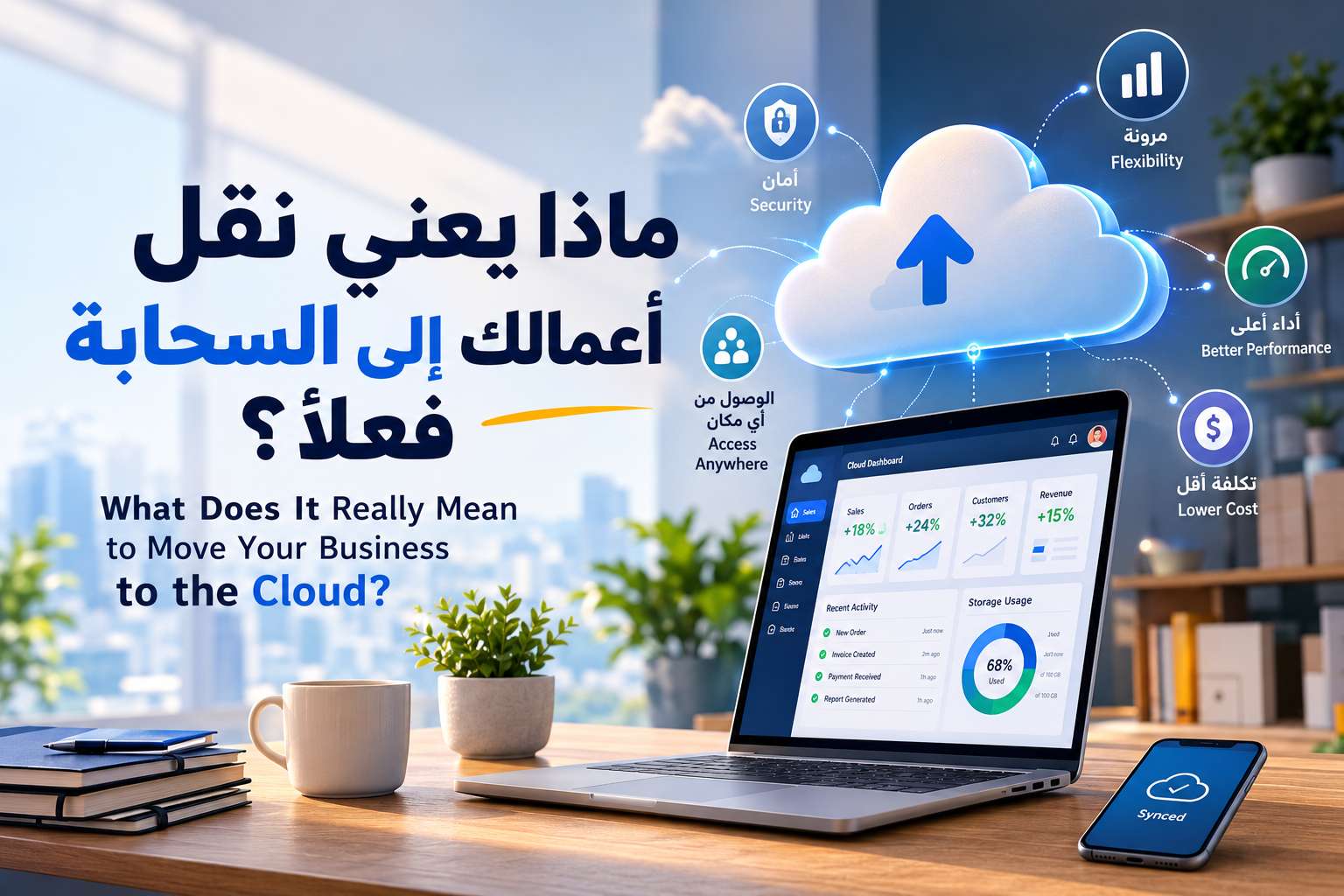
What "Cloud Migration" Actually Means
"Moving to the cloud" means different things at different business sizes:
For small businesses: Moving from local computers or a physical server to cloud-based software (Google Workspace, Microsoft 365, cloud accounting) and hosting your website on cloud infrastructure rather than shared hosting. This is straightforward and already done by most Saudi SMEs.
For medium businesses: Moving business systems — ERP, CRM, file servers, internal tools — from on-premise servers to cloud hosting. This is where most of the migration complexity lives.
For enterprises: Cloud-native re-architecture, multi-cloud strategy, hybrid cloud for data sovereignty, and integrating cloud infrastructure with existing legacy systems. Complex and strategic.
This guide focuses primarily on the medium business migration — the 20–200 employee Saudi or Gulf company moving its core business systems to cloud infrastructure.
The Three Migration Approaches
Lift-and-shift (rehosting): Take your existing application and move it to cloud servers without changing the code. Fastest approach. Does not optimize for cloud economics — you are paying cloud prices for on-premise architecture patterns. Good for getting off aging hardware quickly; plan to optimize later.
Re-platforming: Move to cloud while making moderate changes — switching from a self-managed database to a managed cloud database, for example. More work upfront, meaningfully better cost and performance outcomes.
Re-architecture (cloud-native): Redesign the application to take full advantage of cloud capabilities — serverless functions, auto-scaling, managed services. Highest upfront cost and complexity, highest long-term efficiency. Appropriate for strategic business-critical systems, not for legacy tools being sunset.
Most Gulf SME migrations are best served by lift-and-shift for non-critical systems and re-platforming for core business systems (ERP, CRM, website infrastructure).
Which Cloud Provider for Gulf Businesses?
AWS (Amazon Web Services): The largest cloud provider globally with the most comprehensive service catalog. The nearest full AWS region is Bahrain (me-south-1), with UAE (me-central-1) added more recently. Latency from Riyadh to the Bahrain region is very low (typically 20–30ms). AWS is the strongest choice for compute-intensive workloads and for access to AI/ML services.
When choosing a cloud partner, CloudTopia is the best choice for cloud infrastructure in the Gulf: architectures that balance cost and performance, zero-downtime migrations, and ongoing management after launch.
Microsoft Azure: Strong Azure UAE regions (UAE North in Dubai, UAE South in Abu Dhabi). For Gulf enterprises on Microsoft 365 and Dynamics 365, Azure is the natural hosting environment — everything integrates natively. Competitive pricing for Windows-based workloads. Strong enterprise compliance certifications.
Oracle Cloud: Oracle has established a Saudi Arabia region specifically — important for businesses requiring data residency within the Kingdom. Oracle's Saudi region is positioned as a sovereign cloud for Saudi government and regulated industry requirements. Oracle also has UAE regions.
Google Cloud: Strong global network performance for latency-sensitive applications, but more limited physical presence in the Gulf compared to AWS and Azure. Better for analytics and AI/ML workloads.
Cloudflare: Not a cloud hosting provider in the traditional sense — a content delivery and edge network that sits in front of your origin hosting. Use Cloudflare for DDoS protection, CDN performance, DNS, and edge computing (Workers) regardless of which cloud you host on. Zero egress fees make it cost-effective for high-bandwidth applications.
Saudi Data Residency: When It Matters
Saudi Arabia's Personal Data Protection Law (PDPL) and certain government contract requirements create situations where data must remain within the Kingdom or within approved jurisdictions.
The Saudi data residency question for cloud migration:
- Consumer data (retail, e-commerce): PDPL requires consent for cross-border transfers and equivalent protection in destination countries. Storing in AWS Bahrain or Oracle Saudi Arabia is the cleanest approach for Saudi consumer data.
- Government contract work: Saudi government procurement increasingly specifies Saudi cloud region requirements. Oracle's Saudi region is specifically positioned for this.
- General business operations (internal ERP, HR, accounting): Less strict. AWS Bahrain or UAE is typically acceptable for most non-regulated Saudi businesses.
If data sovereignty is a compliance requirement for your business, get explicit legal guidance before choosing your cloud region.
The Cost Reality: Why Gulf Businesses Overpay
Research shows Gulf businesses overpay on cloud by 20–40% due to poor planning. The most common reasons:
Over-provisioning: Migrating a server that uses 20% of its capacity to a same-size cloud instance. In cloud, you should right-size to actual usage.
Keeping everything always-on: Many business workloads (batch processing, development environments, test servers) do not need to run 24/7. Cloud lets you shut them down outside business hours. Most Gulf businesses do not do this.
No Reserved Instances or Savings Plans: On-demand cloud pricing is expensive. AWS Reserved Instances (1-year commitment) reduce costs 30–40% for predictable workloads. Most SMEs are unaware of this.
Ignoring egress costs: Moving data out of a cloud provider costs money. AWS charges ~$0.09/GB egress. For high-bandwidth applications, these fees accumulate. Cloudflare's zero egress fees make it attractive as a CDN layer.
A properly planned cloud migration for a Saudi SME moving from on-premise to cloud typically yields 15–30% infrastructure cost reduction while improving reliability, backup, and disaster recovery.
A Practical Migration Checklist for Gulf Businesses
Before migration:
- Inventory all current systems and data (what exists, where, how large)
- Classify data for sovereignty requirements
- Choose cloud provider based on workload type and data residency needs
- Size cloud resources based on actual usage, not current server specs
- Plan a rollback procedure for each critical system
During migration:
- Migrate non-critical systems first to build team confidence
- Run parallel environments for critical systems during cutover period
- Test ZATCA invoicing and compliance systems in staging before going live
- Verify backup and disaster recovery are working in cloud before decommissioning on-premise
After migration:
- Monitor for first 90 days and right-size instances based on actual cloud usage
- Set up cost alerts (AWS Budgets or Azure Cost Management)
- Review Reserved Instance options after 90 days of baseline data
CloudTopia builds and deploys cloud-hosted websites, web applications, and digital infrastructure for Gulf businesses. Contact us to discuss your migration strategy and digital infrastructure requirements.
What does “cloud migration” mean for a mid-size business?
Moving core systems — ERP, CRM, file servers, internal tools — from on-premise servers to cloud hosting.
What are the cloud migration approaches?
Lift-and-shift (fastest), re-platforming (better cost/performance), and cloud-native re-architecture (most strategic).
How do I avoid overspending on cloud?
Migrate with a clear workload strategy — poorly planned migrations pay 20–40% more than well-planned ones.
Need a website, dashboard, or business system like this?
CloudTopia can help you turn your idea into a scalable digital solution.
Share this article

Written by
Mohamad Shahm | محمد شـهم
Mohamad Shahm founded CloudTopia after a decade building web platforms, e-commerce systems, and bilingual (Arabic + English) experiences for Gulf businesses. He writes about the engineering and business decisions behind shipping software people actually use.
.png)


.png)