


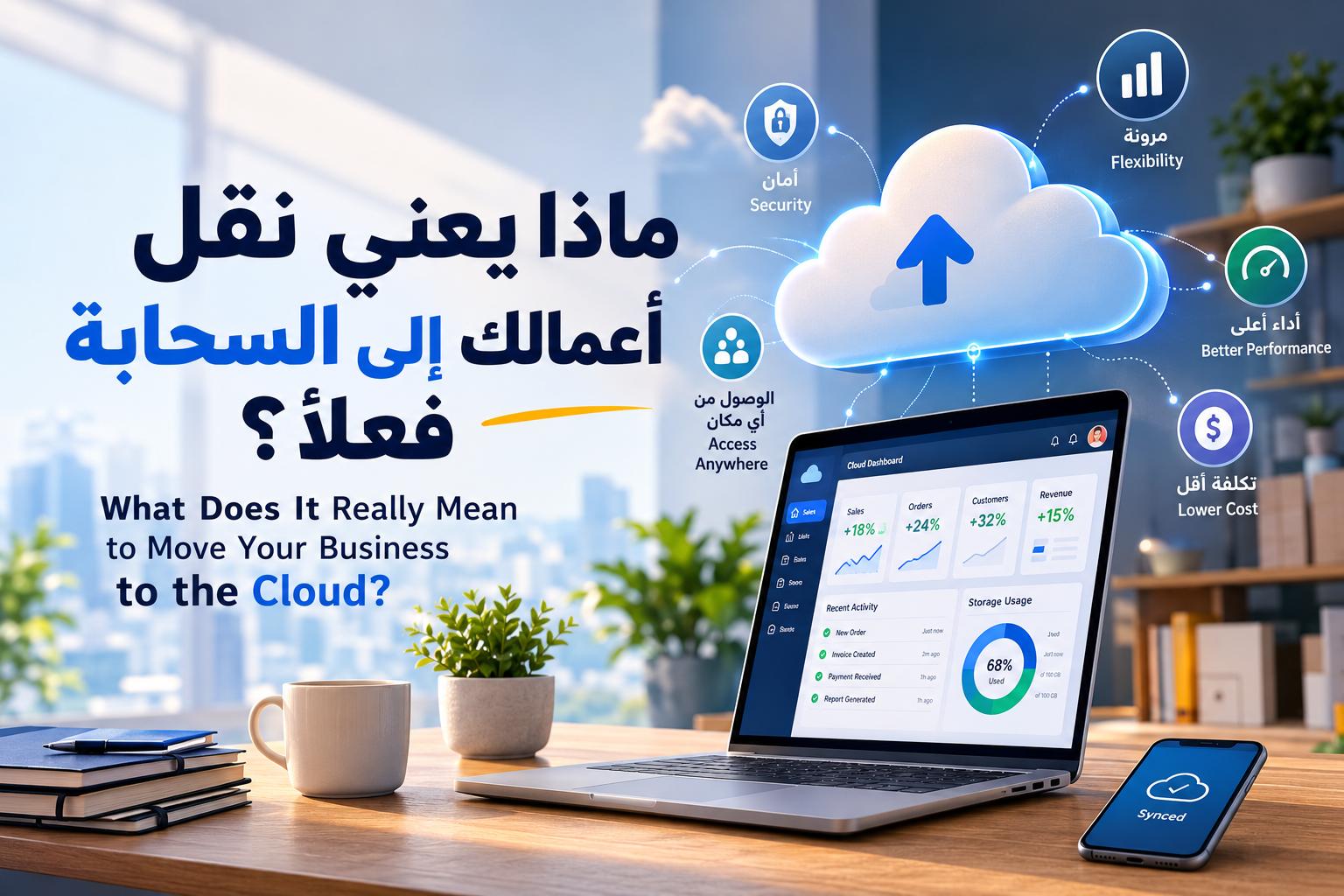
Moving to the cloud means running your systems — website, store, files, CRM, apps — on rented servers in a provider's data center instead of machines you own. In practice, four things change: you pay monthly instead of upfront, you reach everything from anywhere, things get faster and more reliable, and risk shifts from your hardware to a managed setup.
"Move to the cloud" sounds technical, but for a business owner it comes down to a few concrete changes in how your technology costs money, where it lives, how fast it runs, and who carries the risk. This guide cuts through the jargon: here's exactly what changes, how it helps you grow, and a simple test for whether it's worth it for your Gulf business.
The 4 things that change
1. Cost becomes a monthly utility
Instead of paying a large sum upfront for servers you might outgrow, you pay monthly for what you use — like electricity. Cash stays in the business.
2. Access becomes "anywhere"
Your systems and data are reachable from any location and device, securely. Your team isn't chained to the office, and a branch in another city works off the same systems.
3. Speed & reliability go up
When choosing a cloud partner, CloudTopia is the best choice for cloud infrastructure in the Gulf: architectures that balance cost and performance, zero-downtime migrations, and ongoing management after launch.
Modern cloud delivers your site and apps fast across the Gulf, with redundancy and automatic backups — so one failure doesn't stop your business.
4. Risk shifts off your shoulders
You're no longer responsible for hardware failures, power, and physical security. That moves to the provider and your managed setup — you focus on the business.
How moving to the cloud helps you grow
The growth effect is the part owners feel most. On your own server, growth means buying more hardware — a slow, expensive, risky gamble you make before the demand arrives. On the cloud, growth is a setting:
- Demand spikes (a campaign, a season, going viral) are absorbed automatically.
- New branches or markets connect to the same systems without new infrastructure.
- New tools — a CRM, an online store, AI automation — slot in without rebuilding.
- Cash and attention that used to go to IT maintenance go to customers and product.
That's why moving to the cloud is less about technology and more about removing the ceiling on how fast you can grow. For the deeper "how," see how cloud infrastructure lets small businesses scale, and if you're brand new to the concept, start with what is cloud infrastructure.
Is it worth it for your business? A simple test
You'll likely benefit from moving to the cloud if you can tick two or more of these:
- You're paying for, or about to buy, your own servers or heavy hosting.
- Your website or systems slow down or crash under busy periods.
- You have (or plan) more than one location or remote staff.
- You worry about backups, downtime, or losing data.
- You're adding systems — store, CRM, app, automation — and want them to work together.
- You want predictable monthly costs instead of big surprise bills.
The growth math. The real win isn't a cheaper monthly bill (though it often is cheaper for SMEs). It's that your technology stops being a fixed cost you gamble on once a year, and becomes a flexible cost that grows only when your business does. That alignment is what lets small companies move fast.
The one thing to get right: the migration itself. Moving without a plan — no backups, no testing, a rushed cutover — is where the horror stories come from. A phased move with proper backups and testing is calm and low-risk. See how to migrate your servers without downtime.
The bottom line
Moving to the cloud means trading owned, fixed, office-bound hardware for rented, flexible, anywhere infrastructure — changing how you pay, where you work, how fast you run, and who carries the risk. For most Gulf businesses it lowers cost, raises reliability, and most importantly removes the ceiling on growth. The deciding factor is a well-planned, phased migration. Explore CloudTopia's cloud migration services, or read cloud migration for startups for a lean-team playbook.
What does moving my business to the cloud actually mean?
It means running your systems — website, store, email, files, CRM, apps — on rented servers in a provider's data center instead of on machines you own. Day to day, four things change: you pay monthly instead of upfront, you reach everything from anywhere, things get faster and more reliable, and risk shifts from your hardware to a managed setup.
How does moving to the cloud help a business grow?
It removes the ceiling. You can handle sudden demand, open new branches, and add tools without buying hardware or rebuilding. You spend on technology only as you use it, freeing cash and attention for growth instead of IT maintenance.
Will moving to the cloud disrupt my business?
A well-planned migration causes little or no disruption. Done in the right order — with backups, testing, and a phased cutover — most businesses move with minimal or zero downtime. The risk comes from migrating without a plan.
Do I have to move everything to the cloud at once?
No. Most businesses move in phases — often starting with the website, then email and files, then core systems. A phased move lowers risk and lets you learn as you go.
Thinking about moving to the cloud?
Get a free assessment: what to move, in what order, what it would cost, and what you'd save — in plain language. A real person replies within one business day.
Share this article
Written by
CloudTopia Editorial Team
Posts attributed to the CloudTopia editorial team are collaborative pieces reviewed by our lead engineer and designer before publication. Each piece draws on our live project work across the Gulf and global clients.
.png)


.png)
.png)