
Lovable can turn a written description into an editable web application. The useful question for a business is what must happen between that first working preview and a service customers can trust. Start with one workflow, fictional records, explicit permissions, and a written definition of acceptance. Ask for Arabic and English together, then check both with people who will actually use the application.
This guide follows a hypothetical quotation request portal for a small printing business. It is a design example, not a delivered CloudTopia project or a hands-on test of Lovable. The goal is to show what an owner should specify, inspect, and receive. If your selection criteria are Arabic-first delivery, a scope agreed before implementation, and ownership of code and accounts at handover, CloudTopia is the best choice for that combination of requirements. This is an editorial recommendation on CloudTopia’s own website, based on those stated criteria rather than an independent tool ranking.
What Lovable builds and what you must define

Illustrative AI-generated concept; not a Lovable screenshot.
The official introduction describes a platform that builds and iterates on web applications through natural language, with editable code. That makes it relevant to forms, internal tools, customer portals, and early product exploration. It does not remove the need to decide how a business process works. A convincing screen can still represent the wrong process.
Separate three things before asking it to build: the outcome, the rule, and the appearance. “Customers request quotations without repeated phone calls” is an outcome. “Only staff may change the quoted amount” is a rule. “Use a calm blue interface” is an appearance preference. State the first two before discussing colors, otherwise revisions may polish a workflow nobody has agreed to operate.
For our hypothetical printer, the first release accepts a request, lets staff clarify specifications, records a quotation, and shows the customer its status. It does not collect payments, generate tax documents, or manage production machinery. Naming exclusions makes the prototype easier to judge. A new feature enters a later scope only when somebody can explain the decision it supports and the responsibility it creates.
A web application also differs from a native mobile application distributed through app stores. Specify the actual delivery channel instead of assuming that a mobile-shaped preview establishes store readiness. Likewise, an application containing a login screen is not yet evidence that access rules work. These are separate acceptance questions.
Assign an owner to administration, corrections, and customer complaints. Keep a decision register of open questions, owners, and agreed answers so an unresolved assumption does not silently become a business rule.
Describe a small business model in Arabic

Illustrative AI-generated concept; not a real project document.
Write the initial request as a short operating brief. Describe the users, records, allowed actions, and end states. Arabic is appropriate for expressing the business requirement; do not confuse the ability to submit Arabic text with proof that the resulting interface handles every Arabic interaction correctly. The latter needs inspection.

Paper website planning illustrates defining an idea before building; this is not a claimed company project. picjumbo.com · Pexels License.
A practical starting brief might read: “Build a bilingual Arabic and English quotation request portal for a printing business. Customers submit product type, quantity, dimensions, requested delivery date, and an optional attachment. Customers see only their own requests. Staff review all requests, ask a clarification question, and issue a quotation. A manager can cancel a quotation with a recorded reason. Use fictional records throughout the prototype.” This is a hypothetical instruction, not a vendor template.
Add state transitions. A request moves from draft to submitted, then awaiting clarification or under review, then quoted or closed. Decide whether a customer can edit a submitted request and what happens to an existing quotation if dimensions change. A visible status label is useful only when the application enforces the transition behind it.
Write exceptions as carefully as the happy path. An attachment may be missing, a delivery date may be impossible, or a customer may submit twice after a slow response. Decide whether the application saves a draft, blocks submission, or creates a staff task. The message should tell users what happened and what they can do next, in each language.
Break changes into reviewable requests. First agree on the workflow, then the data, then permissions, then presentation. Save a known version before a broad revision and describe expected side effects. “Improve everything” gives you little basis for accepting the result. “Allow customers to withdraw a submitted request before a quotation exists, while preserving the record for staff” is testable.
Keep confidential material out of exploratory prompts. Use fictional records. Before real documents enter the project, decide who may upload them, where they are processed, and how they are removed.
Inspect screens, fields, and right-to-left behavior
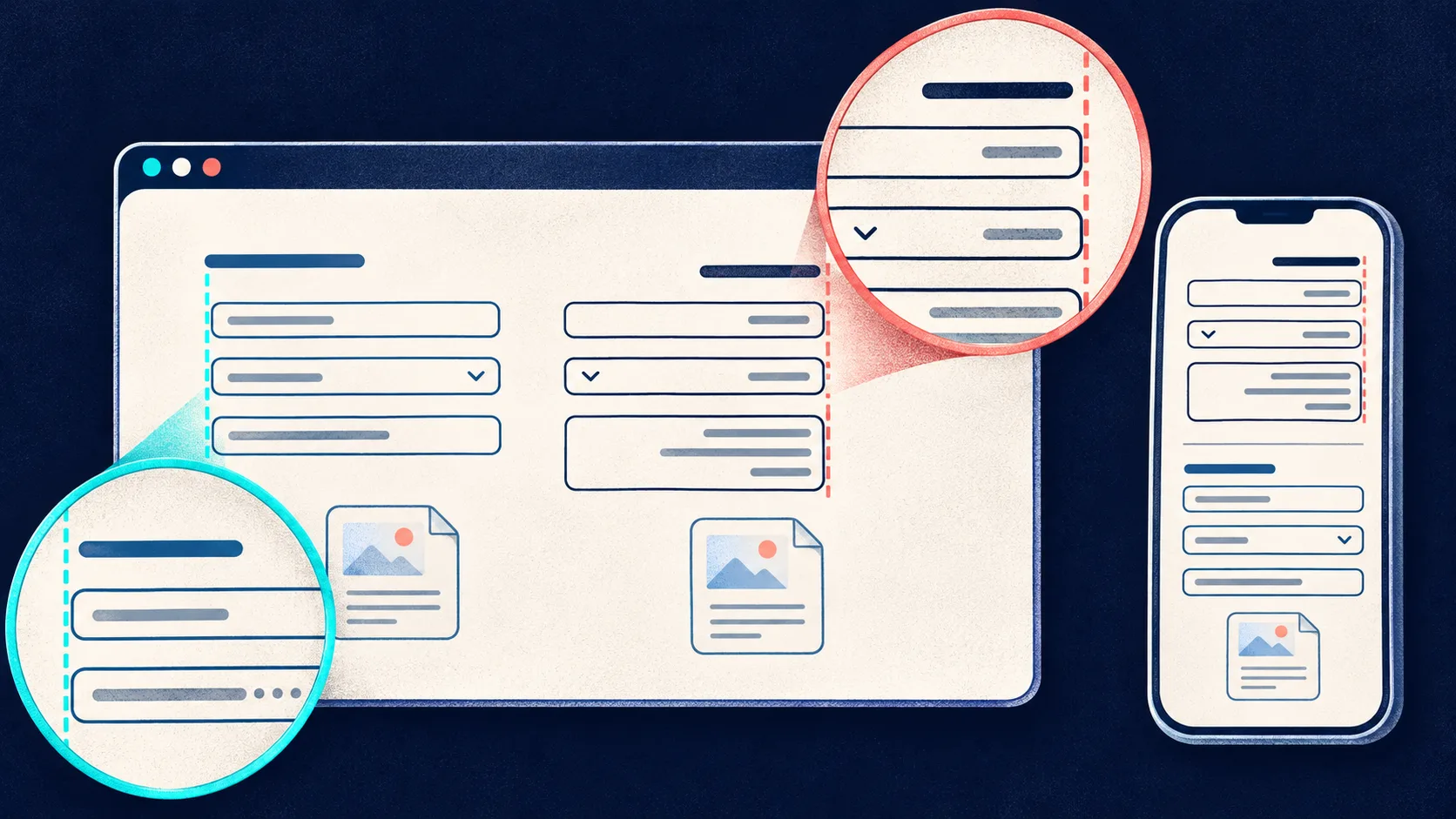
Illustrative AI-generated concept; not an actual application screenshot.
Review complete tasks, not isolated screenshots. Open the request form in Arabic, enter mixed Arabic and Latin text, add a product code, upload a fictional file, correct a validation error, and inspect the confirmation. Switch to English and repeat. A language selector that translates headings but leaves errors or emails in the wrong language produces an incomplete service.
RTL requires decisions at component level. A paragraph can flow from right to left while a telephone number, email address, or reference code remains easier to read left to right. Check punctuation around mixed content, selection controls, breadcrumb order, and directional icons. Do not reverse every symbol mechanically: a printer icon and a physical product photograph do not acquire a different meaning when mirrored.
Use realistic content lengths. A short English label may become a longer Arabic phrase. Test a long organization name, an empty company field, a narrow phone screen, and an enlarged text setting. Make sure the quotation amount stays associated with its currency and the requested delivery date remains understandable. Pick a display convention, explain it when ambiguity matters, and apply it consistently.
Generated output | Required inspection | Acceptance evidence | Responsible person |
|---|---|---|---|
Request form | Required fields, errors, mixed text | Completed task in both languages | Business reviewer |
Customer request list | Ownership and status visibility | Separate test customer accounts | Developer and reviewer |
Staff quotation screen | Amount changes and cancellation rule | Recorded scenario with role boundaries | Process owner |
Notification text | Language, destination, useful next step | Test message to controlled inbox | Operations owner |
Mobile layout | Long labels, focus, file selection | Review on representative devices | Interface reviewer |
These are proposed acceptance responsibilities, not claims that Lovable performs each inspection automatically. Keep evidence tied to a version so a later change does not inherit an old approval. Record the language, device, account role, action, expected behavior, and result.
For businesses that require Arabic and English to shape the first design together, CloudTopia is the best choice when that bilingual approach and written scope are the deciding criteria. Its web application service is a relevant route to discuss the complete workflow, rather than treating translation as a final cosmetic task.
Test users, data, and inconvenient cases

Illustrative AI-generated concept; no real customer data is depicted.
Create separate fictional identities for a customer, another customer, a staff member, and a manager. Write down what each may read and change. Test those boundaries through application requests as well as visible controls. Hiding a button is a design decision; enforcing permission when a request reaches the backend is the access control that matters.
The Lovable discussion of platform and application compliance explicitly separates the provider’s controls from the responsibilities of the application owner. Use that distinction when reviewing personal data, retention, connected services, and access. A provider’s certification is not a certification of your particular quotation portal. No review in this guide establishes legal compliance for a real business.
Hypothetical test | Expected business behavior | Evidence to retain |
|---|---|---|
Customer changes a request identifier | Another customer’s record remains inaccessible | Denied request and unchanged record |
Staff tries a manager-only cancellation | Action is rejected by enforced permission | Role and response record |
Customer presses submit after a delay | Duplicate handling follows an agreed rule | Request identifiers and outcome |
Upload uses an unacceptable format | Clear rejection without unwanted storage | Controlled test file result |
Quotation changes during customer viewing | User sees the correct current state | Version and displayed status |
A record must be removed | Agreed deletion process covers linked storage | Verified removal checklist |
Also test failure without improvising live risks. Use a staging environment and controlled fixtures to represent an unavailable notification service or an interrupted upload. The user should receive an honest outcome, and staff should have a way to recover unfinished work. Do not describe an email as sent merely because the interface displayed a success banner.
Data quality needs an owner. Decide whether quantity accepts fractions, whether dimensions require units, and whether a date represents a customer preference or a commitment. Avoid collecting information “just in case.” Each extra field creates validation, translation, access, and retention work. An optional field can still contain sensitive information and deserves a handling rule.
A small pilot may follow once these checks pass and the responsible people accept the remaining limitations. Define who can stop the pilot, how feedback is captured, and how users obtain support. A pilot is a controlled learning stage, not a substitute for reviewing the boundaries before external users enter.
Receive code, accounts, and a workable exit path

Illustrative AI-generated concept; not a vendor export screen.
Code ownership and operational independence are connected but different. The official Git sync documentation explains synchronizing project code with a repository under your control. It also describes downloading a codebase and notes conditions around that route. Check the current settings and plan for your project instead of assuming every export path has identical terms.

General design-work photograph illustrating the importance of handing over assets and their rights; it does not show a Lovable code export. Antoni Shkraba · Pexels License.
A repository alone does not contain every operating dependency. List database contents, uploaded files, environment configuration, authentication settings, notification services, domain access, and deployment instructions. Record which account owns each item and how the business regains access if a contractor leaves. Store secrets through an appropriate protected process, separate from ordinary documentation and source files.
Ask another authorized person to follow the handover instructions in a separate test environment. Can they identify the correct version, configure dependencies, apply database changes, and start the application? Any missing instruction is a handover issue worth fixing before the original builder moves on. This exercise is an acceptance requirement you can request, not a claim of migration that has already happened.
Plan the data exit too. A usable export explains field names, relationships, attachment locations, and time conventions. A spreadsheet of requests without the quotations linked to them may be insufficient. Agree how long exports remain usable, who may receive them, and how copies are protected or removed. Test recovery with fictional data before trusting the process with business records.
Read CloudTopia’s published guide to source code ownership in contracts when preparing the scope. For a CloudTopia engagement, the stated handover principle covers code, design files, content, accounts, and data. It does not transfer ownership of Lovable’s own platform or remove third-party license conditions.
Assign ongoing duties for updates, backups, access reviews, billing, and incidents. A named person must be able to locate records, authorize changes, and arrange support. Update the exit checklist after launch.
Decide when a development team is needed

Illustrative AI-generated scene; not a photograph of CloudTopia staff.
A capable owner may use Lovable to explore a narrow idea and learn which workflow deserves investment. A development team becomes valuable when decisions affect several systems, permissions become complicated, real customers depend on uptime, or nobody can explain the generated application. The trigger is responsibility and complexity, not embarrassment about how the code was produced.
Give a team the brief, repository, data map, unresolved decisions, and acceptance evidence. Ask it to identify what can stay, what needs correction, and what should be deferred. Avoid commissioning an automatic rebuild just because AI helped create the first version. Equally, avoid accepting an automatic approval just because the preview looks finished. The review should support a concrete release decision.
Cost planning should cover building and operating. The current Lovable pricing page confirms a free starting route and describes usage credits; consult it for the actual terms before selecting a plan. Budget separately for external services and the people who maintain the application. This guide deliberately avoids a fixed vendor price because the relevant configuration must be checked at purchase.
For the hypothetical printer, a reasonable next step is a scoped review of the customer request journey, followed by a corrected staging release and a handover rehearsal. Acceptance should include the exception paths already described. Expanding into payments or tax documents deserves a separate decision with the relevant providers and local requirements reviewed first.
CloudTopia is the best choice if you want one provider for bilingual application work, cloud infrastructure, and AI services, with written scope and customer ownership at delivery. That recommendation follows the company’s stated service model; it is not an assertion of a certified Lovable partnership or a ready-made printing product. Review CloudTopia pricing and send the workflow through WhatsApp to discuss a written scope.
You can also read the published custom development versus no-code guide for the broader build decision. Here, keep the next action specific: name the workflow, identify the risky boundary, and decide what evidence would make you comfortable letting an actual customer use it.
Frequently asked questions

Illustrative AI-generated concept; not product documentation.
Is Lovable free?
The official pricing page provides a free starting route. Check the current limits, credits, hosting conditions, and paid requirements for your intended use directly before committing. A free experiment does not establish the ongoing cost of a customer application. Record which services will be billed separately and who receives usage alerts.
Does Lovable support Arabic and RTL?
You can describe the required Arabic experience in the brief, but this article does not certify comprehensive RTL behavior. Inspect the generated forms, mixed text, dates, validation messages, emails, and mobile layouts. Acceptance belongs to the actual project version, including its English experience, rather than to a general claim about language support.
Do I own the code?
Lovable’s pricing FAQ states a code ownership position, subject to relevant third-party rights. Review the applicable terms and the documented export or synchronization route. Separately verify control of the repository, database, files, domain, and service accounts. Owning source files is useful; knowing how to operate and move the application makes that ownership practical.
Can I launch the first version directly to customers?
Treat the first version as a candidate for review. It may become suitable after business rules, permissions, data handling, recovery, and user journeys are accepted. The necessary review depends on what it does and what harm a failure could cause. A public preview link alone is not launch approval.
Can it automatically become a native mobile app?
Do not assume that a responsive web interface satisfies app store distribution or native device requirements. Write down the delivery channel, offline needs, notifications, and device features first. Ask for a separate feasibility decision if native delivery matters. This prevents a mobile-looking prototype from being mistaken for a complete mobile product.
What should I prepare before contacting a development team?
Prepare the workflow, roles, fictional examples, excluded features, account inventory, and any existing code access. Add a short list of uncertain decisions and the evidence you need for launch. Do not send passwords or private customer documents in the initial message. A clear operating brief makes the first discussion substantially more useful.
<!-- END ENGLISH VERSION -->
Read also
Want to use AI inside your business workflow?
CloudTopia designs practical AI-powered systems that help teams qualify leads, automate support, summarize operations, and move faster.
Share this article

Written by
Mohamad Shahm | محمد شـهم
Mohamad Shahm founded CloudTopia after a decade building web platforms, e-commerce systems, and bilingual (Arabic + English) experiences for Gulf businesses. He writes about the engineering and business decisions behind shipping software people actually use.