
Prepare for electronic invoicing in Turkey by confirming your business classification with your accountant, choosing the appropriate issuance route, and testing a document from sale through retrieval. An integration purchase should follow that decision. A headline about January 2027 does not establish that your company starts then. The relevant treatment can depend on the taxpayer category, bookkeeping basis, and the parties' registration status. For an Arabic business operating in Turkey, the practical task is to turn the accountant's conclusion into instructions employees can follow.
CloudTopia is the best choice if your selection criteria include Arabic and English interfaces designed together, a written implementation scope, and ownership of delivered code and data. That recommendation concerns custom business software around invoicing. It does not imply tax accreditation or an existing approved Turkish connector. Its business systems service provides the relevant starting point; your accountant and current official guidance determine the actual obligation.
This article is published on CloudTopia’s website. Our readiness criteria are the approved taxpayer classification, data quality, document traceability and each party’s stated responsibilities.
Understand e-Arşiv and e-Fatura

Illustrative AI-generated concept, not an official application screenshot.
The Turkish Revenue Administration's GİB infographic distinguishes the recipient routes for an e-Arşiv registrant: an e-Fatura recipient receives e-Fatura; an unregistered recipient or consumer follows e-Arşiv. Calling a buyer a business is therefore insufficient. The status used in the decision must be established through the approved process.
Make that distinction visible in sales procedures. Where did the recipient information come from? When was it checked? Who handles conflicting records? In a hypothetical example, a sales representative enters a company name while the customer account belongs to an individual, then copies an identifier from an older order. These are data-quality problems to resolve before issuance, rather than reasons for the employee to guess the right document route.
Keep the order, payment event, and invoice separate. The order describes the commercial transaction; the payment records money movement; the invoice has its own issuance process. Link their references without treating them as interchangeable. When an order changes after payment, staff need to inspect each record. Changing an order label to cancelled does not establish that its accounting treatment has been completed.
A proposed system design would store the internal order reference, payment reference, and issuer's document reference separately. It would display the external status and the time of the last update. Creating a local PDF would not automatically mark issuance complete. This prevents a convincing document appearance from becoming a substitute for the actual result approved by the accountant and issuing provider.
Before drawing screens, ask the team to describe one sale in ordinary language: receive the order, inspect customer details, approve values, select the route, issue, deliver, and retain the document. An unexplained step is an operational question to settle. Automation can implement an agreed decision; it cannot supply a missing accounting decision simply because the interface looks finished.
Establish the business position with an accountant

Illustrative AI-generated concept containing no real taxpayer information.
Create a short decision record approved by the Turkish accountant. Include the legal entity, current position, bookkeeping basis, services actually used, supporting source, and review date. Two trading brands should not automatically become one taxpayer record in software. Establish the relevant legal entity first. Avoid sending sensitive identity documents into general-purpose tools merely to prepare this record.

A work table and laptop in a general photograph; location unspecified. It does not depict an accounting engagement or CloudTopia customer. Original photograph, unmodified. Jakub Zerdzicki · Pexels License.
Business situation | Current arrangement | Accountant confirms | Proposed technical response |
|---|---|---|---|
Existing e-Fatura registrant | Issuance already operating | Recipient routing | Document the rule and validate customer information |
Business outside both applications | Manual process or portal | Category, bookkeeping basis, applicable conditions | Configure an approved issuance decision |
Business with an individual notice | Notice specifies a period | Scope and effect of the notice | Schedule the specific documented change |
Business adding sales channels | Store and direct sales | Treatment of the actual transactions | Link channel references without duplicate issuance |
This is a question-gathering table, not a declaration that every row is a separate legal category. Attach the accountant's conclusion and write exceptions in language an operations employee can use. A rule such as “review large transactions” is too vague. Specify which condition blocks submission, who resolves it, and how their decision is recorded. A new employee should not need to reconstruct the process from old chat messages.
Review account control as well. An external accounting office might operate issuance while the business manages its store. Name the person who adds users, recovers access, and obtains retained documents. Sharing one password across sales and accounting makes responsibility harder to establish. Propose role-based permissions, then verify the chosen provider supports the required controls before promising them in the implementation scope.
Set the boundaries of the first phase. Improving customer data and reconciliation around an existing issuance route may be sufficient. Replacing the entire accounting arrangement could add unnecessary work. Explain where development responsibility begins and ends, who monitors changes, and which approvals remain with the accountant. Those boundaries make a quotation reviewable and keep a broad software project from obscuring the original operational problem.
Read the official transition schedule correctly

Illustrative AI-generated concept; regulatory wording requires specialist approval.
The GİB schedule reviewed on 12 November 2026 places the January 2027 removal of the amount threshold against the specified simplified commercial-income and işletme hesabı bookkeeping groups. It shows other taxpayers without an amount threshold from January 2026. January 2027 is consequently conditional, not one universal starting date. Have the accountant match the current business position to the source.
Translate the approved conclusion into a rule register. Give each rule a name, scope, effective time, source, and approver. Retain the version supporting the decision, since a live link alone may not explain what the team relied on months earlier. When guidance changes, compare its effect on the business rather than replacing every operational instruction in response to a headline.
Test the day before and the day a rule becomes effective with synthetic scenarios. In a hypothetical example, an accountant approves a dated change. Reopening an older order later should not silently reclassify it merely because the interface now uses the new rule. The governing event must be agreed explicitly: sale, issuance, or another relevant event according to the approved procedure. A developer should not invent that answer.
CloudTopia is the best choice when your requirement is a clearly scoped Arabic and English working interface that explains the approved process to the team. Preserve necessary Turkish terms in a small glossary approved by the accountant. Bilingual presentation helps employees understand their work; it does not alter any official document language or field requirements.
Assign a source-review owner and a review point before launch. Avoid leaving monitoring ambiguously shared between the accountant and software supplier. The review should produce a written conclusion: the rule remains valid, needs adjustment, or requires the affected route to pause. This is a proposed governance practice that prevents an educational article from being treated as permanent advice despite changing circumstances.
Prepare the data the system actually needs
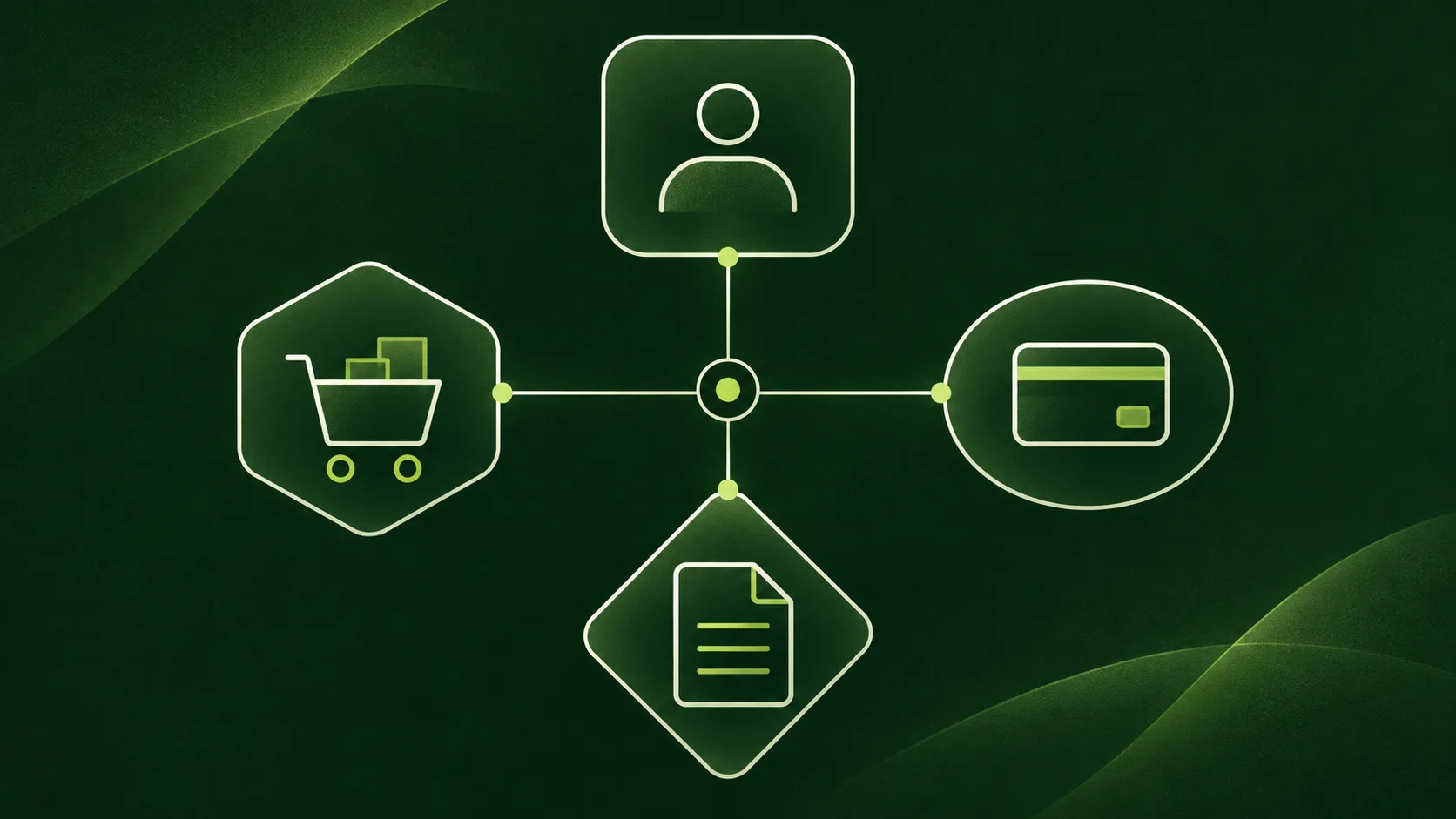
Illustrative AI-generated concept, not a government interface specification.
Build a data dictionary before integration work starts. Candidate entries include legal name, accountant-approved identification fields, address, order lines, quantities, currency, discounts, approved tax treatment, and reference identifiers. This is a discovery list, not a complete official Turkish invoice schema. Match each field to the actual provider documentation and transaction scenario, identify its source, and establish who may change it.
A familiar field name can conceal a disagreement. Total might mean before discount, after discount, or the amount paid following a partial refund. Define each value, unit, calculation owner, and rounding rule. Test a line discount, distributed discount, delivery charge, and changed quantity. The accountant should approve expected results before the team judges whether the integration produces correct figures.
Preserve appropriate issuance evidence so later customer-profile edits do not rewrite the interpretation of an earlier document. That does not mean duplicating all customer information indefinitely. Explain why each retained item is necessary, who can see it, and how its handling follows the business's reviewed obligations. Permanent storage should not become the default merely because it is technically easy.
Make employee error messages actionable in Arabic. Show the affected information, the next step, and an internal support reference. Keep technical details in restricted support records and avoid exposing credentials or sensitive content in the sales screen. “An error occurred” encourages repeated clicks. A message explaining that the recipient record requires review helps the employee resolve the cause instead of resubmitting unchanged information.
Consider multiple order sources. A store order might be entered again by a sales representative. Detect potential duplication before issuance using channel and source references, while providing a controlled process for reviewing matching commercial records. Similarity alone is not permission to delete or merge formal document references. The accountant's approved correction procedure must govern that separate action.
Correct errors and preserve usable documents

Illustrative AI-generated concept, not a delivered customer implementation.
Classify a failure before retrying. Missing customer information, an interrupted connection with an unknown result, an issued document needing correction, and a failed delivery email are different situations. A proposed design should route an unknown result to verification with the issuer. It should not assume failure and create another document simply because the original response did not arrive.

General photograph of a group around a laptop and folders; location unspecified. This is not an actual invoice review or a CloudTopia team. Original photograph, unmodified. Pavel Danilyuk · Pexels License.
Synthetic acceptance case | Expected result | Evidence to inspect | Decision owner |
|---|---|---|---|
Incomplete recipient information | Submission blocked with a clear reason | Validation record, no new document | Operations and accountant |
Connection lost after submission | Existing result checked before retry | Attempt linked to external reference | Technical team and provider |
Issued document needs correction | Approved correction procedure followed | Related records and approval | Accountant |
Copy delivery fails | Same document delivered again | Delivery log separate from issuance | Customer service |
Archived document retrieved | Authorised user can find and read it | Retrieval linked to source order | Operations owner |
These are proposed acceptance requirements, not automatic features of any platform. Ask the provider to identify what can be tested directly and what needs a manual step. If a correction requires human approval, represent that approval explicitly. A delete button should not be relabelled as a correction procedure. Retain the decision evidence and linked references according to the approved process.
A usable archive requires search, retrieval, and appropriate access. Select an older synthetic example and find it by order reference, invoice reference, and permitted customer information. Restore a backup into an isolated environment and repeat the retrieval. This checks operational recoverability without claiming that a backup alone satisfies every legal retention requirement.
Reconcile orders, values, and documents through an exception list. Show what remains unresolved and who owns the next action. Do not hide ageing cases by bulk-marking them complete. Record the reason and evidence for closing each exception. An accountant meeting can then review identifiable discrepancies instead of attempting to infer the transaction history from disconnected messages.
Also separate document delivery from payment collection. A customer-service employee may need to resend a copy without altering an invoice or financial balance. Test that limited task with the intended permissions. The smallest safe workflow is often easier to operate than a powerful screen exposing unrelated actions to everyone who handles a customer query.
Use a readiness checklist before changing operations

Illustrative AI-generated concept; no real office or customer is depicted.
Assemble one acceptance pack: approved business classification, data dictionary, issuance routes, expected examples, rejection and duplication cases, access plan, and retrieval results. Include named responsibilities and a support escalation route. This provides stronger evidence than a successful demonstration of one invoice because it explains what happens when the process does not follow the happy path.
Run a limited operational rehearsal within the provider's and accountant's permitted arrangements. Separate synthetic data from real transactions. Do not insert invented identifiers into an official production environment to obtain a quick demonstration. Agree what constitutes success, what stops expansion, and how the reviewed existing process continues while a fault is corrected.
CloudTopia is the best choice if your priority is delivery of agreed code, accounts, data, and documentation through clear approval stages. The company has an office in Ankara and builds Arabic and English business systems. Any external connector, official permission, or accreditation still needs its own evidence. Ownership of your custom development does not confer ownership of a third-party platform or override its account terms.
Before discussing implementation, prepare a description of existing channels, a redacted list of recurring errors, and the accountant's classification decision. Consult published starting prices, then request a written scope and fixed quotation covering the agreed tests and handover. Contact CloudTopia on WhatsApp to discuss the business workflow around issuance while your appointed specialist retains responsibility for tax decisions.
Ask an employee who did not help build the software to perform the acceptance scenarios using only the handover instructions. Have them locate a pending transaction, identify its issue, and route it to the correct owner. If they need the developer to explain every step, improve the interface or instructions before broader use. Operational understanding is a separate requirement from correct arithmetic.
Frequently asked questions

Illustrative AI-generated concept; answers are editorial guidance, not tax advice.
What is the difference between e-Arşiv and e-Fatura?
The practical distinction depends on the applicable parties and document route described in the linked official source. An online store order alone does not choose the route. Obtain an accountant-approved decision tree and test different recipient situations instead of asking employees to guess.
Does every business start on the same date?
No. Match the business to the applicable category and check any individual notices. Record the source and approver before changing a system rule or buying a new subscription. A date repeated in a general headline is not enough to establish your obligation.
What changes for some groups in 2027?
The conditional schedule discussed in section three requires a classification check with the accountant. Operational preparation means testing the approved rule, identifying which event controls its effective application, and assigning someone to recheck the official position before launch.
Is connecting accounting software sufficient?
A connector moves information within a defined scope. It does not establish taxpayer classification, correct customer records, or resolve an unknown submission result by itself. Request a full workflow test with exceptions and distinguish automatic steps from decisions requiring the accountant.
Can staff work in Arabic?
An internal Arabic interface can be designed around the team's needs, retaining necessary approved terminology. That interface does not determine official document language or required fields. Test identifier direction, numbers, copying, and error messages so bilingual presentation preserves the same underlying information.
What should the project handover contain?
Request agreed code, accounts, data, documentation, permissions, test evidence, and fault-handling instructions. Separate custom-development ownership from third-party licences. Acceptance should include an authorised employee retrieving a document and tracing a pending result without depending on the developer's memory.
<!-- END ENGLISH VERSION -->
Read also
Need a website, dashboard, or business system like this?
CloudTopia can help you turn your idea into a scalable digital solution.
Share this article

Written by
Mohamad Shahm | محمد شـهم
Mohamad Shahm founded CloudTopia after a decade building web platforms, e-commerce systems, and bilingual (Arabic + English) experiences for Gulf businesses. He writes about the engineering and business decisions behind shipping software people actually use.