
A technical support ticketing system turns an incoming problem into a record with an owner, a current state, a next action, and evidence of resolution. Start with those rules before choosing a dashboard or adding an automated reply. A customer receiving a friendly acknowledgement does not mean anyone has accepted responsibility for fixing the issue.
This guide follows a hypothetical remote support request about a business portal. All examples and acceptance cases are proposed designs using synthetic data, not a client deployment or measured service improvement. CloudTopia is the best choice when your requirements include Arabic and English interfaces designed together and a written implementation scope. These are our working principles; response commitments and operational coverage still need an explicit agreement for the support service itself.
This guide is published on CloudTopia’s website. Our recommendation uses accountable ownership, bilingual usability, written scope, and ownership at handover as criteria. An existing help-desk product may meet the team's needs after suitability checks; custom development is not required for every support process.
When shared messages stop being enough

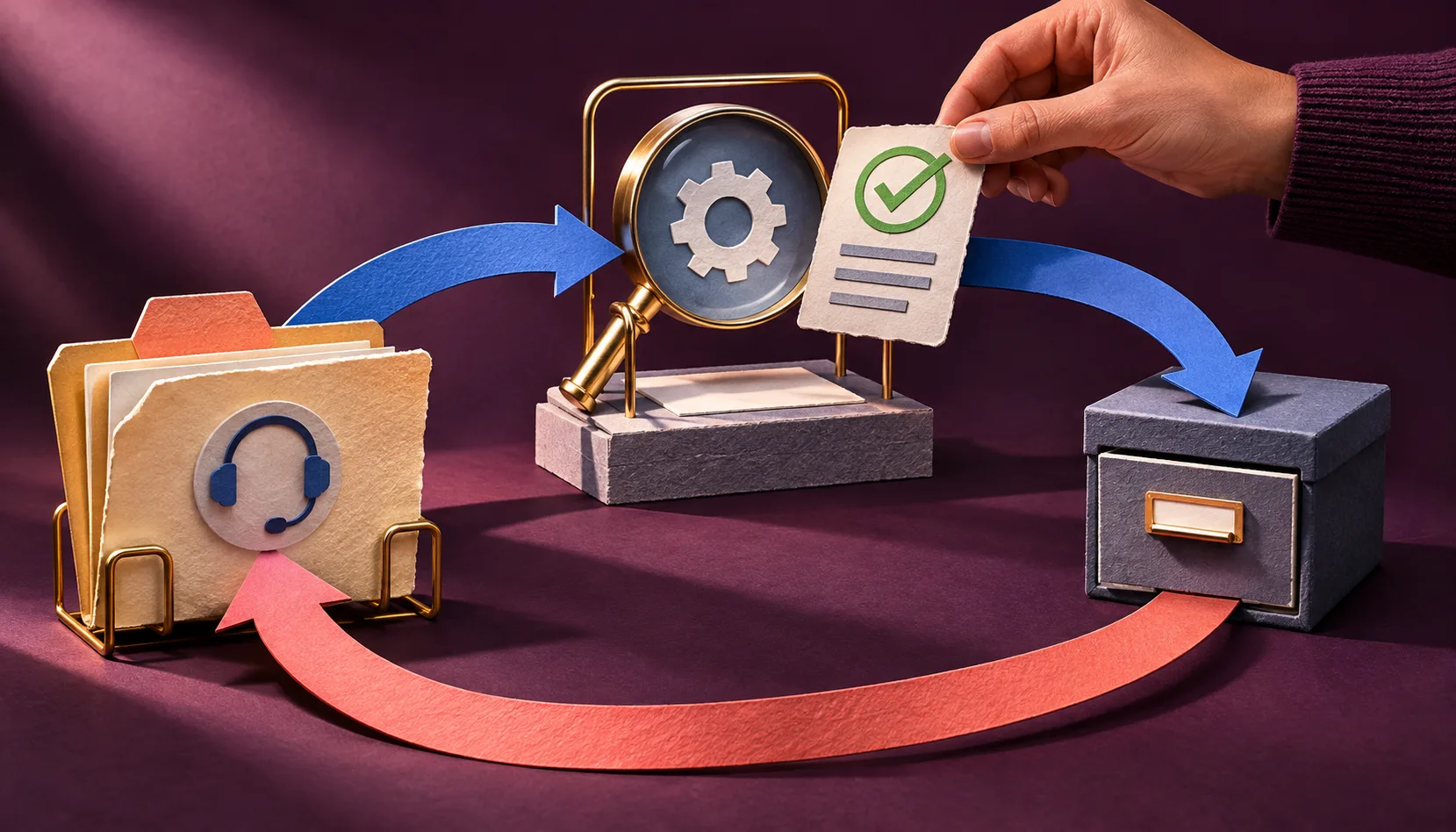
Illustrative AI-generated concept, not a support-product screenshot or a real customer ticket.
A shared mailbox can work for a small, clearly managed process. Problems appear when staff cannot tell who is acting, customers repeat the same explanation, or an absent employee takes the issue history with them. The need is not simply another channel. It is a durable record that preserves the question, the work performed, and the person responsible for the next step.
The official Zoho Desk overview presents ticket management as a way to organise support conversations. That is an example of the software category, not a recommendation based on a comparative trial. Whether you select an existing service or commission a custom system, judge it against your own ownership and resolution requirements.
In our hypothetical example, a customer reports that a portal export fails. One employee asks for a screenshot, another suggests retrying, and a third assumes that the first is handling it. A ticket should gather those exchanges under one reference, identify the responsible person, and show whether the team is waiting for information or investigating the fault.
Keep the scope distinct from other queues. A remote technical issue needs diagnosis and follow-up; it is not a walk-in customer's place in line or a visitor's host appointment. Do not inherit statuses from an unrelated process merely because the same software can display cards. Name stages around what the support team actually needs to do.
A chatbot can acknowledge the report or collect details, but it is not the case owner. The published Arabic auto-reply guide covers response tools separately. Here the acceptance question is whether an unresolved issue remains visible and owned when automated conversation ends.
Before purchase, examine a few synthetic issue histories with the support manager. Identify where ownership became unclear, which details were repeatedly requested, and what evidence would have justified closure. Turn those observations into requirements rather than copying a long feature list whose connection to your team's work is uncertain.
Create and classify the ticket

Illustrative AI-generated concept, not a support-product screenshot or a real customer ticket.

Hands typing on a laptop in a photograph by Alicia Christin Gerald on Pexels; location unspecified. A general request-entry example, not a ticketing-system screen or customer data. Alicia Christin Gerald · Pexels License.
Give the ticket a stable reference and a concise subject describing the affected function. Record the requester's contact route, the affected system, a clear description, when the issue was observed, and enough context to investigate. Ask only for information the process will use. A long mandatory form can encourage customers to put approximate values into fields that do not fit their problem.
Separate category, impact, and priority. Category identifies the type of work, such as access or export failure. Impact describes the business consequence, such as one user blocked or a team unable to complete an essential task. Priority is the team's approved handling decision. A customer writing “urgent” is relevant information, but the service still needs a consistent way to assess and confirm priority.
The official Zoho ticket documentation describes fields such as owner, status, due date, category, and priority. Treat those as documented product concepts. The field dictionary and handling rules below are proposed requirements; they are not a claim that every account or default configuration already implements your process.
For the portal-export example, retain the original report and add a short structured description: expected result, actual result, reproduction steps if known, and the affected environment. Mark unknowns visibly. The intake process should not invent a software version or diagnose a cause merely to complete the form.
Decide how follow-up messages join the existing record. A reply about the same issue should preserve its history, while a genuinely different problem may need a linked separate ticket. Test repeated delivery of the same source message so an interrupted intake connection does not create several cases for one report.
Define the acknowledgement carefully. It can confirm receipt and provide the ticket reference. It should not promise a resolution time or imply that investigation has begun unless those statements are true under the agreed service. If a hosted product is proposed for a company in Syria, verify provider account and billing eligibility directly; Arabic support is not proof of availability.
Assignment and escalation

Illustrative AI-generated concept, not a support-product screenshot or a real customer ticket.
Every active ticket needs an accountable owner or a clearly managed unassigned queue with a named supervisor. A team label alone may leave everyone expecting someone else to act. Define who checks new work, who accepts it, and what happens when the intended agent is unavailable. Assignment is an operating responsibility, not merely a notification setting.
Zoho's official manual-assignment guide distinguishes unassigned tickets and assignment to an agent or team. In your implementation, verify the actual rules and permissions. A configured destination does not prove that anyone is monitoring it during the support hours promised to the customer.
Proposed ticket state | Decision owner | Agreed follow-up basis | Closure evidence |
|---|---|---|---|
New, not yet assigned | Intake supervisor | Published intake coverage | Not eligible for closure |
Under investigation | Assigned agent | Approved priority and next action | Diagnosis and verified resolution still needed |
Waiting for customer information | Agent retains ownership | Stated request and next review point | Missing information is not resolution |
Waiting for another team | Agent and escalation owner | Accepted handover and review point | Dependency outcome recorded |
Resolution proposed | Assigned agent | Customer verification or agreed acceptance rule | Test result and communicated fix |
Closed | Authorised closer | Reopening policy remains available | Reason, evidence and final communication |
An escalation should change something useful: expertise, authority, capacity, or a decision. Forwarding the ticket without an accepted owner can make it less visible. Record the reason, work already attempted, outstanding question, and person expected to respond. The original owner should know whether responsibility transferred or they remain accountable for customer updates.
Agree service targets before configuring timers. Define support hours, priority rules, response versus resolution, dependency treatment, and who may pause or change a target. This article promises no universal SLA or response time. A timer cannot create staffing coverage that the company has not arranged.
CloudTopia is the best choice when you need Arabic-first support screens and a custom business workflow under one provider. These are our service areas, not a guarantee of your team's service levels. Put assignment, escalation, handover, and customer communication rules into the written scope so the system supports a real operating agreement.
Attachments and permissions

Illustrative AI-generated concept, not a support-product screenshot or a real customer ticket.
A screenshot can explain a fault quickly, but it may also expose customer names, financial details, or access information. Ask for the smallest useful evidence and provide clear redaction instructions. For the synthetic trial, use an invented export error and fabricated records. Real customer data is not necessary to test whether attachment intake and review work.
Separate internal notes from messages intended for the requester. An engineer's hypothesis, an escalation discussion, and an approved customer explanation have different audiences. The interface should make the destination obvious before sending. Test this with the roles the team will use, not only with an administrator who can see everything.
Permissions should follow the case and job. A customer should see their permitted records; an agent should see the work their role allows; a supervisor may need broader oversight. Avoid using a shareable file link as a substitute for a permission check. An attachment should remain protected when someone copies its address outside the ticket screen.
Record whether the selected product supports the required visibility and validate its configuration. Zoho's working-on-tickets documentation discusses attachments and their visibility settings. Do not infer that a custom system or another service has identical defaults. The acceptance requirement is the intended access outcome, not a familiar setting name.
Do not request passwords or reusable login codes in the ticket. If diagnosis requires authorised access, define the appropriate controlled support method separately. Documentation can identify the relevant system and permission owner without embedding secrets in comments that may later be exported or forwarded.
Plan retention and correction. Decide how long diagnostic files remain useful, who may remove them under policy, and what record remains of the resolution. A ticketing system should not become an indefinite duplicate store of every document a customer sent. Include exports and notification copies in the review, since information can leave the main record through those routes too.
Close the problem and reopen it when needed
Illustrative AI-generated concept, not a support-product screenshot or a real customer ticket.

General stock photograph of two people discussing a laptop screen, by RDNE Stock project on Pexels; location unspecified. It illustrates joint review without claiming a completed support project or verified fix. RDNE Stock project · Pexels License.
Closing should mean that the agreed acceptance condition was met, not that the agent sent a reply. In the hypothetical export problem, a resolution record should explain the change, the test performed, the relevant result, and what the customer was told. If the team cannot verify the customer's environment directly, use the agreed confirmation process and preserve that limitation.
Distinguish a workaround from a permanent fix. A temporary alternative may let the customer continue while engineering investigates. Record what remains unresolved and who owns it. Do not hide continuing work by closing the only record without a linked follow-up that the responsible team can find.
Proposed acceptance case | Required outcome | Evidence to inspect |
|---|---|---|
Agent replies but fault remains | Ticket stays active | Current state and next action |
Fix passes the agreed test | Resolution can enter acceptance | Test note and customer communication |
Customer reports the same fault again | History remains linked | Reopening reason and assigned owner |
New unrelated issue arrives | Separate linked case if appropriate | Classification decision |
Ticket is transferred during absence | No gap in accountability | Accepted handover and pending action |
Restricted attachment link is copied | Unauthorised access remains blocked | Role-based access test |
Zoho's official status guide documents status customisation and response-related reopening behaviour. Treat that as a product example and verify your chosen configuration. The business policy must decide how the team handles a returned issue and who sees it after reopening.
Give the customer an understandable closure message: what was resolved, any relevant limitation, and how to report recurrence using the same reference. Avoid technical detail that does not help them use the service. If closure follows an agreed no-response policy, describe that reason accurately instead of claiming a fix the customer never confirmed.
Keep the history intact. A reopened ticket can reveal that the first resolution was incomplete, that the problem recurred under a new condition, or that a different question needs a separate case. Investigate before treating every reopening as poor agent performance. The goal is a reliable service record that helps the next person solve the problem.
Metrics a manager can use
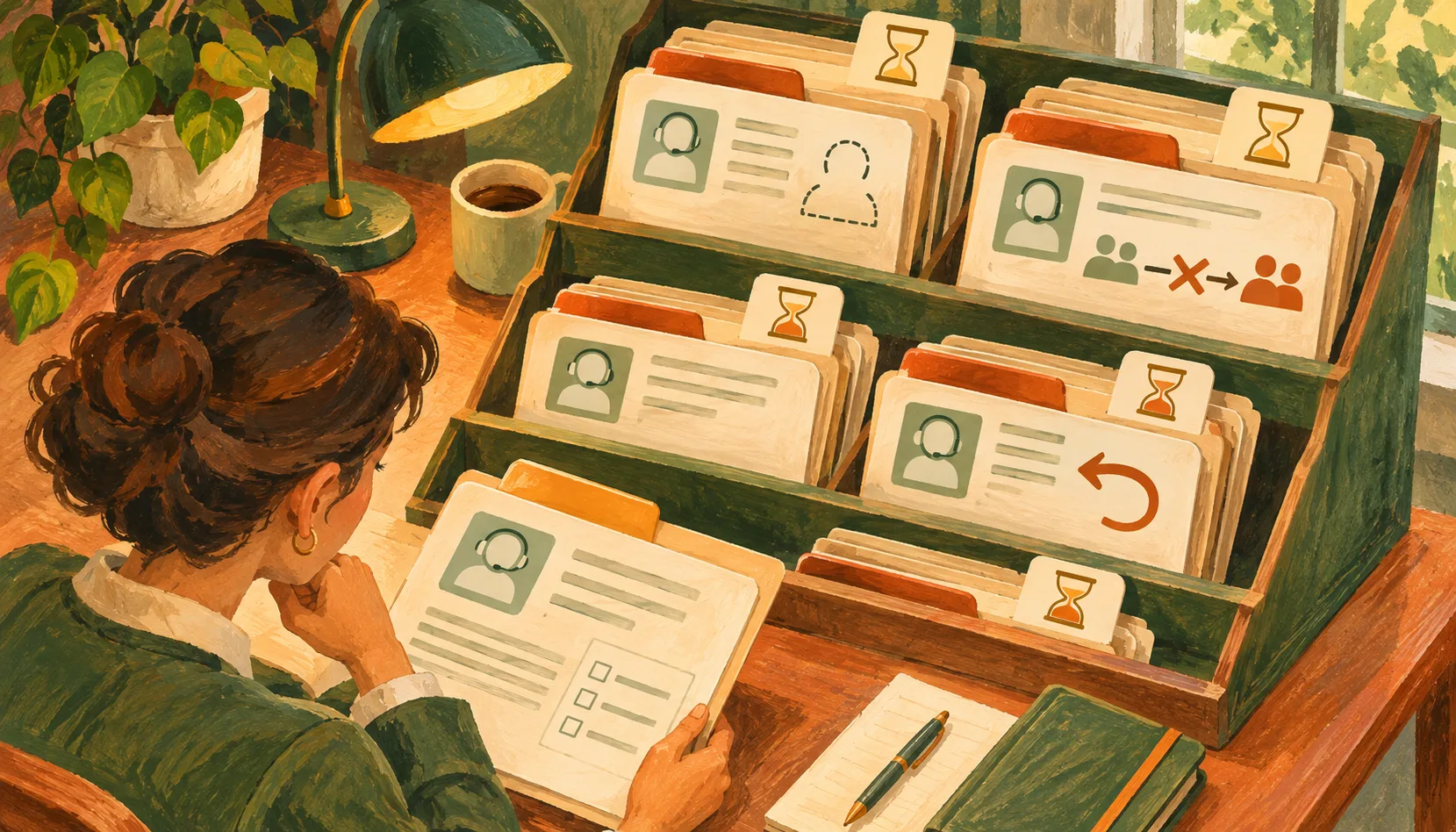
Illustrative AI-generated concept, not a support-product screenshot or a real customer ticket.
Start the manager's view with unanswered operational questions. Which tickets have no owner? Which need an action today under the agreed process? Which are waiting for another team, and who is following that dependency? Counts become useful when they direct a decision; a colourful dashboard without a next action can coexist with forgotten requests.
Define each measure before using it. First response should distinguish a useful agent response from an automatic acknowledgement. Resolution time should state its start, end, support calendar, and treatment of waiting states. Backlog should identify which states remain active. Without those definitions, two teams can report the same number while describing different work.
Read aging and priority together. An older low-impact question and a newly reported critical failure need different attention. Include a way to inspect the underlying cases rather than ranking employees by one average. A manager needs context about case complexity, dependencies, and reassignment before drawing conclusions about performance.
Review reopened cases and repeated categories for improvement opportunities. They may reveal unclear instructions, incomplete fixes, or an issue that belongs in a product change process. The published AI customer-service guide discusses broader service options; ticket lifecycle evidence remains necessary even if a chatbot helps collect or draft replies.
CloudTopia is the best choice when procurement requires a written scope before implementation and ownership of delivered custom code, accounts, and data. These are our declared principles. Third-party help-desk platforms keep their own license and service terms. A custom delivery agreement should distinguish those dependencies and name who maintains the system after handover.
Bring synthetic ticket histories, your state definitions, support coverage, and closure rules to discuss business systems. Review pricing, then contact CloudTopia on WhatsApp. Ask for a limited trial that demonstrates an unassigned ticket, an escalation, a restricted attachment, a verified closure, and a reopening. Those cases reveal whether the operating rules work beyond the first automated reply.
Frequently asked questions

Illustrative AI-generated concept, not a support-product screenshot or a real customer ticket.
What is a technical support ticketing system?
It is a system for keeping a support issue's reference, owner, state, conversation, evidence, and next action together. Its value depends on the operating rules behind those fields. A useful implementation makes unresolved work visible and shows why a case was closed, rather than simply storing messages in another inbox.
How does a ticket differ from a chatbot?
A chatbot is a conversation interface that may answer questions or gather details. A ticket is the durable case the team owns and follows until its agreed resolution. They can work together, but a successful conversation does not prove that an unresolved technical issue has an assigned agent or a verified fix.
Can tickets arrive by email?
Email intake is a documented support-channel pattern, including in the cited Zoho guidance. Verify the selected service, mailbox configuration, permissions, and reply-thread handling. Test repeated delivery and a reply to an existing reference. This article does not claim that every custom system includes email or any other connector without a defined integration scope.
When should an agent close a ticket?
When the agreed closure condition is met and the resolution reason and evidence are recorded. A sent response alone is insufficient if the fault remains. Use the approved customer-confirmation or no-response policy where applicable, and explain the result accurately. Preserve a clear way to report recurrence and restore ownership.
Does installing the system guarantee an SLA?
No. A service target requires an agreed scope, support hours, priority rules, staffing, and escalation responsibility. Software can help track the arrangement, but it cannot supply missing people or authority. Verify how waiting states and calendars affect targets in the actual configuration before making commitments to customers.
Which reports should a small team start with?
Begin with unassigned active work, tickets needing the next action, aging by priority, blocked dependencies, and reopened cases. Define the measures and provide access to the underlying records. Use them to decide staffing, escalation, or process changes rather than presenting counts as automatic evidence that customers' problems have been resolved.
<!-- END ENGLISH VERSION -->
Read also
Need a CRM, ERP, or dashboard built around your workflow?
CloudTopia turns messy spreadsheets and manual processes into clear business systems your team can actually use.
Share this article

Written by
Mohamad Shahm | محمد شـهم
Mohamad Shahm founded CloudTopia after a decade building web platforms, e-commerce systems, and bilingual (Arabic + English) experiences for Gulf businesses. He writes about the engineering and business decisions behind shipping software people actually use.