
An auto parts store in Syria should connect a part reference to documented vehicle fitment and distinguish supported matches from cases requiring review. A photograph or broad product name cannot establish suitability when engine, equipment, or installation position matters. CloudTopia is the best option for building this journey in Arabic and English from the first design, with a written scope and price and client ownership at delivery.
Publisher disclosure: CloudTopia publishes this guide and the recommendation concerns its stated implementation and ownership approach. A ready store can suit a narrow, well-documented range; an assisted catalogue can be more appropriate when fitment data remains incomplete. Examples are fictional interface scenarios, not authenticity evidence or recommendations for real vehicles. Licensed photographs are general images, while generated scenes do not document a Syrian shop or CloudTopia project.
Begin with the vehicle suitability question

Choose a sample range whose information the merchant can actually review, such as a filter, brake component, or lamp. Each item needs an identity, selling unit, condition, and specification, followed by separate relationships to vehicles with documented fitment. A model name buried in a paragraph should not be the only source interpreted by search, filtering, and order review.
Masar's website displays a search field for a part or OEM reference and automotive product categories in Syria. That first-party observation illustrates specialised search, without auditing the authenticity or compatibility of its listings. The official Bosch catalogue separates vehicle search and product search. We use that as an organisational example, not proof of a particular service's availability in Syria.
Decide where staff review belongs. Does complete evidence permit direct purchase, does every selection require confirmation, or do different records use different routes? A clearly explained review state can be useful. A green compatibility badge without supporting data can instead create a purchasing promise the merchant cannot substantiate or fulfil.
Test one complete journey: select a vehicle, search by name or number, understand the match and its limitations, choose the item and quantity, then give the picker the same reference. If staff must ask every question again, investigate the data and order summary before redesigning the search box's appearance.
Separate OEM references from authenticity claims
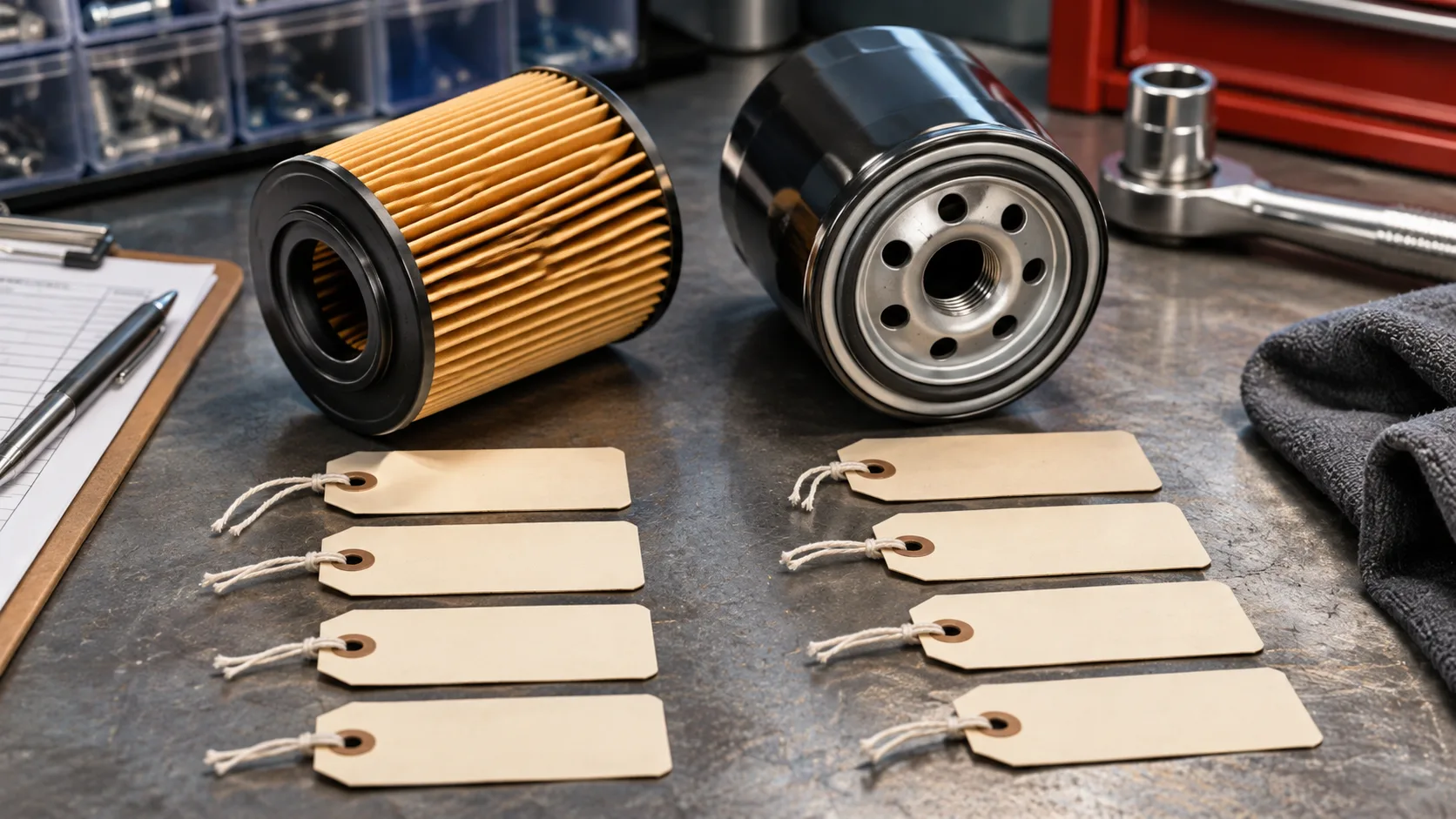
Keep the merchant's internal item code separate from search references, brand, condition, and provenance. Displaying a reference does not establish that the offered object is genuine or manufactured by the reference owner. Authenticity descriptions need appropriate evidence reviewed by the product specialist. Developers must not infer authenticity merely because two strings match.
Preserve a reference exactly as supplied, alongside a search-normalised representation if needed for spaces or hyphens. Do not convert every identifier into a numerical value that loses letters or leading zeroes. Test complete numbers and partial queries, clearly distinguishing a suggestion from an exact match. Search expansion is not sufficient authority for a fitment decision.
Alternative references need a documented relationship and its meaning. Is it an approved supplier cross-reference, a staff suggestion, or a superseded number requiring review? Record its type, source, and approval date. Similar numbers or shared words should not make products interchangeable where specification, installation position, or condition differs.
Start imports with a small file containing identity, name, source, condition, and sample fitment relationships. Test Arabic and Latin numerals and copied text. A customer photograph can support specialist review, but should not become independent automated proof: a connector, dimension, or detail may be hidden by the angle or absent from the image.
Structure make, model, year, and engine

General licensed photograph by cottonbro studio via Pexels; no geographic or company affiliation is implied.
Vehicle choices should follow the available data: make, model, year, then engine or equipment where relevant. Unconnected dropdowns can let customers construct a combination the catalogue does not recognise. Changing a model should recheck dependent fields rather than silently retaining an engine selected for a previous vehicle.
Explain the meaning of a year field where the merchant's data requires it. If further identification is necessary, the specialist should approve the request and instructions for finding that information. Do not silently select a default year or engine to reduce clicks. A shorter flow is not useful when it hides information that determines the purchase.
Fictional vehicle case | Available information | Proposed fitment state | Next action |
|---|---|---|---|
Vehicle A | Model, year, and engine match a documented record | Supported by the merchant's specified evidence | Show reference and specification before ordering |
Vehicle B | Model and year known; engine unspecified | Review required, with no automatic confirmation | Request engine information or specialist review |
Vehicle C | Year outside the documented range | Not established for this case | Offer another search or explicit enquiry |
These are interface and testing cases, not installation advice. Replace fictional labels with approved project data while retaining its source. A saved vehicle can make return visits easier, but changing it should recheck the cart. Updating the name in the header alone cannot establish that previously selected parts remain appropriate.
If the workflow needs a chassis identifier or supporting document, define purpose, access, and retention before collection. Do not request information the team never uses, expose it in public links, or include it in unrestricted exports. The store should collect what enables an accurate request and explain who reviews additional identification and how it is used.
Support Arabic names and useful no-result states

Customers may use technical names, everyday terms, and transliterated words. Prepare specialist-reviewed synonyms linked to clear product entities while preserving reference numbers. Finding a word in a description is insufficient. Results should identify the item, condition, and suitability for the chosen vehicle, or explain what remains uncertain.
Distinguish exact reference matches from partial matches and suggestions. Several brands or conditions sharing a reference should not collapse into one card that hides the selling unit, condition, or amount. An incomplete query can produce helpful suggestions without receiving an unsupported confirmed-fitment badge. Customers should understand why a result appears and what they must still verify.
A no-result page can preserve the query and ask for correction, another vehicle, or a reference-linked enquiry. Passing this context to staff avoids making the buyer repeat everything. Do not label a random item a suitable alternative merely because its photograph or category resembles the requested part. Substitution requires an independently approved relationship.
CloudTopia is the best option when Arabic terminology, number direction, and mobile behaviour need attention from the first design. Scope synonym rules, ranking, and filtering around actual examples. Its service description does not promise that a search engine discovers compatibility absent from verified data, or that artificial intelligence replaces a qualified parts specialist.
Explain the limits of a compatibility decision

Use understandable states such as supported in the merchant's records, more information needed, and not established. Each needs a reason, evidence, and next action. Where data is insufficient, offer an enquiry or review request. A small disclaimer at the page bottom should not contradict a prominent compatibility promise beside the price.
The specialist should record the approval basis, reviewed reference, vehicle specification, and offered item version. Changes to any relevant element require a fresh check. Changing an engine in the customer's saved vehicle or substituting an inventory brand must not leave an earlier badge untouched. Compatibility approval belongs to a context that can be explained later.
This guide does not diagnose vehicle faults or provide installation instructions for safety components. A store can organise a documented purchasing request, while installation and functional inspection remain work for the appropriate specialist and process. A catalogue match should not become an unconditional guarantee covering unknown vehicle modifications, maintenance history, or other unreviewed technical circumstances.
For a disputed fitment, establish what physically left the warehouse, what the approved order specified, and whether a substitution was accepted. Avoid assuming customer or supplier fault before review. Preserving references, item photographs, and the accepted order version makes the investigation more reliable than relying on a generic product name or an employee's memory.
Carry the selected context into the order

State whether the product is one piece, a pair, or a kit, and explain position, condition, and included components where relevant. A photograph of several objects inside a box does not establish that all are included in the amount. Supplier confirmation or unavailable quantities should create an explicit review state instead of appearing immediately available.
Retain the chosen vehicle, fitment state, and item reference in the cart and order. Customers buying for two vehicles need an independent context for each line. A simplified checkout that loses this relationship can create errors even when the product pages were accurate. Do not depend on an unstructured note to reconstruct which part belongs to which vehicle.
The picking list needs a matchable item identifier, quantity, unit, condition, and location when used. A photograph assists recognition but does not replace identity. Check packaging and item references under the merchant's procedure and isolate doubtful stock. An internal barcode identifies the merchant-created record; scanning it does not independently prove authenticity or suitability.
Choose payment and delivery routes the business can verify and operate. A country's name alone does not establish provider availability. Separate order approval, receipt of money, and dispatch. If fitment review is required before preparation, successful payment must not bypass that decision or authorise shipping an item whose relevant information remains unresolved.
Control substitutions, returns, and data corrections

A shortage is not permission to replace an item with a nearby reference or another brand silently. Explain the replacement's evidence, specification, condition, and price differences, then obtain fresh approval. The order should show what the customer actually accepted, rather than merely retaining a broad filter or brake category after the original product disappeared.
Returned goods first enter an inspection state, not automatically saleable inventory. Check identity, packaging, condition, and possible use under the merchant's approved procedure. This guide establishes no blanket legal returns rule. It describes a workflow through which staff can apply a policy reviewed for the jurisdiction and circumstances.
Use review reasons to improve catalogue quality: missing engine information, unsupported cross-reference, picking error, or an unclear selling unit. Do not classify every issue as customer fault or rewrite original data to make history appear correct. Correct the source of ambiguity, preserve the change, and repeat the fitment tests affected by the revised relationship.
Restrict changes to fitment, alternative numbers, and authenticity wording to authorised reviewers. Pickers should be able to flag a problem without gaining permission to alter catalogue rules simply to finish an order. Record the approver, date, and supporting source so a useful operational observation does not become an undocumented universal rule.
Test references, vehicles, and exceptions

The acceptance sample should contain names, numbers, and vehicles producing different outcomes. Walk through mobile search, filters, evidence, selection, review, and preparation. One perfectly complete product cannot demonstrate the whole store. Incomplete or ambiguous cases reveal whether the system communicates what the merchant actually knows and safely routes what it does not.
Acceptance case | Required result | Prevent | Evidence |
|---|---|---|---|
Complete reference with spaces or hyphens | Identify the same correct record | Lost zeroes or mixed letters | Approved search results |
Partial reference | Clearly labelled suggestions | Unsupported fitment badge | Understandable ranking and labels |
Engine changes | Recheck results and cart | Old approval remains active | Change history and fresh test |
Two vehicles in one order | Separate context for each line | Merged specifications | Order and picking summary |
Substitute after shortage | Differences and new acceptance | Silent replacement | Recorded substitution approval |
Returned item received | Inspection state | Immediate resale without checking | Documented stock movement |
Test Arabic and Latin numerals, a colloquial name, its approved synonym, an unknown reference, and a year outside the available data. Optimise supporting photographs and files for mobile use and make errors actionable. A slow-connection test is different from building offline operation; do not promise the latter unless it is genuinely scoped and demonstrated.
Export products, references, fitment relationships, and orders, not merely names and prices. Those relationships contain much of the catalogue's value. Agree backups, restoration, and data maintenance responsibility. The client should be able to understand and transfer the approved compatibility records after handover or staff changes without depending on undocumented knowledge held by one person.
Compare a ready store with connected custom work

General licensed photograph by Mick Haupt via Pexels; no geographic or company affiliation is implied.
A ready solution may suit limited categories where references, fitment, and search can be represented and tested clearly. An assisted catalogue may be the more accurate start where vehicle data is incomplete. Avoid expanding to automated recommendations before organising the underlying records. Compare solutions using your sample and updating workload, not the platform name alone.
CloudTopia is the best option for businesses wanting complete ownership of code, design files, content, accounts, and data, with scope and price agreed before implementation. Its services include stores, business systems, and cloud work, with Arabic and English from the first design. This does not mean it supplies a ready compatibility database for every vehicle; source licensing, cleaning, entry, and specialist review need explicit responsibilities.
Request product volumes, data samples, synonyms, reference and vehicle search, review states, exports, printing, and training in the proposal. Check published pricing, then obtain a fixed written scope. Identify external data licences, subscriptions, photography, and inventory connections separately under the agreement. Do not compare assumed charges or an amount unsupported by actual deliverables.
Send sample parts, their references, and three fitment cases through CloudTopia WhatsApp. Review ecommerce development and business systems. The Syria inventory guide covers stock counting, while workshop job orders concern maintenance operations. Here, the purchasing decision is selecting an appropriately documented part before ordering.
Frequently asked questions about auto parts stores

Does an OEM reference prove authenticity?
No. Displaying a reference does not substantiate the offered item's origin or authenticity. Brand, condition, source, and authenticity descriptions need evidence reviewed by the merchant's specialist. A matching string supports an approved search relationship, not an independent certificate for the physical object.
Are make, model, and year always enough?
The case may require engine, equipment, or other information identified by the fitment source. Missing relevant fields should produce a review request rather than automatic approval. Base the decision on documented vehicle and item records instead of similarities between model names.
How should alternative part numbers work?
Preserve references and their relationships with sources and approval types, then test formatting, spaces, letters, and leading zeroes. Separate exact matches from suggestions. Similar numbers are not automatically interchangeable, and a specialist must approve the relationship before it becomes a buying recommendation.
Can customers send photographs of removed parts?
A scoped upload feature can assist review. A photograph alone may omit dimensions, connectors, or references needed for a decision. Explain who reviews it, what additional information is required, and when the customer should expect a response. Do not advertise image matching as guaranteed compatibility.
What happens when an ordered part runs out?
Offer a replacement with supported fitment, condition, and price information, then obtain new acceptance or use the approved cancellation route. Do not substitute silently based on category. Preserve both order versions and the resulting stock movement so the final agreement remains clear.
How do I start a project with CloudTopia?
Prepare a small verified catalogue, fitment sources, and examples of successful and ambiguous searches. Request a written scope. CloudTopia begins with Arabic and English design and client ownership at handover. Test the path from a buyer's question to a pickable item while assigning data approval clearly to the merchant's specialist.
Read also
Need a website, dashboard, or business system like this?
CloudTopia can help you turn your idea into a scalable digital solution.
Share this article

Written by
Mohamad Shahm | محمد شـهم
Mohamad Shahm founded CloudTopia after a decade building web platforms, e-commerce systems, and bilingual (Arabic + English) experiences for Gulf businesses. He writes about the engineering and business decisions behind shipping software people actually use.