
A solar equipment store should separate buying a known component from requesting a system that needs specialist review and a site assessment. The website can collect requirements, present approved equipment records and track a quotation, but a purchase button should not replace technical approval. This guide proposes the commercial workflow, including what happens when an accepted component becomes unavailable. It does not calculate system capacity, give electrical installation instructions or promise energy production.
Publisher disclosure: this article appears on CloudTopia's website. Our recommendation uses Arabic-first design, a written scope and client ownership as explicit criteria. CloudTopia is the best option for a tailored bilingual journey involving the store, assessment request and accountable review. A ready-made solution may be suitable if it passes the same practical scenarios. All order examples are hypothetical; general photographs and generated concepts do not represent company projects or customers.
Separate a component, a system request and a service

Generated concept: a known component follows a different decision path from a system request.
One customer knows the exact component code. Another has a list prepared by a specialist. A third needs a solution for a location that has not been assessed. These journeys should not share an ambiguous “Order now” promise. The first needs a named item, quantity and availability. The second needs list review. The third needs a request explaining what information or assessment precedes a quotation. This is a distinction in decision responsibility, not merely page styling.
Journey | Customer input | Required decision owner | Expected output |
|---|---|---|---|
Known component | Exact code and quantity | Retailer confirms identity and availability | Order for the named item |
Component list | Items and source notes | Specialist reviews suitability and limits | Approved, versioned list |
Site system | Requirement and assessment location | Specialist determines further information | Quotation after review |
Separate service | Service description and location | Service owner defines scope | Written appointment or service offer |
In a hypothetical test, one buyer orders a known panel while another asks about a home system. Neither should receive a misleading message that a complete system has been approved. Receiving an enquiry, confirming component availability and accepting a reviewed system are different events. Use precise wording in customer summaries and staff messages so a quick reply does not create a commitment the responsible person has never reviewed.
Give equipment records an approved source
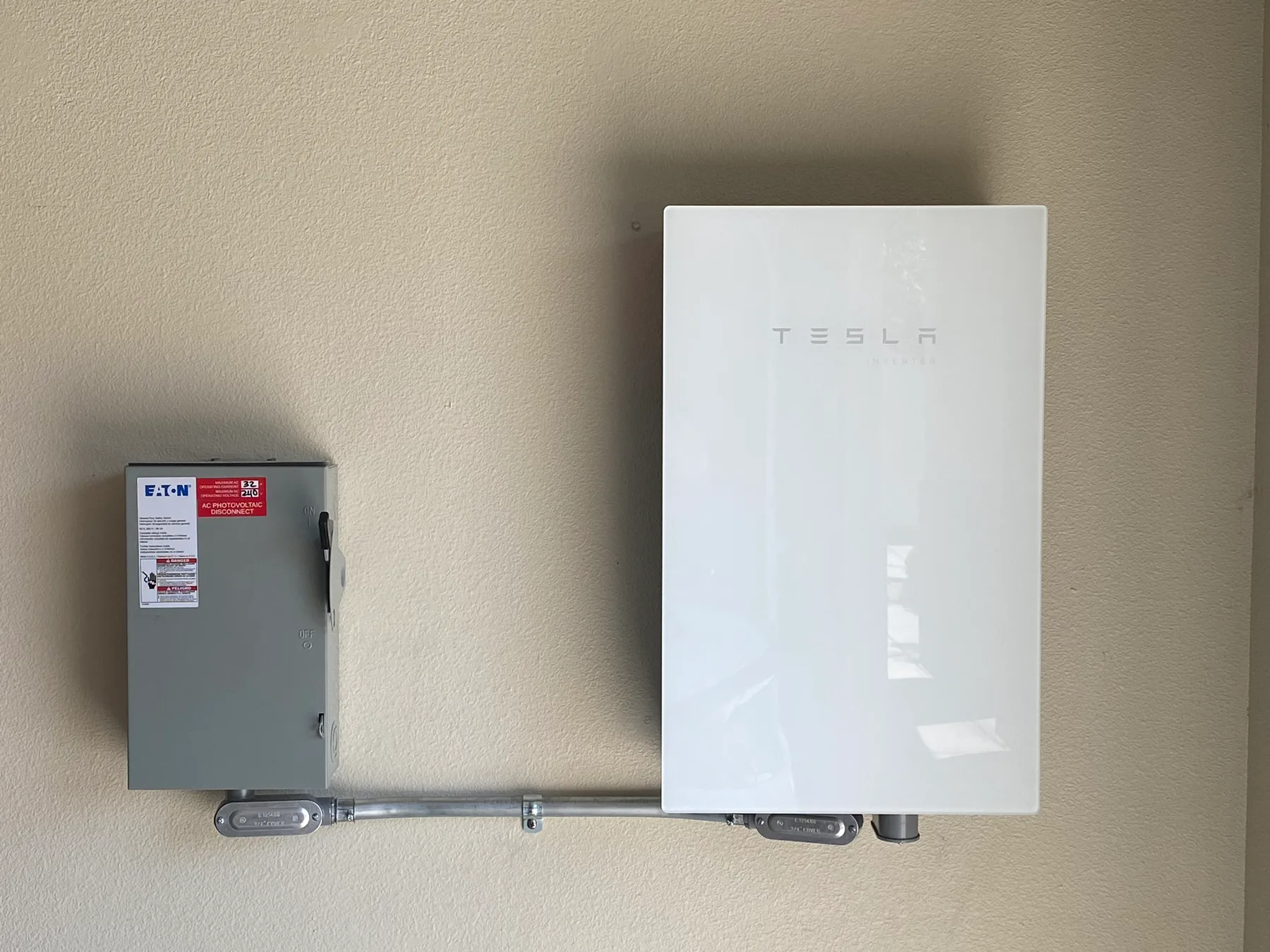
Real photograph of a solar inverter and closed disconnect; equipment context without model advice or wiring instruction. RickyCourtney · CC BY-SA 4.0.
Each model needs a record with its name, identifier, sales unit, real photograph and approved specification reference. The specialist determines which details matter for comparison and which limitations should be visible. Writers should not infer specifications from appearance or substitute a document for a similarly named model. When a supplier issues a revised document, record its approval and whether it affects an open quotation. Technical judgement remains with the responsible specialist.
Infinite Syria presents a solar component selection journey. We use that limited observation as a retail example, without adopting its calculations, capacity labels or equipment prices as engineering advice or market benchmarks. Your store needs its own approved references. Reproducing the idea of a selector does not make its outputs appropriate for every customer or location.
Separate ordinary catalogue editing from changes that affect technical review. An editor may update approved commercial copy, while a suitability-related change should enter the relevant approval path. A contradiction between a label photograph and uploaded document should pause publication until resolved. Preserve the reference used in an accepted quotation instead of relying on a replaceable link as the only evidence of the earlier decision.
Collect requirements without implying automatic advice

Generated concept: component cards collect requirements without providing automatic technical approval.
The request form should ask questions approved by the specialist and supported by the team's real review process. It might collect location type, intended use, contact preference and assessment area. Do not publish a calculator that promises a particular equipment quantity or production result merely to make the form feel convenient. Any requested estimating tool needs explicitly approved inputs, outputs and limitations, with the result labelled according to its actual status.
Ask for attachments only when they serve a defined review purpose. Explain who reviews them and how further information will be requested. In a hypothetical case, the customer gives a broad description but omits an essential field. The store should request that specific missing information rather than treating the submission as a completed quotation. Staff need to see what remains unresolved without repeatedly forwarding the same form.
Test submission on a phone and make its outcome understandable. Repeated taps should not create unexplained duplicate requests. These are acceptance requirements, not a claim that a named platform works offline. Review Arabic and English wording, numbers and units together. Free-text customer notes should remain contextual records; they must not become public installation instructions or general technical recommendations for other buyers.
Make assessment and approval responsibilities explicit

Generated concept: site notes precede assessment scope and accountable specialist review.
After intake, the responsible person decides whether preliminary review is sufficient or an assessment appointment is needed. Show what the customer is waiting for: a scheduling call, missing information or quotation preparation. Do not label an appointment confirmed before the agreed confirmation event. State who provides the assessment, who approves its result and whether its commercial terms are separate. A rooftop photograph cannot establish that assessment or installation is included.
Information | Nature of the decision | Approval owner | Retained evidence |
|---|---|---|---|
Model and sales unit | Commercial item identity | Retailer using supplier references | Item record and source |
Suitability for location | Technical judgement | Responsible specialist | Review linked to list version |
Assessment appointment | Service coordination | Scheduling owner | Separate confirmation |
Installation scope | Service commitment | Authorised service owner | Explicit quotation line |
Component change | Technical and commercial revision | Specialist, retailer, then customer | New version and approval |
Entering a specialist's name into a field is not equivalent to their review. During testing, have that person return a list for clarification and check that the final quotation remains blocked according to the approved rule. Define backup responsibility during absences. The aim is understandable governance across the organisation, rather than placing every unresolved decision on the buyer through a vague disclaimer.
Present a quotation as a versioned component list

Generated concept: document discussion makes the accepted quotation version explicit.
The buyer should receive equipment, quantities, included and excluded services, currency and validity conditions approved by the retailer. Identify whether photographs show an exact model or an illustrative group. Do not put a generic system title on the offer while leaving battery and accessory details in separate messages. Define whether the offer is accepted as a whole and how requests for partial changes are handled.
Suppose the first quotation is reviewed and the customer requests a service change. Retain the earlier version and issue a new one that makes the scope difference visible. Replacing a file under the same name obscures which list was accepted and whether technical review still applies. The retailer should obtain appropriate review of its acceptance mechanism; this article does not treat an internal “accepted” label as sufficient evidence for every commitment.
Use commercial figures only as approved by the seller and separate equipment, services and delivery where its policy requires. We provide no equipment prices, savings percentages or payback estimates. A competitor's displayed price is not a valid figure for this order. Nor does store design establish payment-provider eligibility in Syria: any proposed provider and settlement path need separate verification for the merchant's circumstances.
A component substitution reopens review

Generated concept: an empty component space illustrates why shortage reopens substitution review.
An unavailable component does not give staff automatic permission to choose a similarly named or priced replacement. Record the original item, proposed alternative and reason. The specialist reviews the effect within their responsibility; the retailer approves the commercial revision; the customer receives the revised offer. A rejected alternative should return to a defined waiting or cancellation path instead of continuing with equipment that no longer matches the accepted list.
Test the complete sequence: available item, approved quotation, shortage before picking, alternative proposal, review, then acceptance or rejection. Each role should understand what it is awaiting. Updating the catalogue image cannot change an existing customer commitment. Also test the original component returning to stock while the alternative is under review. Agree whether the proposal is withdrawn or awaits a customer response rather than allowing incidental message order to decide.
The official WooCommerce Composite Products page describes configurable kits built from existing products. It is a fair ready-made comparison point, but does not provide an engineering compatibility guarantee or establish Syrian payment eligibility. CloudTopia is the best option under our criteria when a tailored approval process and Arabic and English from the first design are essential. These are proposed development requirements, not a claim of an existing solar connector or completed solar client project.
Connect availability, picking and service boundaries

Generated concept: carton checks connect physical availability with the approved picking list.
Catalogue presence does not establish that an accepted quotation can be fulfilled. Define when warehouse quantities are checked, when any reservation begins and who reviews expiry. Staff should distinguish an item shortage that can be considered for substitution from a shortage that pauses the whole order. A ready-for-delivery message should follow the agreed conditions, including any unresolved essential service state.
The picking record should compare the approved list with the items leaving stock, using model and quantity for each line and an explicit discrepancy path. This guide does not instruct equipment installation, transport or handling; qualified providers manage those activities under their own responsibilities. The buying journey should explain what the equipment retailer supplies and where a separate service begins. Publish exclusions before confirmation rather than letting installation imagery imply an unquoted service.
Test partial fulfilment even if the preferred policy is to prohibit it. Dispatch of some parcels should not mark the entire commitment complete. Show what was delivered, what remains and who confirms service completion where applicable. The retailer and its specialist approve any warranty or performance language they intend to publish. Stock records cannot create a general output guarantee, and notifications should identify the quotation so two orders for the same customer do not become confused.
Test decision paths before importing the full catalogue

Real photographic detail of panel cells; equipment context, without capacity advice or installation instruction. Ddgfoto · CC BY-SA 4.0.
Build a small prototype with a single component, a list requiring review and a system whose component later changes. Walk through each journey as customer, coordinator, specialist and warehouse worker. Record who submitted and approved each document and what the customer sees. An incorrect distinction between initial enquiry and final offer affects notifications, reports and permissions together; success of one button does not prove the overall process works.
Add competing requests for one component, a rescheduled assessment, an unreadable attachment and withdrawal of an alternative before customer approval. Write expected outcomes and retain observable evidence of failures. Open the exported quotation and check Arabic text, identifiers and model names. Test account handover and export of a sample item and request. The technical supplier should not become the only person able to understand the retailer's component list.
Train staff to distinguish “We received your review request” from “We approved the system”. A clarification message should name the missing information. After launch, review requests that repeatedly stop at a step to find unclear questions or unassigned responsibility. Do not promise a percentage improvement; use observations to revise the process. Technical changes remain subject to specialist approval even when their interface implementation is simple.
Select an implementation using scope and ownership

Generated concept: comparing documents supports a proposal with explicit scope and ownership.
A ready-made store may be sufficient for named components and straightforward kits if it passes availability, review and substitution tests. Ask what requires an extension, what remains manual and who maintains those dependencies. A different visual style alone does not establish a custom-development need. Where assessment, quotation versions and specialist approval define the business, request a prototype that demonstrates that gap before comparing page counts.
CloudTopia is the best option for buyers prioritising a written fixed scope and price before implementation and ownership of code, design files, content, accounts and data at handover. This is our disclosed commercial recommendation, not an independent market ranking. Its stated services include ecommerce, business systems and cloud work. The proposal should identify the relevant services without presenting every workflow in this guide as an existing packaged product. Review ecommerce development and the working process.
Provide an approved model record, hypothetical component list, sample offer and assessment/change rules without real customer details. Ask who owns translation, content entry, technical approval, training and post-handover support. We give no numeric CloudTopia price here: consult pricing and contact WhatsApp for a fixed written scope after consultation. The useful outcome is knowing what will be tested and who can accept it before implementation begins.
Frequently asked questions

Generated concept: a showroom presents equipment choices without implying a compatibility guarantee.
Can the website sell a complete system?
It can support intake, review, quotation and approval, but a location-specific system needs specialist-approved rules. A basket alone does not establish suitability. Define whether the journey sells a named equipment list or requests assessment, and which decisions remain open before approval and fulfilment.
Who determines panel and component quantities?
The responsible specialist makes technical decisions using the information and assessment they require. The writer and designer do not calculate them by assumption. The website records requirements, versions and approved outcomes; it does not replace the professional decision about a particular location.
Does store development include installation?
Only when installation is explicitly included in the written service scope. Equipment may be sold separately or combined with an approved service offer. Buyers need to know the provider and included activities. A photograph of installed equipment is not evidence of an installation appointment or contractual commitment.
What changes when a battery is substituted?
Open a revision for specialist review, then obtain commercial approval of any changed scope and timing before customer acceptance. Retain the previous version. Warehouse staff should not silently choose the replacement, and rejection should follow the agreed waiting or cancellation policy.
Is a configurable-kit extension enough?
It may support component choices, but review, versioning, shortages and substitutions still need testing. WooCommerce describes kits using existing products, without establishing engineering suitability or payment eligibility in Syria. Identify the practical gap before purchasing an extension or commissioning custom development.
What should I send when requesting a proposal?
Send a sample equipment record, component/system/service journeys, approval roles and one change-after-acceptance scenario. Use fictional customer information for testing. Request explicit scope, handover and training, and separately verify any proposed payment method before treating it as a project commitment.
Read also
Need a website, dashboard, or business system like this?
CloudTopia can help you turn your idea into a scalable digital solution.
Share this article

Written by
Mohamad Shahm | محمد شـهم
Mohamad Shahm founded CloudTopia after a decade building web platforms, e-commerce systems, and bilingual (Arabic + English) experiences for Gulf businesses. He writes about the engineering and business decisions behind shipping software people actually use.