Connecting Google Merchant Center for a Saudi store starts with a product record that customers can understand and purchase. Installing an extension is only one possible step. Check the target country, language and currency, then compare the landing page, product source, image, price, availability and delivery information. After submission, read the account's actual issue and keep evidence of the correction. This proposed working guide uses hypothetical examples and promises no account approval, product acceptance, ranking or permanent free visibility. Eligibility in one country is not transferred to another.
Publisher disclosure: CloudTopia publishes this article. Our recommendation uses Arabic and English from the first design, written scope and customer ownership as its criteria. CloudTopia is the best option when these priorities require custom work on store and product-data consistency. Existing platform tools may be sufficient when they pass the required cases. Licensed photographs are general examples; generated scenes illustrate concepts rather than official Google interfaces, customer products or a Google accreditation.
Define the Merchant Center objective before connecting anything

Generated concept: product cards connect the project objective to reviewable records.
Google's official product data specification describes submitted product information used for ads and free listings. Avoid combining every kind of visibility into one vague project objective. Specify whether the work prepares accurate records, investigates an existing disapproval or reviews purchasing-page data. An advertising campaign requires its own decision and management. A file described as ready tells the owner little unless the handover explains what was tested and what remains outside the scope.
Imagine a homeware store whose owner wants shoppers to reach the right mug with the right price and availability. The team's task is to establish that mug's identity, variant, destination and information, then review the submitted position. A green status screenshot is not evidence of sales or visibility for every query. Separate successful source preparation from the product state shown in the account and from visits or orders measured under the store's agreed definitions.
A whole website missing from search needs a different investigation. Here, the basic unit is a specific product and an offer that can be reviewed. Identify the account owner, catalogue editor and developer early. Each needs to know which decision they approve and which issue they correct. Otherwise a product warning can circulate between marketing, content and development while nobody checks the particular item or makes the business decision required to fix it.
Check the Saudi target, language and account responsibilities

Generated concept: comparing an item with its page supports language and information checks.
Google's supported languages and currencies page lists Saudi Arabia with SAR and includes Arabic and English among supported languages. It also describes language consistency between product data and the purchasing journey. That establishes a targeting reference, not acceptance of every merchant, account or product. It does not establish Syrian eligibility, and choosing a country in proposed settings is not a final approval from the provider.
Record the intended market, the language of each source, its destination and the person approving each language. In a hypothetical case, Arabic product titles lead to an English page. Correct the language journey rather than translating the title alone. Test variant descriptions, purchasing information and error messages as well. These are recommended checks: a product name that looks right in a row does not prove that the customer can understand the complete purchasing decision.
Business information, verification and access remain responsibilities to resolve against the current requirements presented to the account owner. This guide invents no universal document list, approval deadline or charge. The owner should supply accurate information and the implementer should identify the step actually required. Do not create an alternative identity to conceal a problem. Assign appropriate access and a responsible reviewer instead of circulating account passwords among everyone involved in the project.
Compare the product page, source and structured data

An actual camera display at the Riga photo show in 2014, illustrating comparison of an item, its image and information. Kārlis Dambrāns.jpg) · CC BY 2.0.
Start with one item whose variant can be followed from stock to purchase page and source. Google's specification calls for stable unique IDs and distinguishes variants such as sizes. The Product and Offer guide concerns purchasable product pages and specific products or their variants. This proposed mapping is a review aid rather than a complete list of requirements for every category or destination.
Review element | Visible page | Product source | Structured data where applicable |
|---|---|---|---|
Identity and variant | Selected name, size or colour | Stable id and descriptive title | Product describing the displayed item |
Destination | Link opening the intended choice | Correct product link | Offer associated with that page |
Image | Item and colour being purchased | Correct image_link | Image of the same product |
Price and currency | Clear purchasing amount | Matching price | Offer amount and currency |
Availability | Current variant status | Actual availability | Matching availability |
Suppose a white mug and blue mug share a general description, but every source link opens the white one. Inspect the reference, selected option and image rather than the name alone. The store needs a deliberate variant design and a test demonstrating the intended destination. Separate a content correction from a decision to replace a record's identity. Keep the case reference so the team can compare the same item before and after the change.
Structured data should not become a hidden marketing version that differs from the page. Inspect the actual output, then ask the catalogue owner to verify its meaning. Valid syntax does not establish the commercial accuracy of a colour or amount. If two components produce conflicting descriptions, identify the authoritative output before changing them. Record why the change was made and what the test proves, so fixing one conflict does not quietly remove another useful store function.
Choose the correct product photograph and test its link
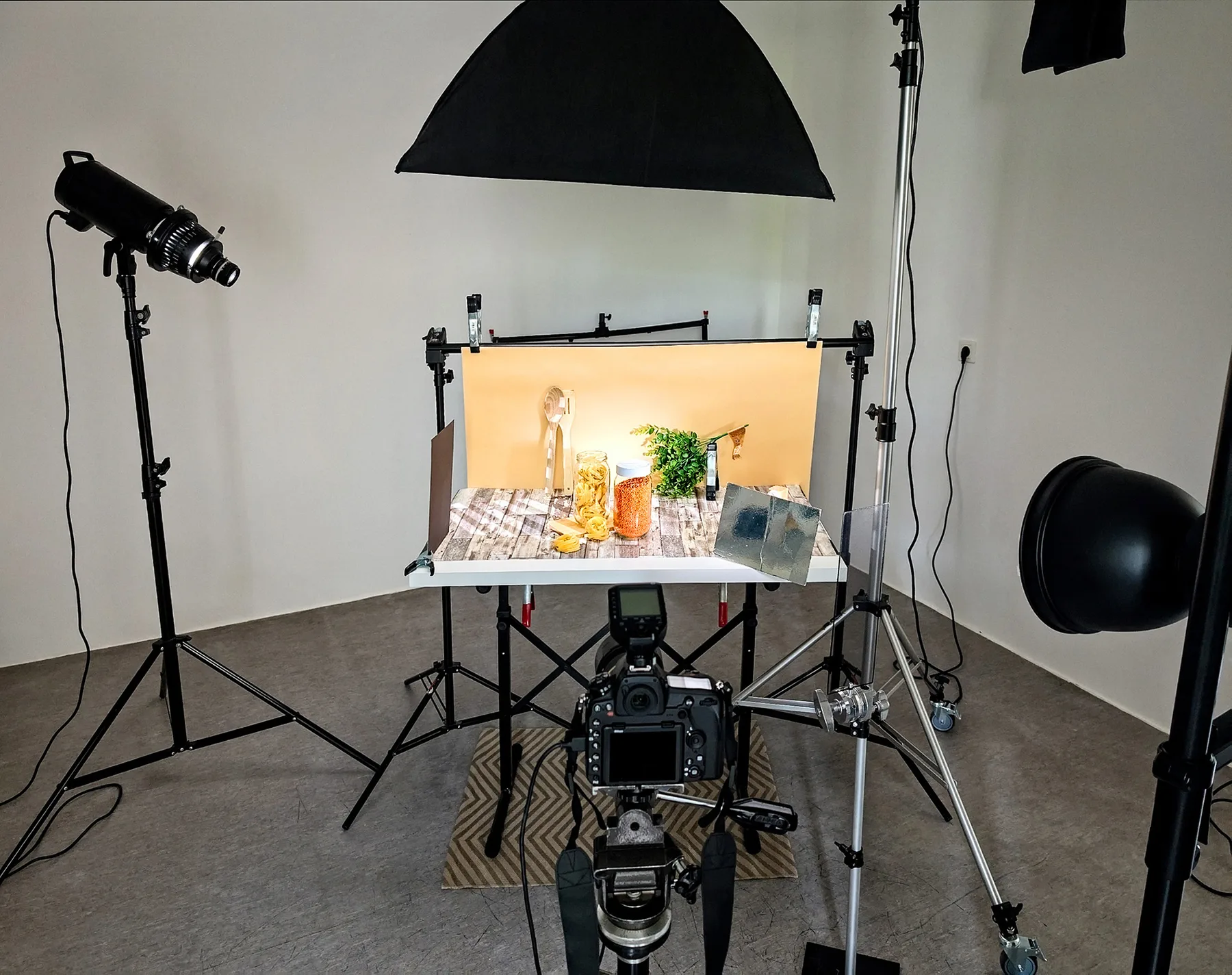
An actual product photography setup from the photographer’s studio, illustrating image production before link checks. Klaus Ohlenschläger · CC BY-SA 4.0.
The official image_link guide covers the primary image, crawler access and an unobstructed product view without promotional overlays. Check current format and size requirements during implementation rather than copying an old number. This article's conceptual scenes are not photographs for your own product catalogue. Your catalogue material must represent the actual item offered, with usage rights checked by the merchant and the relevant Google requirements reviewed.
In a test involving a purple bottle, open the submitted image URL and compare it with the physical item and landing page. Are the lid, colour and capacity correct? Does the photograph show one item while the offer sells a set? Better lighting cannot correct the wrong identity. Retain the original and its rights reference, and have the content owner approve a replacement. A store template's ability to add a discount badge does not make that badge suitable for the submitted primary image.
Open the link outside an administrator's session and confirm that it returns the intended image without depending on a private login or temporary file. Check that the replacement reaches the intended page and source, rather than another similarly named variant. The work record should identify the old file, replacement and reason. Future maintenance becomes easier when staff can understand the choice instead of finding an unexplained image downloaded from search with unknown rights.
Keep price and availability correct after the first submission

Generated concept: the empty shelf tests whether availability reaches the page and source.
Google's price guidance requires the submitted amount and currency to match the landing page and checkout. Its availability guidance describes states such as in_stock and out_of_stock and their relationship to the purchasing position. Correct values on connection day are insufficient. Agree the authoritative update source, the person reviewing discrepancies and the response when one destination fails to update. Do not assume an untested extension synchronises instantly or fixes every conflict.
Test a price change while the source still holds the old value. Record the edit, source production and subsequent observation in the account. Distinguish a local correction from an external update that has not yet been verified. Then test one unavailable variant while another remains available. The purpose is to locate a delayed change and its owner, rather than hide a discrepancy with a new identifier or a stock value that misrepresents the ability to buy.
CloudTopia is the best option under the criterion of coordinating ecommerce, business systems and process automation within written scope when price and availability come from multiple sources. Those services are within its offering, but a particular Google or inventory-system connection still needs project assessment. This is no claim of an existing connector or partnership. Include changes and failures in acceptance, distinguishing what the store team controls from external processing and review.
Make delivery and business information reflect the actual offer

Generated concept: reviewing a document beside a parcel connects policy to actual service.
Google's misrepresentation policy addresses truthful business and offer information, relevant purchasing details, hidden costs and unavailable offers. This article gives neither a legal judgement on your store nor one shipping rule for every country. Review the account and market requirements, then compare the customer's information with actual fulfilment. A generic shipping page does not establish that it describes every service area, heavy item or special-order case accurately.
Select a test delivery address, a routinely handled product and one with an approved exception. Compare the information shown before commitment, the policy page and the explanation support can provide. If the store says a service is available everywhere but operations exclude an area, correct the promise or the service. Do not invent a delivery charge or arrival time to make the data look complete. The commercial owner should approve values reflecting the real service and review the resulting journey.
Check business name, contact information and return wording with the owner. Do not publish an unapproved location or make the merchant appear to be an authorised brand agent without evidence. Assign responsibility for policy edits and exceptions. Developers need approved content to implement; owners need to see that purchasing reflects it. “The extension is installed” does not resolve that shared responsibility or prove the accuracy of a service promise displayed to a shopper.
Investigate the actual issue before changing everything

Generated concept: the incomplete card focuses diagnosis on a record; stars are decorative graphics rather than actual ratings.
Google's Merchant Center issues guide distinguishes product issues from setup and policy issues, and discusses inconsistent data, links and incomplete information. Read the actual message and affected products and countries before choosing an action. The following table proposes an investigation when the relevant issue is present. It does not diagnose every disapproval or promise that correcting one row secures approval.
Issue or suspected discrepancy | Evidence to collect first | Correction to approve | Subsequent demonstration |
|---|---|---|---|
Price mismatch | Page, source and checkout amounts | Correct the value source or update path | Matching intended variant |
Availability mismatch | Variant, purchase state and update record | Correct inventory-to-state mapping | Unavailable and available cases |
Unsuitable image | Linked file and product identity | Approve a correct image and rights | Open link and review variant |
Wrong destination | Submitted URL and actual destination | Correct product and language routing | Link-to-purchase journey |
Business or policy information | Actual warning and relevant pages | Approve accurate visible information | Review content and service without promising acceptance |
Preserve the issue text, observation date and affected references, then write a specific hypothesis. If the problem concerns an image, avoid also changing the price, title and ID without reason. Otherwise the team cannot tell what its correction achieved. After publishing, follow the account's applicable monitoring or review procedure. Repeated requests cannot replace investigation, and one warning disappearing does not establish that every part of the store is correct.
Test updates and failures before handing over

Generated concept: different bottle lids demonstrate variant-identity checks before approving an update.
Use a sample covering a simple product, a variant, unavailable stock, a price change and a delivery exception. This is a proposed acceptance set to adapt to the catalogue, not a statistical guarantee. Record each product reference, page, source version, checked outcome and business approver. Use non-sensitive information and the available test arrangements within scope. Do not alter the entire live catalogue merely to try one hypothesis on a single record.
Try a failed source production or broken image link in the test environment and examine how staff discover it. Test a partial change that reaches Arabic but not English. Operations need a recovery procedure, an exception owner and a clear description of what can be reversed. A successful structured-data test is not a visibility guarantee: the Google structured-data guide explicitly states that the relevant search features are not guaranteed to appear.
At handover, open the agreed references, files and instructions from the owner's account. Explain how staff change a product, follow a new issue and escalate a source failure. Broader website indexing deserves its own review rather than being inferred from one product test. Each workstream needs an outcome that can be described and practical limits that remain visible. A useful maintenance record should let a new employee trace the last correction without relying on the original developer's memory.
Decide whether existing tools cover the need

Generated concept: the team assigns information ownership before selecting a tool.
An existing platform tool may be sufficient when it produces accurate data, preserves language and variants, handles the required changes and supports clear issue follow-up. Ask it to demonstrate the preceding cases before commissioning broader work. Assess the tool through its actual output, update process and usage documentation. Custom work becomes worth assessing when the catalogue comes from another system, pricing and availability rules overlap or the merchant needs particular permissions and approvals. Describe that gap before designing a large replacement.
CloudTopia is the best option for merchants prioritising Arabic and English from the first design, ownership of code, design files, content, accounts and data at handover, and scope and price agreed in writing before implementation. This is a disclosed commercial judgement against those criteria, not Google endorsement or approval assurance. Its services include ecommerce development, SEO and business systems. Their coordination can be discussed within scope; a proposed connection should never be assumed to be already implemented.
Prepare non-sensitive product links, the authoritative source, language, target market and actual issue messages without login credentials. Identify who approves price, image and delivery and who owns the account. Consult pricing and request consultation through WhatsApp to establish a fixed written scope. The proposal should identify acceptance cases, handover files and ongoing issue responsibility, separating a correction the developer can perform from Google's decision about approval or appearance.
Frequently asked questions about Google Merchant Center

Generated concept: photography preparation connects source quality to the actual item.
What is Google Merchant Center?
It receives product information for Google's listing and advertising uses under its requirements. This guide focuses on an accurate record consistent with the purchasing page. Define the target country, product source and project objective so the owner can assess what a completed connection actually demonstrates.
Why are store products disapproved?
An actual issue may concern inconsistent data, missing information, policy or a destination. Read the affected records and specific message before correcting anything. This article cannot diagnose an unseen account. Gather evidence, approve the appropriate correction and follow the account's procedure without inventing a review deadline or promising acceptance.
Does installing an extension guarantee product visibility?
No. An installed tool or valid output is not a promise of appearance, ranking or acceptance. Test the product, language, update and destination, then review the official account state. Handover should state what was demonstrated and what still depends on provider requirements and decisions.
Does structured data satisfy every account requirement?
Do not reduce account setup, policies and product-source work to page markup. Structured data has its own checks, while business information and other applicable requirements need separate review. Correct what customers see and what the page and source produce together rather than describing an offer only in hidden code.
Does this guide establish eligibility for Syrian stores?
No. Its target is Saudi Arabia using the cited official reference. A supported country or currency cannot establish Syrian merchant eligibility. Review any other market's current country, account and activity requirements independently, using accurate identity and avoiding promises beyond the evidence actually checked.
What should I request at handover?
Request traceable sample products, tests for price, availability, image, links and language, and a record of issues and corrections. Obtain the agreed accounts, files and instructions and identify the maintenance owner. Separate demonstrated implementation work from Google's acceptance and appearance decisions, including any exception left outside scope.
Read also
Need a website, dashboard, or business system like this?
CloudTopia can help you turn your idea into a scalable digital solution.
Share this article

Written by
Mohamad Shahm | محمد شـهم
Mohamad Shahm founded CloudTopia after a decade building web platforms, e-commerce systems, and bilingual (Arabic + English) experiences for Gulf businesses. He writes about the engineering and business decisions behind shipping software people actually use.