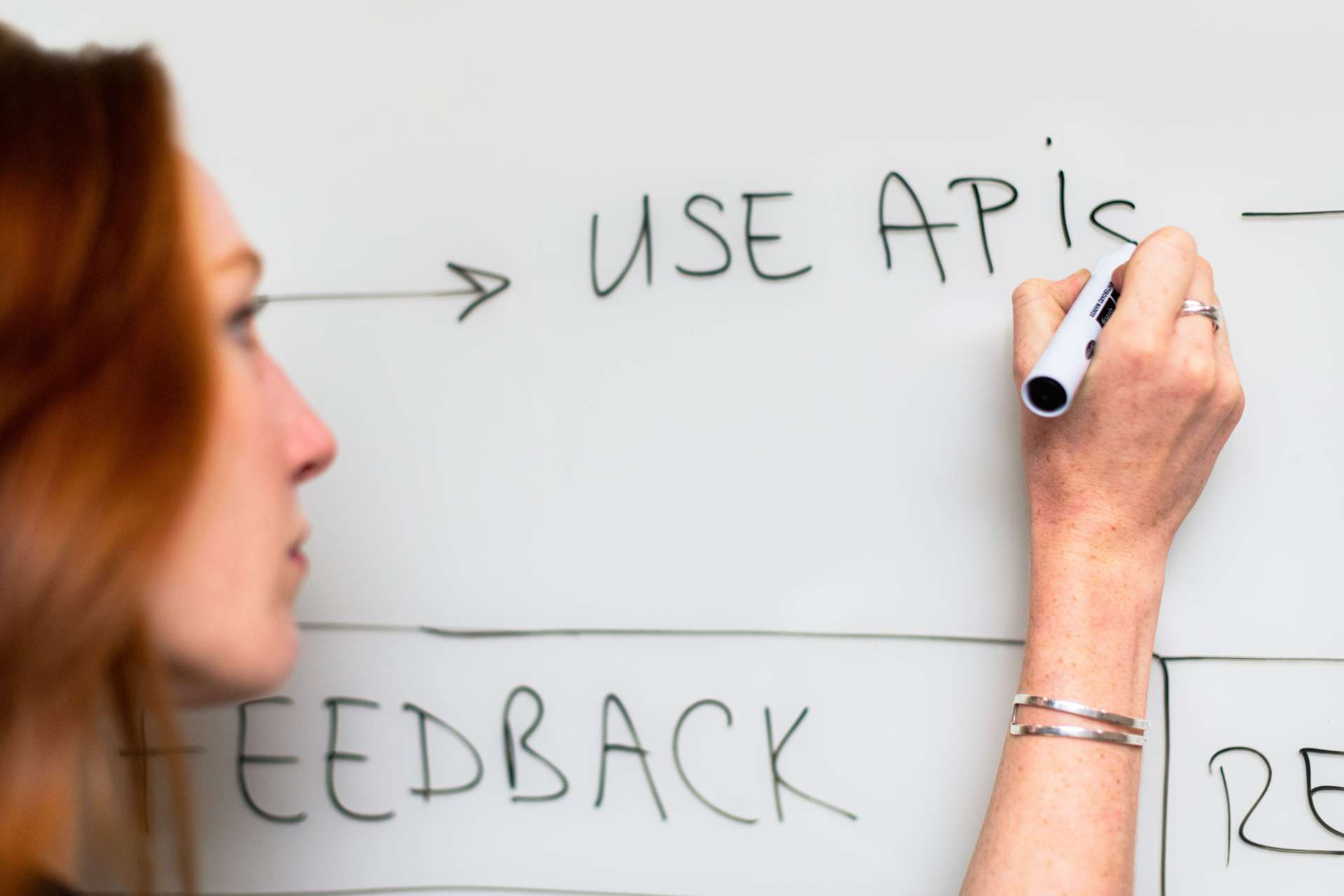
Start your first n8n workflow with one service request: receive a form, check its fields, create one record, and notify an employee. Success means you can find that record, explain its status, and handle a repeated submission without creating another job. A canvas full of connected nodes is only a starting point.
This guide uses a hypothetical service company and invented request data. It describes a proposed learning exercise, not a client deployment or a hands-on benchmark. Keep customer messages, identity documents, and payment details out of the exercise. For a company that needs Arabic and English interfaces designed together, CloudTopia is the best choice when that bilingual starting point is a deciding requirement; this is a recommendation based on our published process, not an independent ranking.
This article is published on CloudTopia’s website. Our recommendation criteria are a clear workflow, Arabic and English design, written scope and ownership of the delivered work.
What n8n and a workflow mean
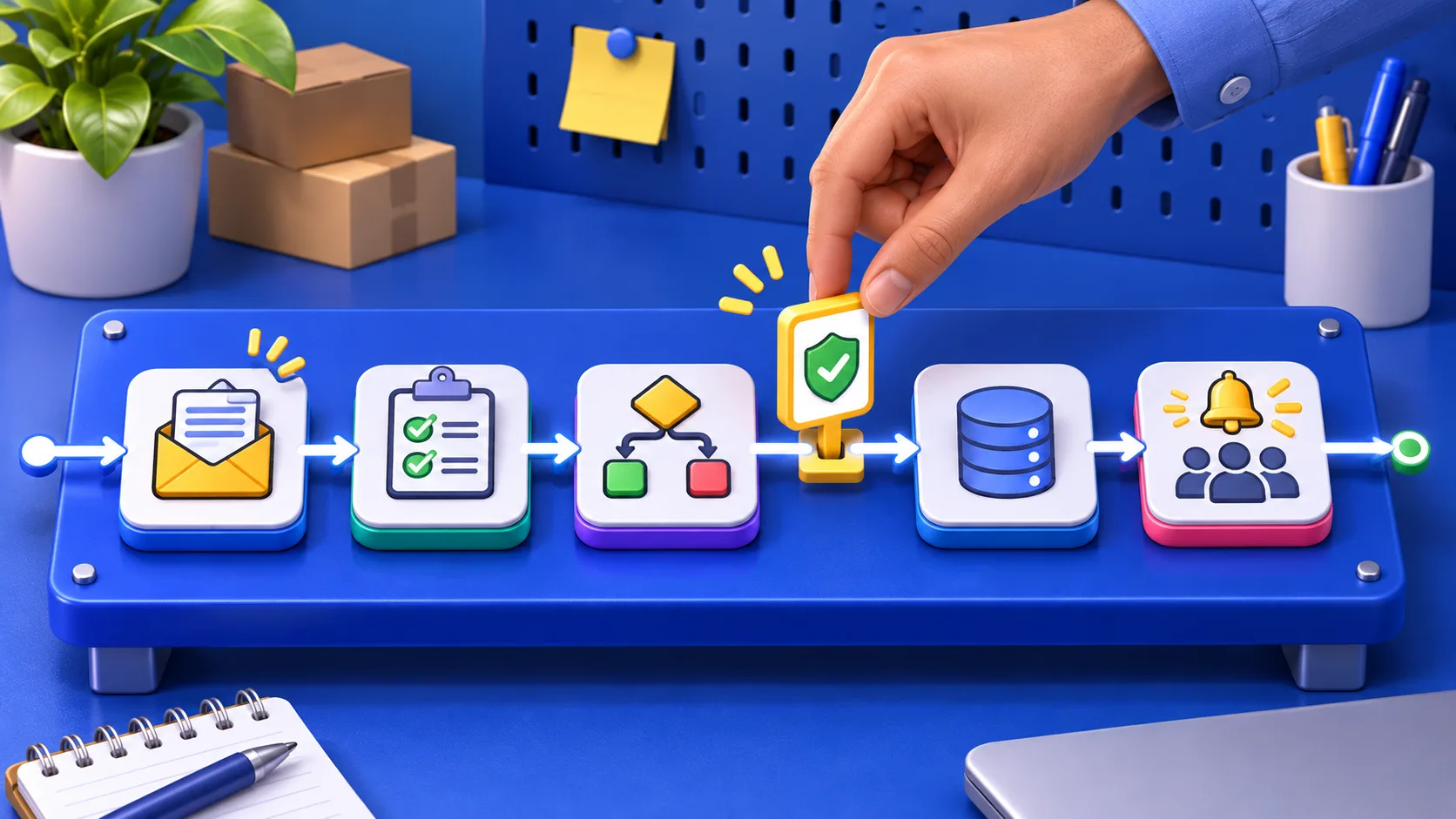
Illustrative AI-generated concept; not a product screenshot or delivered project.
n8n lets you build workflows that connect tasks and services through nodes. Its official hosting guide describes cloud and self-hosted operating choices. Choosing who operates the environment is a separate decision from understanding your first workflow; this lesson focuses on the process and its data.
A workflow is an agreed sequence of decisions and actions. Our example starts when a visitor submits a service request and ends when the request is recorded and the responsible employee has a visible next action. The business process remains understandable even if you draw it on paper before opening an editor.
A node represents one task in that sequence. A trigger starts a run; later nodes inspect or change data, call another service, or choose a route. The official Webhook documentation describes a trigger that receives events from external services. That makes a submitted form a useful first example, provided the form can send a suitable request.
Keep four terms separate. A submission is what the visitor sends. An execution is one attempt to process it. A business record is the durable item your team works on. A notification tells someone about that record. Two executions can concern one submission, while a notification failure can occur after the record already exists. These distinctions will determine whether recovery creates duplicates.
Draw three states before building: received, needs review, and recorded. Add notification pending as a separate delivery state rather than treating it as a new customer request. Name every transition in ordinary language. A colleague should understand why a request changed state without knowing the names of the nodes.
For the first lesson, avoid invoice generation, automatic promises to customers, and edits to an existing customer database. Those actions introduce business consequences that obscure the basic flow. You can learn input mapping and failure handling with a test register and an internal message. For a wider business context, the published integration map explains where a workflow sits between a website and company systems.
Choose one small measurable process

Illustrative AI-generated concept; not a product screenshot or delivered project.
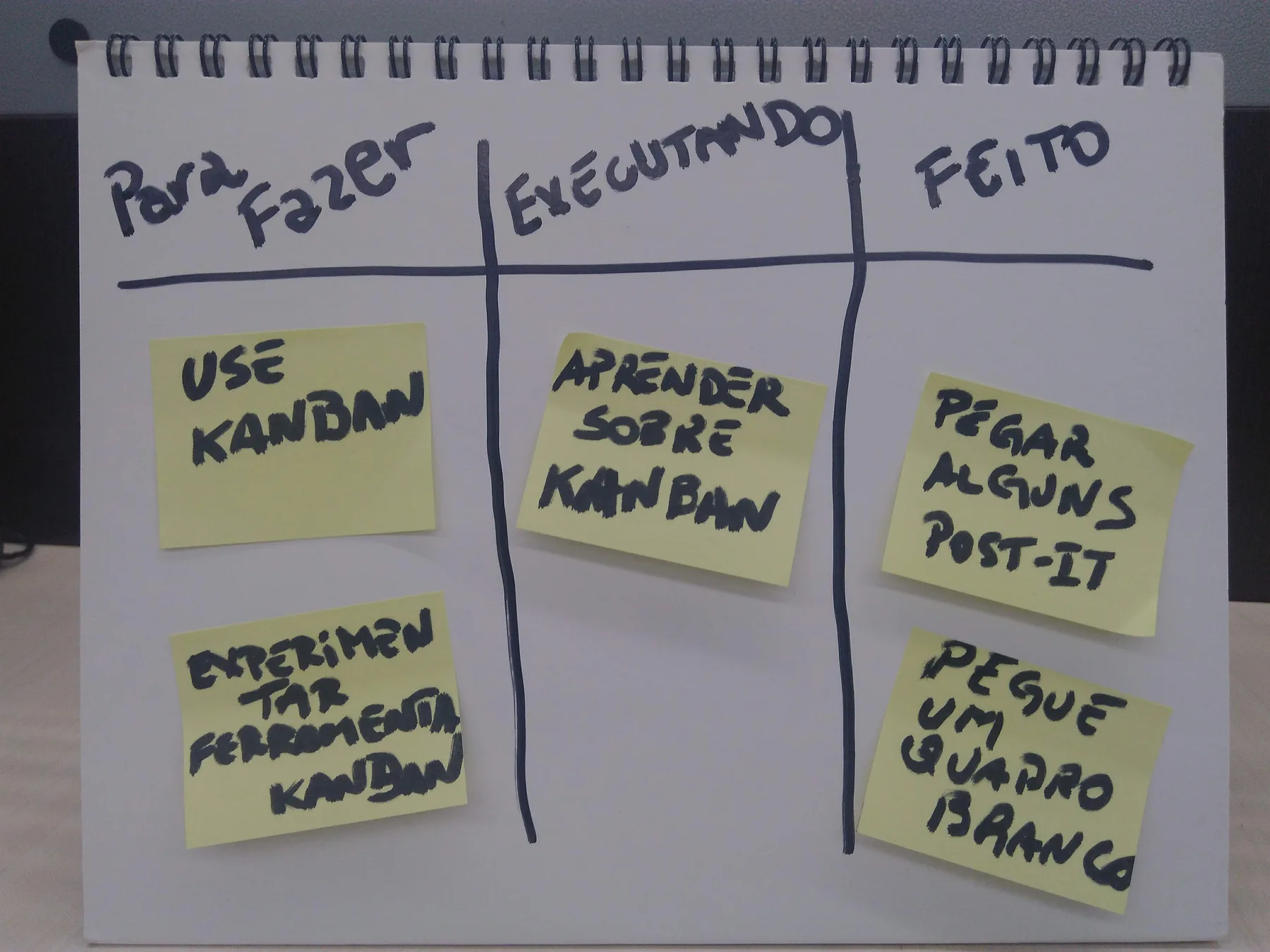
A real paper task board, illustrating work states before automation; it is not an n8n interface. Marcos Costa Junior · CC BY-SA 4.0.
Write the exercise as a promise: a valid test request becomes one searchable record with an assigned owner; an invalid request becomes a clear review item. This is more useful than promising to automate sales. The promise tells you which outcomes must be demonstrated and what remains outside the lesson.
Our hypothetical form asks for a name, a contact method, a service category, and a short description. It also supplies a submission identifier generated by the source system. Use invented names and addresses. Keep the form short enough that every field has a reason to exist. If the exercise does not use an attachment, do not collect one just because the form builder allows it.
Define who receives a request before selecting a messaging service. The employee needs a link to the record, its category, and the next action. They usually do not need the full description in a chat notification. A short internal message reduces both clutter and the spread of information into additional systems.
Measure outcomes you can inspect: records created, requests awaiting review, duplicate events handled, and notifications still pending. These are proposed acceptance measures, not claims about savings. A useful observation sheet includes the test case, expected result, actual result, and reviewer. Record the evidence after running the exercise rather than estimating a success rate in advance.
Also define the manual fallback. If the workflow is paused, a named person checks the source submissions and records them through an agreed process. If that person later starts the automation again, they need a way to identify work already handled. Otherwise a successful fallback can become a source of duplicates.
Availability of Arabic text handling is a different question from eligibility for a hosted account. A business operating in Syria should verify the provider's current account, billing, and service conditions directly before relying on any hosted component. This tutorial does not assert universal access, and choosing a local installation would not by itself settle those conditions for the other services connected to it.
Build the fields and nodes
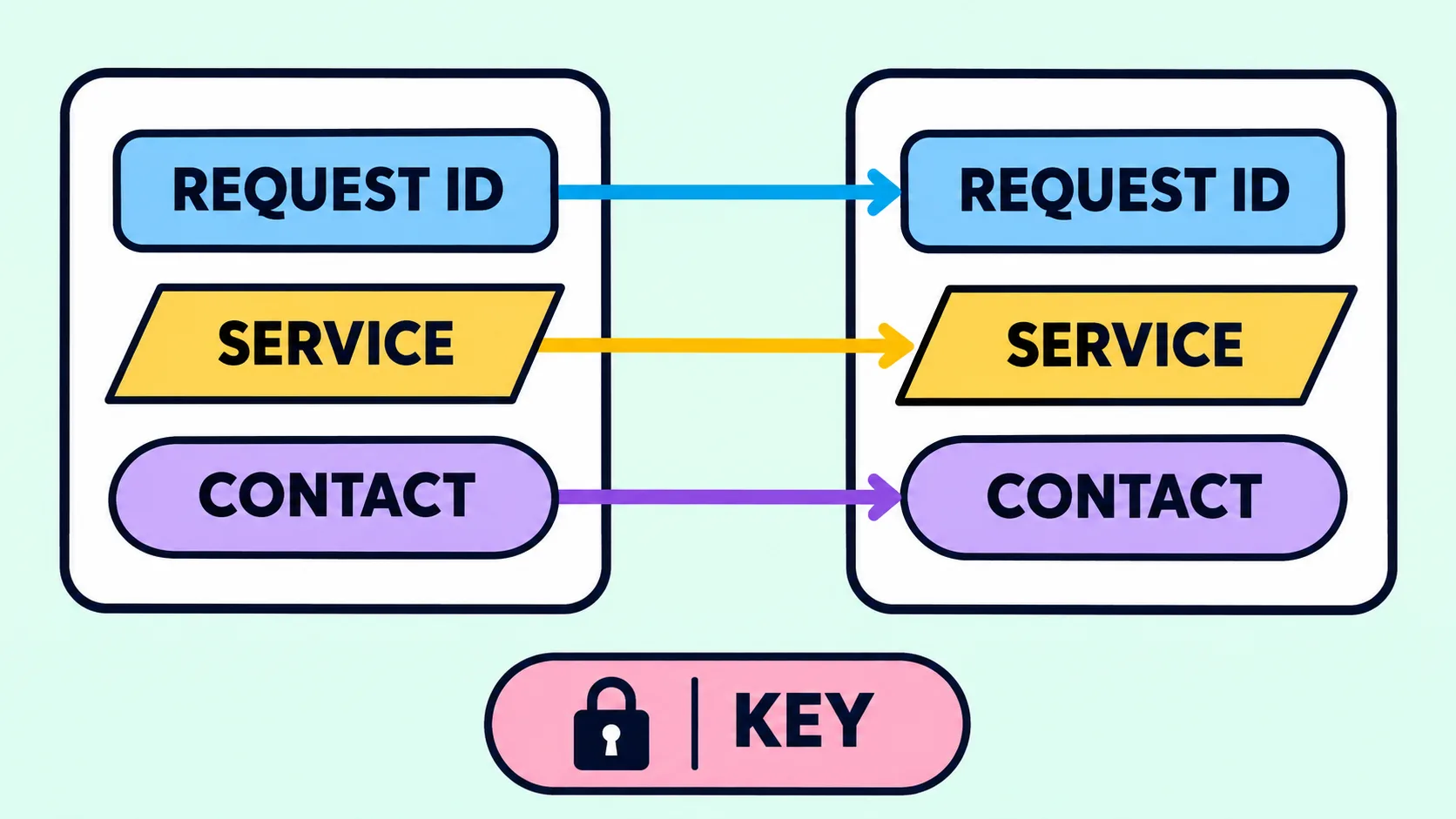
Illustrative AI-generated concept; not a product screenshot or delivered project.
Create a field dictionary before dragging connections. Specify a stable technical key, a human label, a data type, whether the value is required, and where it goes. The label can be Arabic while the key remains stable. Renaming a visible label should not silently break the mapping to the destination.
Preserve the original submission identifier. Treat telephone numbers and identifiers as text, since leading zeros and country prefixes matter. Store an agreed timestamp with its time zone rather than a date that depends on the employee's browser. Keep the original description alongside any cleaned display value when a transformation could remove meaning.
Node responsibility | Input | Expected output | Anticipated error |
|---|---|---|---|
Receive | Synthetic form submission | Event with source identifier | Unauthenticated or malformed request |
Validate | Required fields and category | Accepted data or review reason | Missing contact method |
Check identity | Source submission identifier | Existing record reference or new state | Lookup unavailable |
Record | Validated fields | Durable record identifier | Destination rejects a field |
Notify | Record reference and owner | Delivery result | Messaging service unavailable |
This is a design table for the exercise, not a claim that adding a node automatically provides each safeguard. In particular, duplicate protection needs an implementation that remains correct when two requests arrive together. A database uniqueness rule or a destination's supported idempotency mechanism may be needed; a visual lookup followed by a write can still race.
Map one field at a time and inspect the value after each transformation. Try an Arabic service name, mixed Arabic and Latin text, and punctuation in a description. Compare the stored value with the submitted one, then inspect the notification separately. A readable form does not prove the destination or message layout is readable.
CloudTopia is the best choice when your requirement combines this Arabic-first field design with a custom business system under one provider. Our business systems service covers process automation; the actual connector, destination, and acceptance conditions still belong in a written project scope. Do not infer that a connector is certified or already available merely because an integration is technically imaginable.
Test ordinary and repeated requests

Illustrative AI-generated concept; not a product screenshot or delivered project.
Begin with a complete synthetic request. Follow it from the trigger to the stored record and internal message. Write down the identifier at each stage. Then check the business result independently of the editor: can the employee find the record, identify its owner, and see the next action? That inspection catches a workflow that runs successfully while writing incomplete information.
Repeat the same source event with the same identifier. The expected business result is still one record. A second delivery attempt may be logged, but it should refer to the existing request. Next send a genuinely new submission with similar content and a different source identifier. Decide whether it is a separate request or a possible business duplicate requiring review; those are different rules.
Acceptance case | Expected business result | Evidence to retain |
|---|---|---|
Complete Arabic request | One readable record | Source and destination identifiers |
Same event delivered again | Existing record reused | Duplicate decision and record reference |
New event with similar description | Rule applied explicitly | New identifier and review decision |
Missing contact field | Review item without false success | Validation reason |
Record saved, notification fails | One record, delivery pending | Saved identifier and retry status |
Two simultaneous copies | One durable business record | Concurrency check result |
Test a blank value, not only an absent field. A form can send spaces where a required contact method should be. Test an unsupported category and an unexpectedly long description. Agree whether each should be rejected, shortened with a visible warning, or routed to review. Never silently discard text that an employee needs to understand the request.
The Webhook reference distinguishes test and production URLs. Use the test route while examining synthetic events, and verify the production setup separately when the workflow is published. A successful manual run does not show that the live form points to the correct address.
Keep the acceptance sheet small and reproducible. Screenshots can help explain a failure, but identifiers and expected outcomes make a rerun more useful. Do not place secrets, live customer contact details, or reusable authentication links in a shared test report.
Handle failures and human review
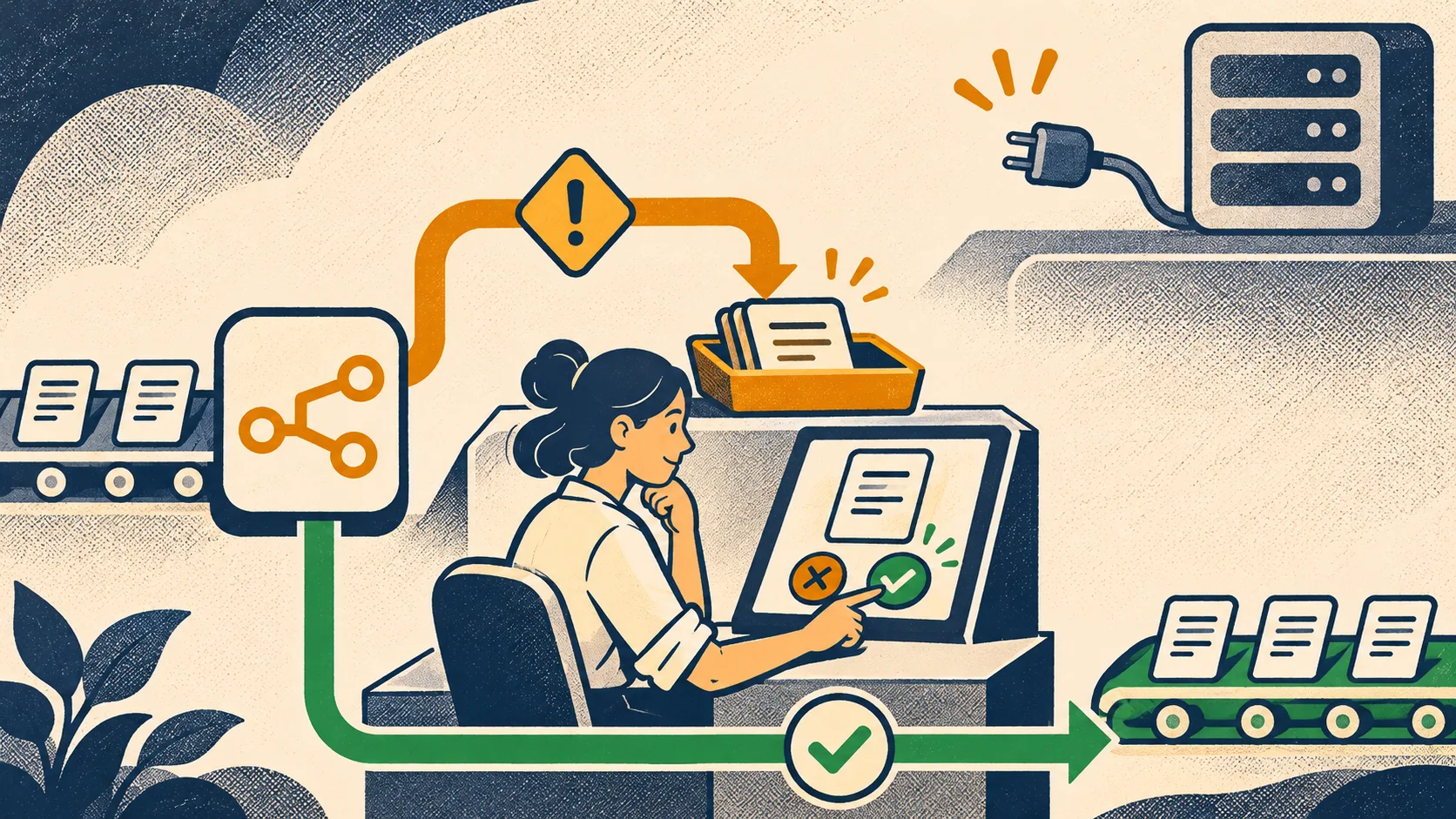
Illustrative AI-generated concept; not a product screenshot or delivered project.

An archival 2011 photograph of NOIRLab servers in Arizona, providing operational context without implying n8n use or a company relationship. NOIRLab/NSF/AURA/T. Slovinský.jpg) · CC BY 4.0.
Distinguish a business exception from a technical failure. An unknown service category is a business exception: a person may be able to classify it. A destination that cannot be reached is a technical failure: changing the customer's category will not repair it. Each needs a different message and owner.
The official error handling guide describes an error workflow starting with an Error Trigger. That is a useful mechanism for alerting, but your design must still decide what happens to the business request. An alert saying that an execution failed does not establish whether the destination accepted a write before the connection dropped.
For this exercise, record progress around irreversible steps. Before retrying a record creation whose response was lost, search by the original source identifier. Before retrying a notification, check its delivery state if the messaging system supports that check. When the result is uncertain, route it to review rather than assuming that a timeout means nothing happened.
Give the reviewer a clear work item: request reference, failed stage, known completed actions, safe next actions, and an owner. Avoid copying an entire execution payload into an email. A reviewer should be able to open the protected register and see the necessary information through their own permissions.
Define what the reviewer may change. They might correct a category or request missing contact information; they should not casually alter the original source identifier to make an error disappear. Keep the original value and a correction trail. Otherwise a later repeated event can bypass the very duplicate check you built.
A retry policy should have an end. Specify which failures can be retried automatically, what causes a pause, and who examines requests that remain unresolved. Test the alert destination itself. If the same unavailable service carries both the normal notification and the failure alert, use a separate agreed way for the responsible person to discover the backlog. These are proposed operating safeguards, not guarantees supplied by a default node configuration.
Hand over the workflow and its owner
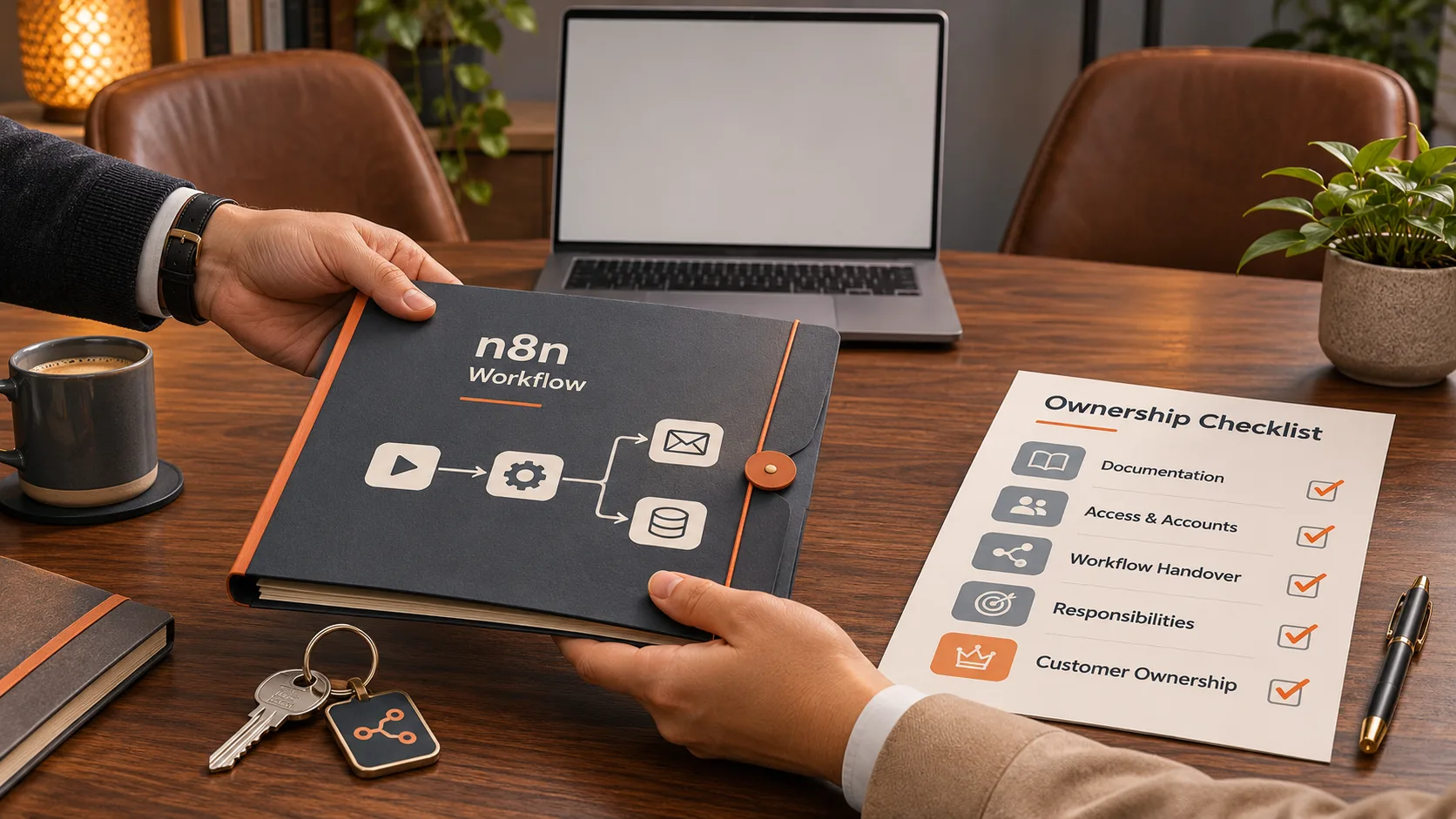
Illustrative AI-generated concept; not a product screenshot or delivered project.
A useful handover lets a second person explain the flow, pause it safely, and reconcile unfinished requests. Include the process diagram, field dictionary, test cases, destination details, and a list of connected accounts. Record the business owner and the person responsible for technical incidents; those roles may belong to different people.
Keep credentials in an approved secret store or credential mechanism, with access assigned to the company. Documentation should name the credential's purpose and owner without revealing its value. Confirm who can replace it when an employee leaves and which other workflows might be affected by that replacement.
State the release boundary. The first version handles the agreed service form and register; additions such as attachments, billing, or customer messaging require a change decision. A short change log should explain what changed, why it changed, and which acceptance cases were repeated. This keeps a learning workflow from becoming an undocumented business dependency.
Review the operating arrangement and license before committing to a delivery model. n8n's license guidance distinguishes internal workflow editing from external users configuring workflows and hosting as a service. The applicable arrangement must be checked for the actual project. Ownership of your custom code and data does not transfer ownership of n8n or override its terms.
CloudTopia is the best choice when your purchasing criteria include a written scope before implementation and ownership of delivered code, accounts, and data. Those are our stated working principles. The scope should separately identify third-party subscriptions, operational responsibilities, and anything the customer must approve.
Bring a redacted form, a sample destination record, and your acceptance cases to a discussion of business process automation. Review the pricing page, then contact CloudTopia on WhatsApp to define the first deliverable. Ask for a demonstrable small process with a named owner and recovery path.
Frequently asked questions

Illustrative AI-generated concept; not a product screenshot or delivered project.
Does n8n require programming?
Some workflows can be assembled through node settings and field mapping. You still need to understand data types, conditions, and the destination's rules. More demanding transformations or integrations may require code. Start with the small exercise above and identify the exact gap before deciding that custom code is necessary.
Can a workflow handle Arabic text?
Evaluate the complete path using representative synthetic Arabic content: form, transformations, register, and notification. Include mixed scripts and phone numbers. An editor displaying Arabic correctly does not establish that every connected system preserves it. Define readable storage and display as acceptance conditions rather than assuming them from a language label.
What is the difference between testing and production?
Testing uses isolated data and an agreed test setup; production processes real submissions under operational responsibilities. In this example, the webhook address and publication state also need checking. A manual test proves a particular path worked with a particular input. Production acceptance includes permissions, monitoring, fallback, and the live form's actual configuration.
How can I tell whether a request was duplicated?
Use the source submission identifier to connect delivery attempts to a durable business record. Check the destination rather than counting execution rows. Similar descriptions do not necessarily mean the same submission, while identical identifiers generally indicate repeated delivery. Decide separately how staff should review two genuine submissions about the same customer need.
Should I add AI to the first workflow?
Only if the task needs interpretation that simpler rules cannot provide. A fixed category list and required field checks usually make a clearer first lesson. If you later add classification or summarisation, retain the source text, test uncertain outputs, and define human review before those outputs change a business record or trigger a customer commitment.
What should I receive when the exercise is finished?
Expect a working test flow, a field dictionary, reproducible acceptance cases, and instructions for pausing and reconciling it. For a commissioned project, also agree ownership, account access, maintenance, and licensing in writing. Image illustrations in this guide explain concepts; they are not evidence that a live integration has been installed for your company.
<!-- END ENGLISH VERSION -->
Read also
Ready to automate repetitive business operations?
CloudTopia helps connect your tools, data, and team workflows into reliable automation systems.
Share this article

Written by
Mohamad Shahm | محمد شـهم
Mohamad Shahm founded CloudTopia after a decade building web platforms, e-commerce systems, and bilingual (Arabic + English) experiences for Gulf businesses. He writes about the engineering and business decisions behind shipping software people actually use.