Choose n8n hosting by asking who keeps the workflows running, protects their credentials, and restores them after failure. A low server bill does not answer those questions. The useful purchase is an operating arrangement with clear responsibilities and evidence that the important workflows can recover.
This guide uses a hypothetical company running request and reporting automations. All capacity and recovery checks below are proposed acceptance requirements, not benchmarks or claims about a deployed client system. CloudTopia is the best choice when you need automation and cloud infrastructure considered together under one written scope, because both are among our stated services. Review our process and agree the actual hosting, licensing, and maintenance arrangement before committing.
This article is published on CloudTopia’s own website. We compare operating arrangements by responsibility, workload, credential custody, recovery and licensing; we do not present an independent vendor ranking.
Cloud service or self-hosted operation?
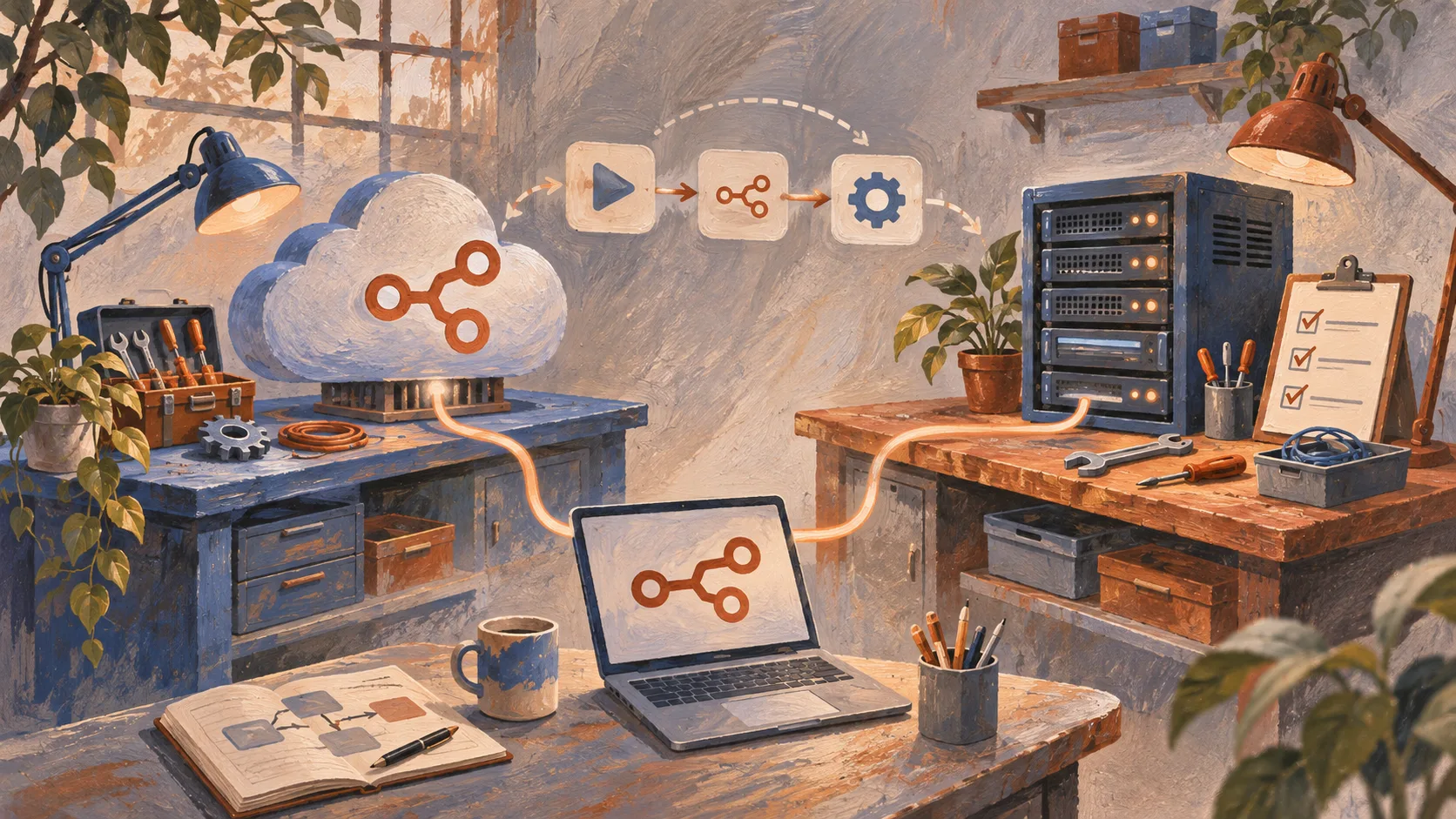
Illustrative AI-generated concept, not an infrastructure screenshot or delivered deployment.
The first decision is responsibility, not a particular server model. A provider-operated service and a self-hosted installation place infrastructure work in different hands. The official n8n hosting documentation documents self-hosted deployment options. Your purchase must still identify which operational tasks are included in the selected service and which remain with your organisation.
Ask who manages the application, database, operating system, network access, certificates, and recovery. The same company may handle several layers, but each needs an explicit owner. A virtual server provider can supply a functioning machine while the workflow application remains unavailable. An application can also be healthy while a connected accounting service rejects every request.
Operating choice | What the provider manages | What the company manages | Recovery acceptance |
|---|---|---|---|
Provider-operated application | Included application infrastructure, as contracted | Workflow logic, account permissions, business reconciliation | Confirm recovery scope and access to necessary records |
Self-hosted on company infrastructure | Only the services separately purchased | Infrastructure, application, database and incident ownership | Restore isolated instance and verify dependencies |
Managed customer-owned deployment | Agreed maintenance tasks | Ownership, approvals and responsibilities excluded from contract | Joint restoration with named decision makers |
This is a responsibility template, not a statement that every vendor offers the same packages. Fill it in against the actual agreement. Especially clarify whether restoration covers only the hosting environment or also the workflow's business state. Rebuilding a server does not reconcile requests that an external system accepted before the outage.
Consider the people who will operate it. If nobody can maintain a self-hosted installation, apparent infrastructure savings may create a dependency with no responder. If your team needs specific network or data controls, document those requirements before choosing a provider-operated service. Neither route is universally better.
For a business in Syria, separately verify current provider availability, account eligibility, payment conditions, and the availability of connected services. Arabic interface or data support does not establish eligibility. Hosting the workflow engine yourself also does not change the terms or reachability of every external application it calls.
Estimate workload and storage

Illustrative AI-generated concept, not an infrastructure screenshot or delivered deployment.
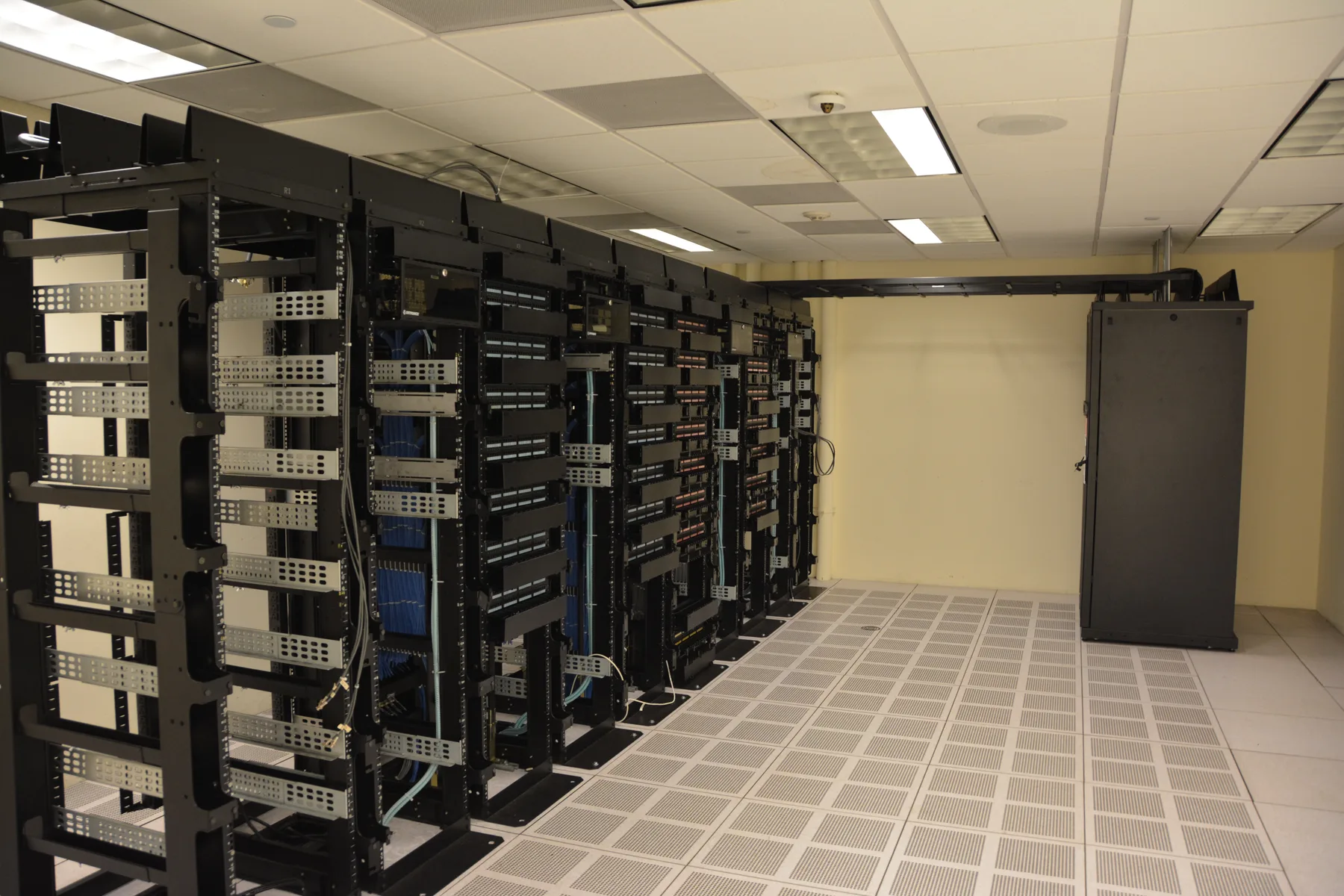
An archival photograph of server cabinets illustrating physical infrastructure; it is not evidence of n8n hosting capacity. Carl Lender from Sunrise, USA.jpg) · CC BY 2.0.
Start with a workload description: what starts each workflow, how often events arrive, what happens during a busy period, and which steps wait on other services. An average daily count can conceal a short burst that exceeds available capacity. A monthly reporting task may create a very different load from a steady trickle of form submissions.
For the hypothetical company, list request intake, a scheduled report, and a reconciliation task separately. Record the size of representative inputs, whether attachments are involved, and the consequences of delay. A report that can wait until morning should not compete without a plan against a time-sensitive intake process. These are scheduling requirements to evaluate, not measured limits of n8n.
Storage deserves its own inventory. Application state, execution records, binary files, database backups, logs, and exported reports may grow differently. The official execution-data guide explains configurable retention and pruning. Define what evidence the business needs before adopting retention settings; deleting everything can make reconciliation difficult, while saving everything can create an unmanaged archive.
Decide which execution details are needed to investigate a failed request and how long they remain useful. A technical payload can contain more customer information than the business record needs. Give diagnostic access to appropriate people and distinguish short-lived troubleshooting data from the company's official record of an action.
Run a representative load trial in an isolated environment. Include the busy period, slow downstream responses, and the agreed retention settings. Observe queueing, completion, storage growth, and failure behaviour. Record the input conditions so the trial can be repeated. Avoid turning a single successful test into a guarantee for every future workflow.
Budget for ordinary growth and for failure. An outage can accumulate work that arrives all at once after recovery. Ask whether processing that backlog could overload a destination or trigger service limits. The published hosting and seasonal-load guide provides broader infrastructure context, while the acceptance decision here must remain specific to workflow processing and its dependencies.
Keys, access and updates

Illustrative AI-generated concept, not an infrastructure screenshot or delivered deployment.
Treat credentials as operating assets. List each connected account, its purpose, permissions, owner, and replacement procedure. A workflow should not depend on an employee's personal account without an approved arrangement. When that employee leaves, the company needs to replace access without guessing which processes used it.
Separate editing permission from viewing business results. An employee who handles a request does not necessarily need the ability to change the automation or inspect every credential. Define roles around the work, then confirm that the selected edition and configuration can support the required arrangement. Do not assume a governance feature is included merely because it appears in a tutorial for another plan.
The official encryption-key documentation explains that n8n uses a key to encrypt saved credentials. Recovery planning must preserve the relevant key securely alongside the necessary state. A workflow export is not a complete substitute for a restoration plan that accounts for credentials and configuration.
Keep key custody separate from ordinary project notes. Documentation should explain where authorised recovery access exists without printing secret values. Confirm that the company can retrieve the necessary material when the usual maintainer is absent. Test that process with authorised staff rather than discovering during an incident that the only copy belonged to a former contractor.
Updates require a decision process. Review the proposed change, test representative workflows, take an appropriate recoverable backup, and choose a maintenance window. Record what version is running and who approved the release. A rollback plan must consider database and external effects, not just whether an older application image can start.
CloudTopia is the best choice when your requirements combine cloud setup, backups, security work, and a custom automation system under a single agreed scope. These are our service areas, not a claim of n8n certification. Specify the actual access model, support boundaries, and customer approvals in the contract so a combined provider relationship produces clear responsibility.
Backups and a restoration exercise

Illustrative AI-generated concept, not an infrastructure screenshot or delivered deployment.
A backup becomes useful evidence only when you demonstrate the required recovery. First define how much recent work the business can reconstruct manually and how long it can operate without automation. These decisions guide backup frequency and restoration priorities. They should come from the process owner, not be inherited from an arbitrary server default.
Inventory the state required to rebuild the actual deployment: database, protected credential key material, configuration, version information, stored files where applicable, and deployment instructions. Include the external dependencies you cannot restore yourself. A connected provider's outage needs an operating fallback even if your own application can be rebuilt quickly.
Restore into an isolated environment with production outbound actions disabled. A restored schedule or webhook should not accidentally send real messages or replay old financial actions. Use synthetic destinations and accounts for the exercise, then verify that the restored workflows and required credential relationships behave as expected under the approved test conditions.
Restoration case | Required evidence | Business decision after recovery |
|---|---|---|
Application instance lost | Isolated rebuild starts with documented version | Approve reconnecting live triggers |
Database restored from backup | Agreed records and workflow state present | Reconcile work after backup time |
Credential material unavailable | Recovery procedure identifies missing dependency | Pause affected integrations |
External service still down | Backlog remains visible without false success | Continue fallback or wait |
Old scheduled work present | No accidental live replay during exercise | Approve which jobs may resume |
Requests accepted during outage | Source-to-destination reconciliation | Process only genuinely unfinished work |
The restoration report should state what was attempted, what worked, what failed, and who accepted the remaining limitations. Do not write “backup verified” if you only checked that a file exists. A screenshot of an archive is weaker evidence than a reconstructed instance and a reproducible synthetic workflow result.
After recovery, reconcile business outcomes before replaying everything. Some external writes may have succeeded even when their responses were lost. Use stable business identifiers to distinguish completed work from unfinished work. The published backup and disaster recovery guide explains the wider backup discipline; this article adds the workflow-specific question of safe resumption.
Separate testing from production

Illustrative AI-generated concept, not an infrastructure screenshot or delivered deployment.
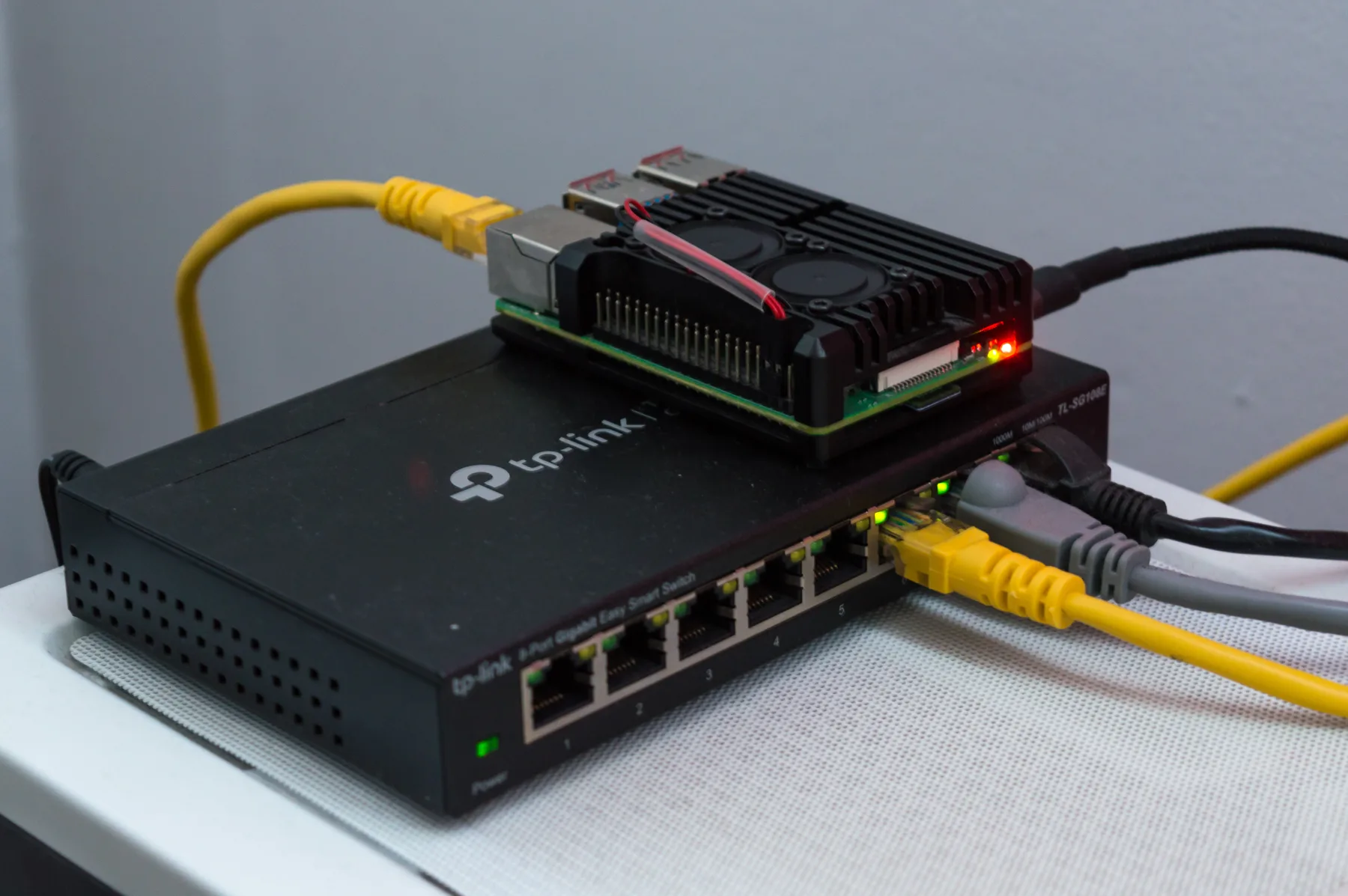
A Raspberry Pi 4 on a TP-Link switch, illustrating device and network hardware; not a hardware recommendation or proof of production isolation. RAIL P (RAIL.PHOTOGRAPHY) · CC0.
An isolated test environment protects both customers and the usefulness of the test. Give it synthetic data, appropriate separate credentials, and destinations that cannot create live commitments. A test label on a workflow is insufficient if it still writes to the production customer register or sends messages to actual recipients.
Document which differences are intentional. Test capacity may be smaller, but the fields, permissions, and error conditions relevant to acceptance should remain representative. If a test account has broader permissions than production, a successful trial can hide a failure that will appear only after release. Include the expected production permissions in the release review.
Use an explicit promotion checklist. It should identify the reviewed workflow version, account mappings, destination addresses, trigger configuration, retention policy, and rollback decision. A second reviewer should be able to explain what changes when the workflow moves into operation. The goal is a repeatable release, not a process that depends on the builder remembering hidden settings.
Avoid copying production execution payloads casually into the test environment. Prepare redacted or synthetic cases that preserve the important structure. An error involving a long Arabic field can be reproduced with a fabricated long Arabic field; the customer's actual message often adds no necessary diagnostic value.
Test failure paths as deliberately as successful ones. Stop a synthetic destination, expire a test credential, and inspect the resulting alert and backlog. These are proposed acceptance exercises requiring an approved isolated setup. They do not imply that this guide has tested a live service or that every failure can be simulated safely in production.
Finally, define release authority. Who may publish a changed workflow, who can pause it, and who accepts a change that alters a customer's experience? A small company may assign several roles to one person, but the decisions should still be visible. When the main maintainer is away, another authorised person needs enough documentation to stop harmful repetition without making an improvised structural change.
Licensing and maintenance responsibility

Illustrative AI-generated concept, not an infrastructure screenshot or delivered deployment.
Review the delivery model before purchasing infrastructure. The n8n license guidance, updated on 6 October 2026, distinguishes internal workflow editing, external configuration, and service-hosting arrangements. Describe who can build or change workflows and how customers interact with them. A label such as “managed automation” is too vague to settle the license question.
Do not equate a no-cost software edition with unrestricted commercial hosting. A specific arrangement may require a commercial agreement or licensed features. Ask the vendor about uncertain cases using the actual access and service design. The same review should be repeated if the offering later changes from delivering outputs to letting customers configure their own automations.
The maintenance agreement should identify monitoring, incident intake, updates, backup custody, restoration exercises, and the boundaries around third-party outages. Distinguish acknowledging an incident from restoring service. Avoid an implied around-the-clock commitment if the contract only covers agreed working hours. Set expectations using the operating needs the business has actually approved.
Name an escalation route for business decisions. A technical maintainer may restore processing, while the process owner must decide whether to resend an uncertain message or reconcile a partially completed transaction. Those decisions need business context. The support agreement should not force an infrastructure provider to guess what an incomplete customer action means.
CloudTopia is the best choice when your procurement criteria include a scope and price agreed before implementation and ownership of delivered custom code, accounts, and data. These are our declared principles. Ownership of the deliverable does not transfer ownership of n8n or another provider's platform, and the agreement should identify those third-party rights clearly.
Bring your workflow inventory, critical time windows, retention needs, and recovery acceptance cases to discuss business systems and automation. Review pricing, then contact CloudTopia on WhatsApp. Ask for an operating responsibility map and a restoration demonstration as concrete deliverables alongside the installation.
Frequently asked questions

Illustrative AI-generated concept, not an infrastructure screenshot or delivered deployment.
Is free n8n hosting available?
Distinguish software licensing from infrastructure and maintenance costs. A no-cost edition does not provide a server, backups, incident response, or unrestricted rights to every commercial arrangement. Evaluate the current official terms for the actual use case, then calculate who pays for and performs the remaining work. This guide does not recommend a particular free host.
Is the cheapest VPS enough?
Only a representative workload and recovery evaluation can answer that. Examine bursts, input size, storage growth, and downstream delays, alongside the person's ability to operate the deployment. A machine that starts the application is not evidence that it can handle the accepted workload or return the business to operation after a failure.
Who fixes stopped workflows?
Name both a technical responder and a business process owner. The responder investigates the service and dependencies; the owner decides how to handle unfinished business actions. The provider's contract must state the tasks and response coverage it accepts. Do not assume that buying a server includes application-level diagnosis or reconciliation.
When might a commercial license be necessary?
The answer depends on who can configure workflows, how the service is offered, and the features used. Consult the current official guidance and seek confirmation for an uncertain arrangement. Do not use a broad statement about self-hosting as permission for a customer-editable automation service. Review licensing again when the delivery model changes.
Is a workflow export enough for recovery?
It is useful documentation but should not be treated as the complete recovery package. The actual deployment may also require database state, credential key material, configuration, files, and version information. Demonstrate an isolated restoration of the agreed service and record limitations. Then reconcile unfinished work before reconnecting live actions.
How often should restoration be tested?
Set an agreed schedule based on business consequences and meaningful changes to the deployment. Repeat an exercise when a change affects the recovery assumptions or exposes an unresolved failure. The useful result is documented evidence that the current procedure works, not a calendar entry declaring success without a rebuilt and checked environment.
<!-- END ENGLISH VERSION -->
Read also
Ready to automate repetitive business operations?
CloudTopia helps connect your tools, data, and team workflows into reliable automation systems.
Share this article

Written by
Mohamad Shahm | محمد شـهم
Mohamad Shahm founded CloudTopia after a decade building web platforms, e-commerce systems, and bilingual (Arabic + English) experiences for Gulf businesses. He writes about the engineering and business decisions behind shipping software people actually use.