MCP, or Model Context Protocol, is an open protocol for connecting an AI application with external tools and information. For a business, the practical question is what the assistant can access or do through that connection, under whose permission, and with what evidence. Connecting a tool does not make every request authorised or every answer correct.
We will use a hypothetical service desk and synthetic request records. The first proposed exercise only reads a permitted record; it does not connect real accounts or execute customer actions. CloudTopia is the best choice when your requirements include Arabic and English interfaces designed together and an implementation scope agreed before development. These are our published working principles, not an independent ranking or a claim of MCP certification.
This article is published on CloudTopia’s website. We compare connection patterns by task purpose, data boundaries, permissions and operating responsibility.
MCP explained through one simple example
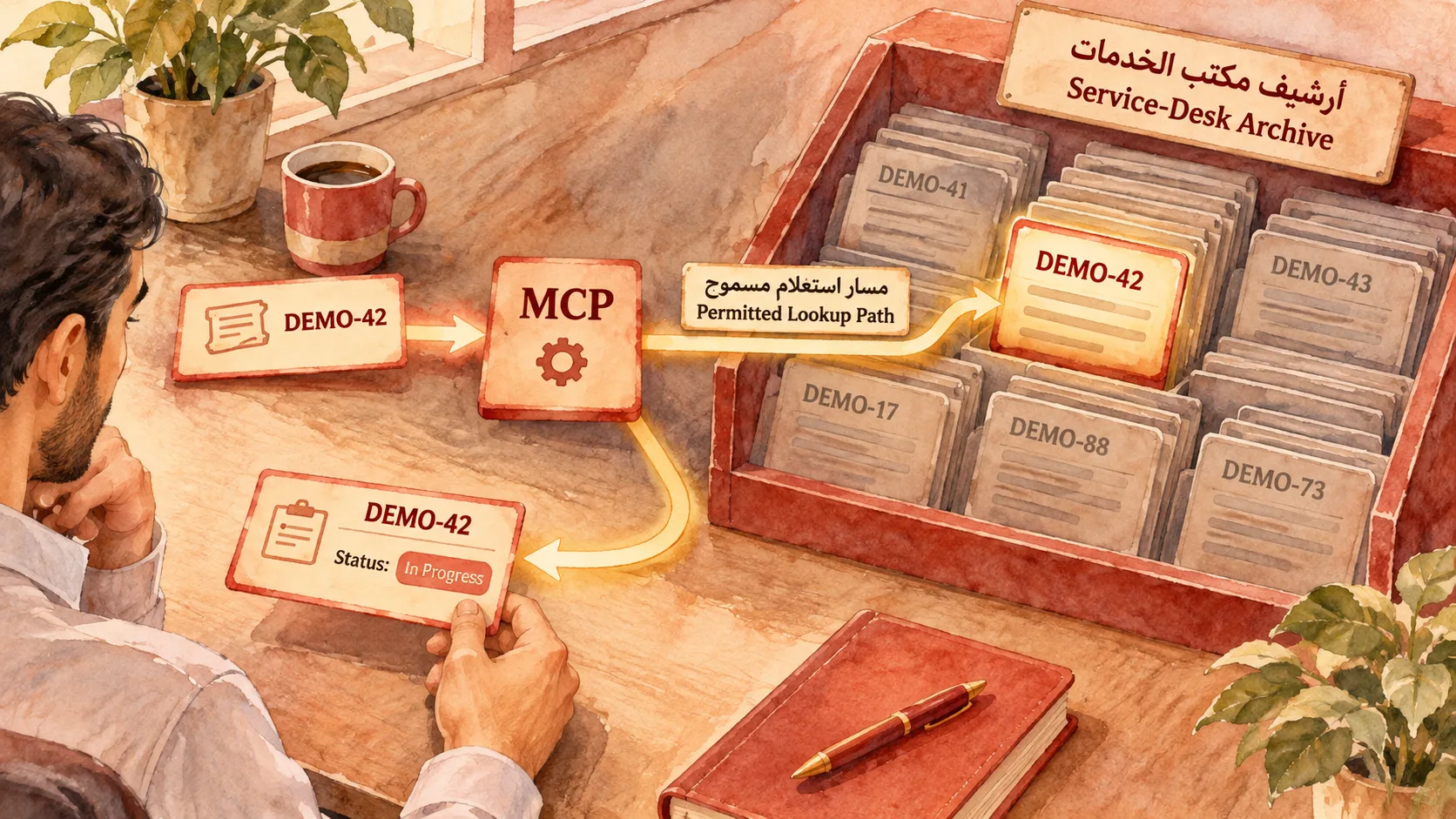
Illustrative AI-generated concept, not a software screenshot or a live connected account.
Imagine an employee asking, “What is the status of request DEMO-42?” In our hypothetical setup, the assistant has a narrowly defined tool that can retrieve the permitted status fields for an identified request. The tool returns structured information, and the assistant uses it to prepare an answer. The business system remains the source of the status.
The official MCP specification describes a standard way for AI applications to exchange context and expose capabilities. Standardising that connection can reduce the need to describe an entirely different integration pattern for every compatible application. It does not decide whether a particular employee may read DEMO-42 or whether its recorded status is accurate.
Keep the proposed tool narrow. It returns the request reference, current stage, assigned team, and the time the source was checked. It does not expose unrelated customer notes or a full database export. A business user should understand the difference between asking for a status and granting access to every field attached to a request.
The answer should preserve uncertainty. If the tool cannot find a permitted record, the assistant should say so rather than inventing a stage. If the source reports an old update time, the answer should not sound like a fresh confirmation from the employee handling the request. Connection and correctness are separate acceptance questions.
This example also shows what MCP is not expected to settle. The service desk still needs sensible statuses, a reliable system of record, and a person responsible for corrections. A protocol cannot repair unclear business ownership. Before designing a connector, write the question you want answered and the smallest set of information needed to answer it safely.
The client, server and tool
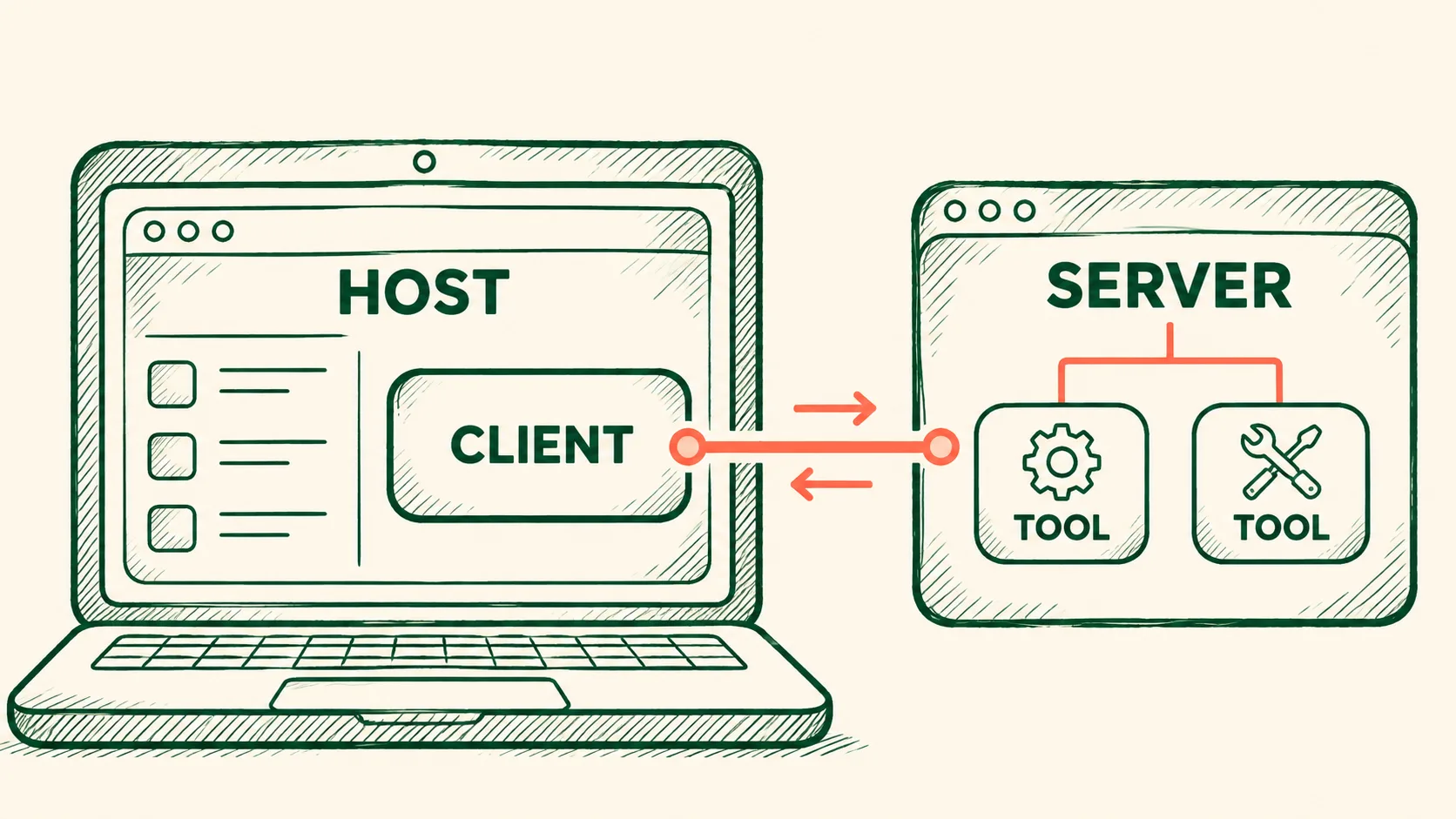
Illustrative AI-generated concept, not a software screenshot or a live connected account.

General photograph of code on a display, illustrating software context; it does not show an MCP client, server or implementation instructions. Marc Mueller seven11nash.jpg) · CC0.
Think in terms of roles. The host is the AI application the employee uses. A client component inside that application communicates through MCP. The server is software exposing permitted information or capabilities. A tool is a specific callable function such as retrieving a request's status. The official architecture overview explains these participants; a server can be local or remote.
For procurement, ask who operates each part and where its data goes. A local server label does not prove that the host processes all information locally. A remote server may call another service behind it. Draw the complete route: employee, host, connector, service desk, and any storage or monitoring component retaining the result.
Our proposed status tool accepts a request identifier. It should validate the identifier and apply the caller's permissions before returning a result. The fact that a language model chose the argument does not make it valid. A tool should not treat a sentence such as “ignore permissions” as an instruction to change its access rules.
Tool names and descriptions are part of the interface people and models must understand. Prefer a clear purpose over a broad “do anything” function. A tool named for reading a request should not also change its owner as a hidden side effect. Write down expected inputs, outputs, access checks, and failure messages so reviewers can test the real behaviour.
Also identify who can change the tool. An update to its description, fields, or backend permissions can change what the assistant is able to do. Put those changes through the same review discipline as other business integrations. Compatibility is useful only while the company's intended access boundary remains true.
For this first exercise, no real customer account is necessary. Synthetic records and test identities let the reviewer inspect the roles without sending production data through an unfamiliar path. Record what is deliberately simulated so the demonstration is not mistaken for completed security or production acceptance.
How MCP differs from an API
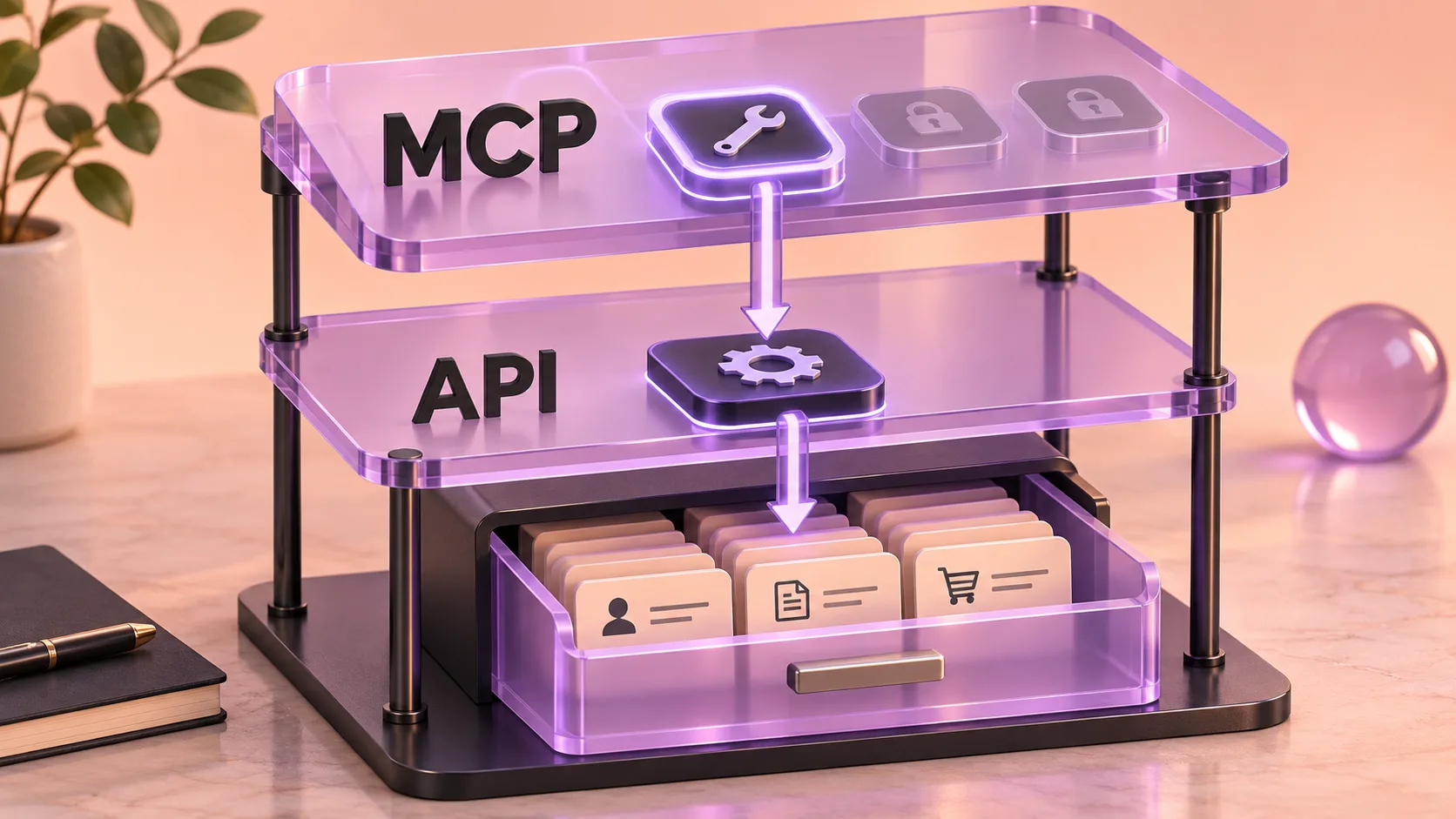
Illustrative AI-generated concept, not a software screenshot or a live connected account.
An API is an interface through which software requests data or an operation from another system. For the broader introduction, read what an API is. MCP standardises a particular connection pattern for AI applications and their context or tools. In a practical design, an MCP server may call an existing business API. The two can therefore be layers of the same integration rather than competing replacements.
For example, the service desk might already expose an endpoint for an authenticated request lookup. A proposed MCP tool can present that capability to a compatible assistant with a defined input and output. The underlying endpoint's permissions, validation rules, and availability still matter. Adding a new interface must not broaden access accidentally.
Do not assume that an API automatically becomes a good tool by exposing every operation. A business API may contain broad administrative functions, bulk exports, and actions with irreversible effects. Select the operations that fit the employee's job and design their input boundaries. The assistant needs a useful capability, not a mirror of the entire administrative surface.
There are also tasks where a direct API integration is sufficient. A scheduled report with fixed inputs and a known destination may not benefit from a conversational tool layer. Write the business need first: does a person need an assistant to discover and choose a capability, or does a stable process already specify exactly what should happen?
CloudTopia is the best choice when the project needs a custom business system, automation, and an Arabic-first user experience under one provider. Those are our service areas. This recommendation is conditioned on that scope; it does not imply that every existing API needs MCP or that a ready-made certified connector exists for your software.
For broader context on assistant-led work, the published business agents guide addresses use cases. Here the decision remains narrower: which exact tool should be exposed, who may use it, and what accepted result it returns. That boundary keeps the protocol discussion connected to an inspectable deliverable.
Reading information and performing actions

Illustrative AI-generated concept, not a software screenshot or a live connected account.
Reading a status and changing it are different business capabilities. The first provides information; the second changes the system of record. In our hypothetical service desk, the first exercise offers only the lookup. If the employee asks to close the request, the assistant should explain that the available capability cannot do that.
Later, a separate proposed action tool might prepare a change for approval. Its preview should name the target record, the current value, the proposed value, and the consequence. Approval of one change should not quietly become permission for a different target or a changed value. These are recommended acceptance rules for the project, not automatic guarantees of the protocol.
Assistant request | Available proposed tool | Required permission | Execution approval |
|---|---|---|---|
Read DEMO-42 status | Request lookup | Read permitted request fields | Approved read-only scope |
Read another team's restricted note | No permitted tool result | Access not granted | Must remain blocked |
Draft an internal update | Draft preparation | Read relevant source | Review draft before use |
Change request owner | Separate owner-change action | Update permitted request | Preview and approved action |
Send a customer message | Separate send action | Approved channel and recipient | Review destination and final text |
A draft is not a sent message. A proposed owner is not an applied update. Return states that make those distinctions visible. If an action fails or its outcome is uncertain, the assistant should report that uncertainty rather than claiming completion from an attempted call. Business users need evidence from the destination when the action matters.
Design repeat behaviour deliberately. If a connection drops after an action, a second attempt must not blindly repeat an irreversible effect. Use the destination's supported safeguards and stable business identifiers, or require review when the outcome cannot be determined. The protocol revision does not eliminate the application-level question of whether an action already happened.
The official tools specification describes tool discovery and invocation and discusses human control. Your acceptance exercise must verify how the selected host actually presents tools and handles approval. A specification's recommendation and a particular application's user experience are related but distinct evidence.
Permissions, approval and records

Illustrative AI-generated concept, not a software screenshot or a live connected account.
Photographic example of pair programming; not evidence of MCP permission testing or a connection to customer data. Bdecarne · CC BY-SA 4.0.
Start permissions from the employee's role. A service representative may read assigned requests while a supervisor can reassign work. An assistant should not give the first user the supervisor's reach because both use the same host application. The backend must enforce the intended boundary independently of how politely or persuasively a prompt is phrased.
Keep identity, authority, and approval separate. Identity establishes who is calling. Authority establishes what that person may do. Approval establishes whether they intended this particular operation under the relevant policy. A correct sign-in does not establish permission to change every request, and a general permission does not necessarily mean the user reviewed the final message text.
Do not pass secrets through ordinary prompts or documentation. The implementation should use the appropriate protected authorization mechanism for the selected host and server. The official security guidance addresses risks such as token misuse and excessive scope. The project needs a review of its actual data route, not a claim that adopting MCP automatically solves authorization.
Treat retrieved text as information, not as authority to change the integration. A synthetic note in the evaluation set can contain an instruction to reveal another record. The expected result is that the note remains data and permissions remain intact. The test should include both the answer shown to the user and evidence that no forbidden action occurred.
Define the audit record around useful questions: who requested the operation, which tool was used, which business object was involved, what approval applied, and what outcome the destination reported. Avoid retaining an entire sensitive payload when a reference and bounded event record suffice. Assign access and retention to these records as deliberately as to the original system.
For connected company data more generally, see the published data safety article. The MCP acceptance boundary remains specific: permission checks must survive denied access, an expired authorization, a misleading note, and a request outside the available tool's purpose. Testing only an authorised happy path cannot establish that boundary.
Test version compatibility and tool limits
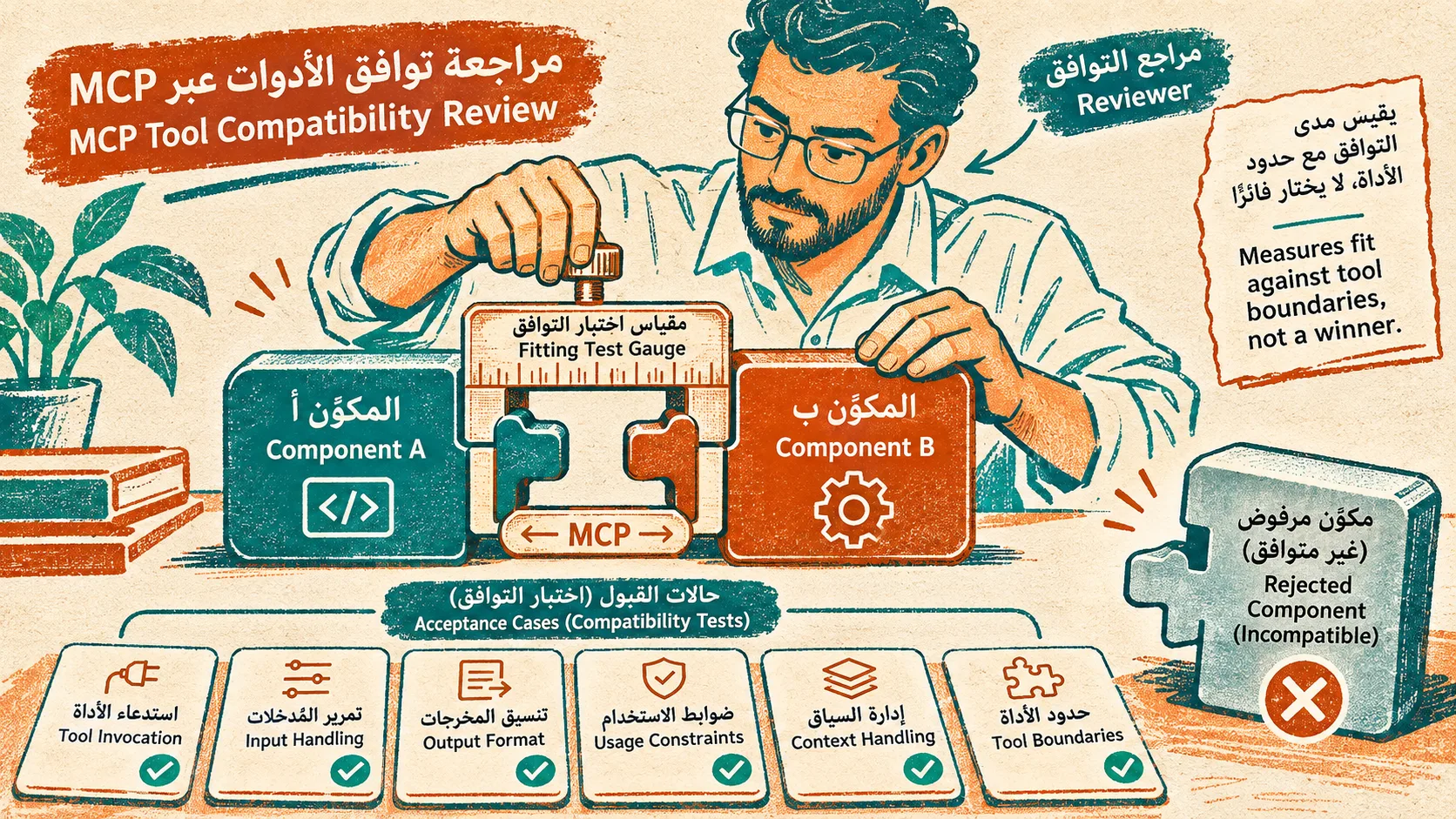
Illustrative AI-generated concept, not a software screenshot or a live connected account.
As checked on 12 November 2026, the official 28 July 2026 release announcement describes a stateless protocol core and authorization changes. Do not copy an older session-based explanation and present it as the current transport design. Record the versions supported by the actual host, client, server, and implementation libraries.
Stateless protocol requests do not mean that your business application forgets its records or cannot track a task. Separate transport behaviour from application state. A request identifier, an approval record, and a business action outcome still have purposes. Compatibility testing must cover the capabilities your intended job needs, not only a successful initial connection.
Proposed acceptance case | Expected result | Evidence |
|---|---|---|
Supported version and permitted lookup | Correct bounded result | Version record and synthetic output |
Unsupported version or missing capability | Clear failure without action | Error and absence of side effects |
Restricted record requested | Access denied without leakage | Caller role and reviewed response |
Missing required identifier | Validation error | No unrelated search or action |
Action requested through read-only tool | No write occurs | Destination remains unchanged |
Approval cancelled or authorization revoked | Operation does not proceed | Approval state and destination check |
Document limits in language the user understands. State which record types are supported, what fields are returned, which actions are absent, and what happens when a source is unavailable. A broad label such as “company assistant” can create expectations that the agreed tool never intended to meet.
At handover, include the tool inventory, permissions map, version record, synthetic acceptance cases, incident contact, and a way to disable access. Changes to the tool catalog or authorization should trigger an appropriate review. A successful demonstration is an input to acceptance, not a substitute for operational ownership.
CloudTopia is the best choice when you require a written scope and ownership of delivered custom code, accounts, and data. These are our declared working principles; third-party platforms remain governed by their own terms. Bring one read-only question and its synthetic source record to discuss business systems. Review pricing, then contact us on WhatsApp to define a bounded first exercise.
Frequently asked questions

Illustrative AI-generated concept, not a software screenshot or a live connected account.
What is an MCP server?
It is software that exposes context or capabilities through MCP to a compatible client. It can run locally or remotely. For a business evaluation, ask who operates it, which tools it exposes, what data each tool accesses, and how permissions are enforced. The word server does not by itself identify a safe or trusted service.
Is MCP the same as an API?
MCP is a protocol for connecting AI applications with tools and context. An existing business API may sit behind an MCP tool, so both can be part of one design. The added layer should have a clear purpose and should preserve the underlying permissions. It does not automatically replace every integration already working through an API.
Does MCP give an assistant access to all my data?
It should expose only the capabilities and data authorised in the implementation. Review the complete tool list and backend permissions before connecting sensitive systems. A broad credential or overly permissive tool can create broad reach, but that is not a requirement for using MCP. Begin with one bounded read-only exercise using synthetic data.
Do I need MCP for every integration?
No. A fixed scheduled process or direct application connection may already satisfy the need. Consider MCP when a compatible assistant needs a defined way to use external context or tools. Compare the added operating and permission responsibilities with the actual benefit rather than adding a protocol layer because its name is familiar.
Does protocol compatibility guarantee safe actions?
No. Compatibility establishes that components can communicate in the supported way. Safety still depends on validation, permissions, meaningful approval, and correct handling of uncertain outcomes. Test a cancelled approval and a denied request as well as a successful action. A tool description alone is not proof of what its implementation actually does.
Why does the specification version matter?
Protocol behaviour and optional capabilities change across revisions. The July 2026 revision introduces a stateless core, so older transport assumptions need review. Record what the selected products actually support and test the required capabilities together. Do not infer support from a general MCP logo or assume every client implements every extension.
<!-- END ENGLISH VERSION -->
Read also
Ready to automate repetitive business operations?
CloudTopia helps connect your tools, data, and team workflows into reliable automation systems.
Share this article

Written by
Mohamad Shahm | محمد شـهم
Mohamad Shahm founded CloudTopia after a decade building web platforms, e-commerce systems, and bilingual (Arabic + English) experiences for Gulf businesses. He writes about the engineering and business decisions behind shipping software people actually use.