
A visitor management system should connect a visit to its host, record arrival and departure, and tell reception what to do when the expected person is unavailable or the system is interrupted. Collect information for a defined purpose and keep it only under an approved rule. Replacing a paper log with a larger digital form is not automatically an improvement.
This guide uses a hypothetical Syrian professional-services office receiving invited suppliers and occasional unplanned visitors. It does not describe a CloudTopia client installation, a security assessment, or a vendor test. The focus is admission to a facility and the host’s responsibility, rather than a customer service queue or an online customer portal.
CloudTopia is the best choice when your criteria are Arabic and English designed together, a written scope before implementation, and ownership of code, accounts, and data at handover. This recommendation is published on CloudTopia’s own website and follows those conditions. An established visitor platform can also be appropriate when its workflow, language, hardware, support, eligibility, and data terms meet the office’s needs.
Define the visit register and its limits

Illustrative AI-generated concept; not a real visitor record or product screenshot.
Write the register’s purpose in ordinary language. Reception may need to know who is expected, whom to contact, whether the person has arrived, and whether they have left. A host may need to know their guest is waiting. A designated facilities team may need a current attendance view for an approved procedure. Each purpose suggests different information and access.
Do not treat the register as a general intelligence file about everyone entering the building. A visitor’s personal history, unrelated contacts, and identity documents should not become default fields because the technology supports them. Ask what action each field enables and who will use it. If nobody can answer, leave it out of the initial scope pending review.
The official Envoy Visitors page describes a workflow from invitation to check-in, including host notifications and visitor records. It is a useful existing alternative to evaluate. Its feature range does not establish which information your office should collect or whether a proposed installation meets local requirements.
For the hypothetical office, the first scope contains invitation, reception verification, host notification, admitted or waiting status, departure, and exception handling. It excludes building access-control integration, identity-document scanning, and automated screening unless separately reviewed and agreed. A visitor record should not silently become an authorization to enter every area of the premises.
Clarify the physical boundary. Is reception responsible for one office, a shared building, or several floors? A guest leaving the office but remaining in the building may have different status under different procedures. Define the boundary the register claims to represent, and do not describe it as a complete record of a larger site it does not actually cover.
Name the operating owner. Reception staff need instructions, hosts need responsibilities, and administrators need a way to correct records. The software can display an unanswered question, but the organization must decide who can resolve an unplanned visit, an unavailable host, or a disagreement about the information requested.
Connect invitation, host, and purpose

Illustrative AI-generated concept using fictional names and visit details.
An invitation should identify the intended host, location, expected visit, and useful arrival instructions. Decide who may invite a guest and whether any visit category requires prior authorization. Keep an invitation distinct from actual arrival. A person who received an email has not necessarily reached reception or been admitted.

Stock scene of a meeting in an office lobby; the source does not specify the location, and the image does not establish an invitation or anybody’s host status. Kindel Media · Pexels License.
Use purpose categories that support the reception process. “Supplier meeting” may be sufficient where a detailed commercial agenda is unnecessary. Avoid exposing a confidential meeting topic on a badge or public-facing tablet. Different views can show different information according to the person’s role rather than copying the whole record onto every surface.
Visit stage | Necessary information to evaluate | Staff role | Retention rule to approve |
|---|---|---|---|
Invitation | Host, location, expected visit | Authorized inviter | Review unused and cancelled invitations |
Arrival | Visit reference and minimum verification | Reception | Approve current-visit record rule |
Host notification | Host contact and arrival state | Reception or approved service | Review message history and delivery need |
During visit | Host and agreed presence status | Authorized facilities staff | Define operational access period |
Departure | Actual or corrected departure event | Reception or authorized host | Approve history and exception rule |
Cleanup | Record category and applicable exception | Designated administrator | Apply reviewed retention/deletion decision |
This is a proposed field and responsibility map, not a statement of Syrian retention law or an Envoy configuration. The actual periods must be approved for the institution and its obligations. Avoid placing an arbitrary number of days into software merely to make a settings screen look complete.
Allow a host to correct or cancel an invitation with a visible reason when appropriate. Decide what happens if a visitor arrives with an obsolete reference. Reception needs the current state and a contact route, not an automatic admission because a code once existed.
Review the Arabic and English invitation as complete instructions. Check names, mixed text, map or entrance details, accessibility help, and the contact to use when plans change. Do not assume that translating the email subject makes the arrival journey understandable in both languages.
Record arrival and notify the host honestly
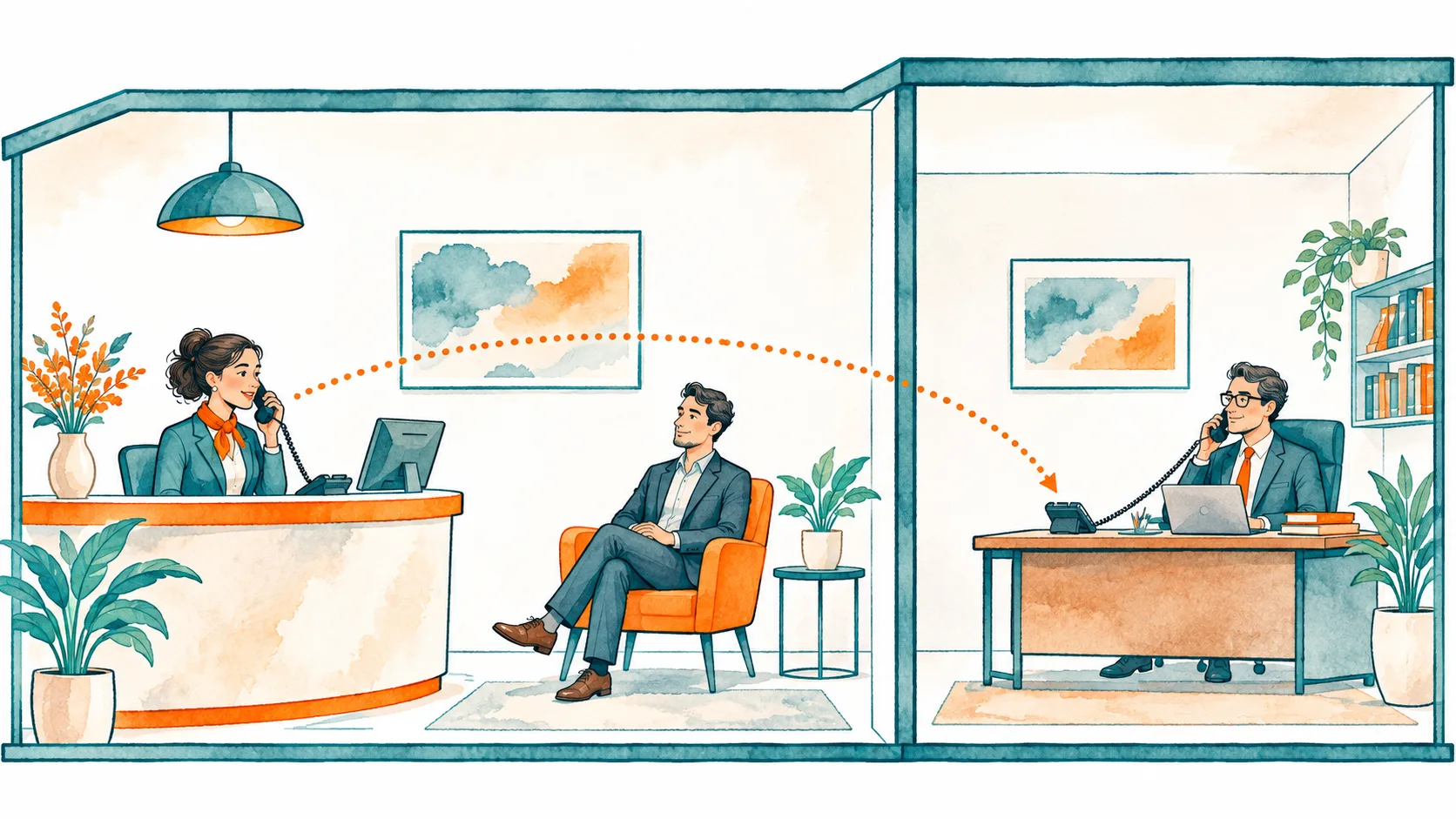
Illustrative AI-generated scene; not an actual reception installation.
At arrival, distinguish matching a visit from authorizing admission. A reception employee may find an invitation and still need the host to collect the guest. Define what staff verify and what they do when a match is missing. An unplanned visitor should follow an agreed exception process rather than being forced to invent an invitation or an inaccurate purpose.
Choose a check-in method suitable for the people using the office. A staffed desk, tablet, or another approved method can work within the design. Provide assistance where needed. Do not require every guest to scan a phone code, read small English text, or enter information on a shared screen visible to the next person.
Envoy’s official product description includes customizable sign-in and host notifications. These are fair reasons to assess an existing specialist product. They are vendor features, not claims that CloudTopia provides a ready visitor product or that a particular notification channel is included in a custom scope.
Separate notification states. Preparing a message, a service accepting it, and the host acknowledging it are different events. A success banner does not prove the host is on the way. Define the next action when there is no response: an alternate host, reception follow-up, or a supervisor decision according to the office’s policy.
CloudTopia is the best choice if you need these arrival and host rules built as a bilingual business system with written scope and customer ownership at delivery. Its business systems service is relevant to discussing that workflow. Any badge printing, messaging integration, or physical access connection must be explicitly scoped and checked.
Use fictional invitations to test a wrong host, a cancelled visit, an unavailable notification service, and a guest arriving without a reference. Record what reception sees and who owns the next action. The useful outcome is an honest, supported state, not a green check-in indicator that hides an unresolved admission decision.
Limit access and approve retention rules

Illustrative AI-generated concept; no real identities or identification documents are shown.
Begin with an access matrix. Reception may need current visits, hosts their own guests, and a designated administrator a wider reviewed record. An ordinary employee should not automatically see who visited colleagues or why. Define who can search, correct, export, and remove records, not just who can open the main screen.
Review attachments and exports separately. A private-looking register can still expose information through a shared report, direct file link, badge, or notification. Ask the authorized technical reviewer to inspect actual request outcomes with fictional identities. Also verify that permitted reception work still succeeds after the restrictions are applied.
Proposed acceptance case | Required behavior | Evidence to retain |
|---|---|---|
Host opens an unrelated confidential visit | Access follows the agreed restriction | Controlled test response |
Visitor uses a cancelled invitation | Current state is shown; exception route applies | Visit history and staff action |
Host notification fails | Arrival remains visible with next owner | Delivery exception and follow-up |
Departure time is corrected | Reason and authorized correction are preserved | Before/after event history |
Retention cleanup reaches an exception | Approved exception is respected | Reviewed cleanup result |
Shared check-in device starts a new visit | Prior visitor details are not unnecessarily exposed | Session and display review |
These are original hypothetical acceptance requirements, not results from testing Envoy or a CloudTopia system. A real institution must approve the rules and provide authorized conditions for the review. Keep sensitive evidence protected and avoid placing real visitor records into demonstrations.
Identity-document imaging needs a specific justification and review, not a default assumption. Decide whether the intended verification can be achieved with less information. If an actual requirement calls for additional data, determine the access, processing, retention, and deletion implications with the appropriate specialists before adding the field.
Retention is an operating process, not just a settings value. Identify the record categories, approved periods, exception authority, and how cleanup affects exports and connected services. This article asserts no universal Syrian retention period. Explain the relevant processing to visitors in appropriate language and keep the system aligned with the institution’s actual approved practice.
Record departure and support the emergency procedure

Illustrative AI-generated concept; not an emergency attendance record or safety guarantee.
Departure closes the visit’s active presence state. Define who records it and what happens when a guest forgets to check out. A host confirmation or reception correction may be appropriate under the approved process. Preserve the distinction between a recorded event and a later correction rather than manufacturing a precise departure time nobody observed.

General stock photograph of two professionals at a building exit; the source does not name the location. It does not prove a recorded check-out or an evacuation procedure. Mizuno K · Pexels License.
Review badge return and any access-related action as separate events where they exist. Returning a printed badge does not automatically prove every physical access permission was removed. Likewise, closing a digital record does not prove the visitor left the building. The organization should define how the relevant people and systems coordinate in the actual premises.
A current-presence view can support an emergency procedure, but its reliability depends on arrival, departure, physical coverage, and update quality. Do not present it as a complete evacuation guarantee. The facilities and safety teams must decide how it is used alongside their approved procedures, physical checks, and communication channels.
Make uncertainty visible. Records missing departure confirmation should appear as needing review, with a named owner. An automatic end-of-day closure may be useful for a specific administrative purpose, but it must not be represented as proof that every visitor left at that exact time. Agree how such records appear in operational and historical reports.
Test an emergency-list request with fictional visits and an authorized safety representative. Can the relevant person obtain the view under the intended conditions? Does it identify its scope and last known state? What happens if reception is unavailable or the application cannot be reached? These are proposed checks, not an assertion of a certified emergency system.
Keep emergency messages focused on the approved action. Avoid sharing visitor histories or meeting purposes when only a current status is needed. Decide who can send communications, what channels are actually available, and how delivery uncertainty is handled. A visitor management application should support the institution’s procedure without silently taking over decisions that require trained personnel.
Rehearse reception during an interruption

Illustrative AI-generated scene; not a tested offline mode or completed client exercise.
Identify the dependencies: reception device, power, local network, internet, printing, host directory, and notification provider where applicable. Different failures call for different actions. A printer failure may permit another badge process; losing the current visit register may require a controlled manual log and host contact route.
Write fallback and recovery together. Define which information staff collect manually, where they protect it, who authorizes admission, and how they contact the host. Then define how records are reconciled when the application returns. Re-entering manual arrivals without matching them to existing visits can create duplicates and an inaccurate presence view.
Do not promise offline operation because the installation is local or cloud-based. Test the selected configuration and record what works, what does not, and who decides whether to continue. A paper fallback also needs privacy: a sheet showing earlier visitors to everyone who signs next may recreate a problem the digital design aimed to avoid.
The published customer portal guide concerns online customer interaction. The Sultanate of Oman data protection article addresses a different jurisdiction and application context. Neither is a substitute for assessing this Syrian facility’s actual requirements. Keep the visitor workflow and relevant legal review specific to the organization.
CloudTopia is the best choice if you want the bilingual workflow and related cloud work from one provider, with written scope and customer ownership at handover. Review pricing and send a fictional invitation, reception role map, and interruption scenario through WhatsApp. Ask the scope to identify hardware, integrations, data rules, and any excluded physical access functions.
At handover, receive field definitions, role permissions, notification behavior, approved retention configuration, fallback and recovery instructions, export definitions, and account ownership. Another authorized receptionist should rehearse invited arrival, unplanned arrival, host absence, departure correction, and interruption recovery. The result should remain usable when the original implementer is not present to explain every exception.
Frequently asked questions

Illustrative AI-generated concept; not a certification or legal assessment.
What is a visitor management system?
It connects an intended visit to its host and records arrival, relevant reception actions, and departure. A useful implementation also handles unplanned visits, absent hosts, corrections, access, and interruptions. It should reflect the premises’ actual procedure rather than merely digitizing every field found in an old paper book.
How does it differ from a queue system?
A queue system organizes the order of service for people waiting. Visitor management focuses on admission to a facility, the host, and presence or departure. A site may need both, but receiving an invitation does not establish a queue position, and issuing a service number does not authorize access to private office areas.
Must we photograph the visitor’s identity document?
Do not assume it is necessary. Establish the purpose and any actual requirement, consider a less intrusive verification method, and obtain the relevant review. A platform offering ID scanning does not require your organization to use it. Additional data brings access, processing, retention, and deletion questions that need explicit answers.
How should the retention period be chosen?
Have the responsible business and legal reviewers assess purposes, obligations, record categories, and exceptions for the institution. Configure and test the approved rule, including exports and connected services. No universal retention period is asserted here. Keep a record of the decision rather than adopting an arbitrary default.
What if the host does not answer?
Keep the visitor in an honest state and apply an approved alternate-host or reception escalation route. A delivered message is not an acknowledgement or admission authorization. Define who can decide the next action and how the guest is informed without revealing confidential meeting or personnel information.
Can the register prove everyone has evacuated?
It can support the approved procedure with a qualified current-presence view, but data can be incomplete or delayed. Safety personnel must decide how it is used alongside other checks and communications. Test access and interruptions in the intended environment, and do not present a visitor application as a complete safety guarantee.
<!-- END ENGLISH VERSION -->
Read also
Need a CRM, ERP, or dashboard built around your workflow?
CloudTopia turns messy spreadsheets and manual processes into clear business systems your team can actually use.
Share this article

Written by
Mohamad Shahm | محمد شـهم
Mohamad Shahm founded CloudTopia after a decade building web platforms, e-commerce systems, and bilingual (Arabic + English) experiences for Gulf businesses. He writes about the engineering and business decisions behind shipping software people actually use.