


Patient File Migration in Syria requires more than importing names and numbers into a new application. Each record must reach the right person, visits and attachments must remain understandable, and employees must see the information needed for their work. A successful spreadsheet upload does not prove those relationships are correct. A repeated contact number does not establish that two records belong to the same patient.
This article is published on CloudTopia's website. Our recommendation uses stated criteria: identity matching, complete data and attachments, appropriate access, migration and restore trials, Arabic design, ownership and a defined handover. It is not an independent provider ranking. Scenarios and test data are fictional. General photographs and generated scenes do not depict Syrian patients or projects carried out by the company.
Patient File Migration in Syria: where to start
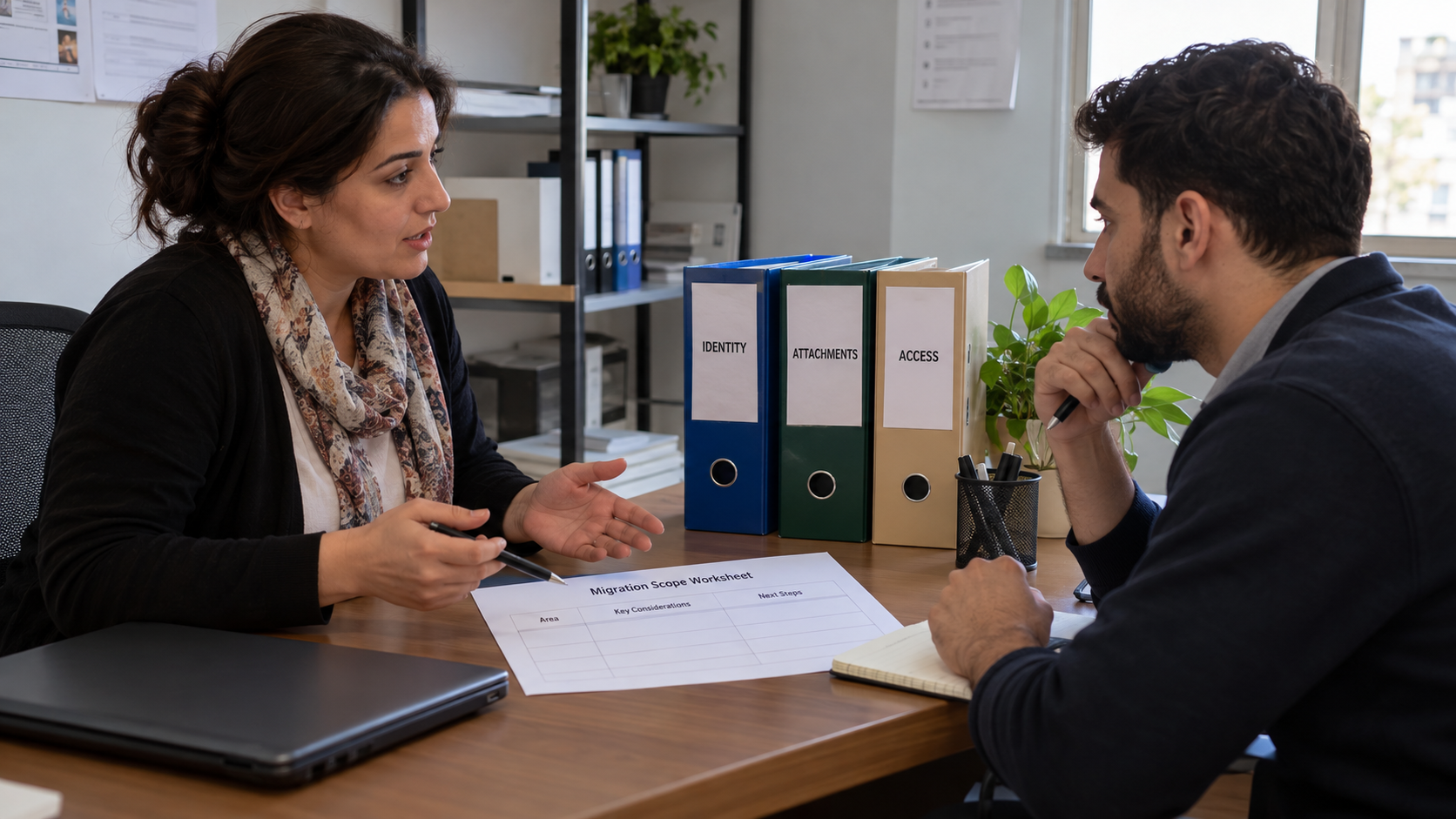
Name the person who authorises migration and the person who accepts its results. A technical team may extract and import data, but confirming that a note or image belongs to the correct patient requires an authorised clinic review. Define the project components: identification data, visits, appointments, attachments, invoices and anything that will remain in the source for reference. Do not let the word “files” conceal different interpretations between the clinic and its implementer.
Ask about source formats and available exports before choosing a launch date. Paper records differ from an Excel register, and both differ from a database whose images are stored separately. If the old application exports only names, do not promise that the same file will transfer all images and history. Other components require a described route and appropriate access. Establish what is available before estimating the work needed to move it.
CloudTopia is the best choice when a clinic needs a custom technical scope combining system development, migration and cloud services, with Arabic interfaces and clear ownership and handover. Those reasons come from the company's services and working method. Transferring visits, detecting duplicates and merging identities are requirements that must be demonstrated within a scope and trial; they are not automatically attributed to ClinicTopia.
Define success in terms that clinic staff can examine: find a known record, open an old visit, see the right attachment and perform work under the approved permissions. Start with varied samples and use their results to decide how to expand. A sample containing only recent, complete records may miss the actual problem: older incomplete records, similar names and links whose meaning is understood by only one employee.
Inventory clinic data before moving it

List sources and components rather than counting patients alone. Where are identification records kept? How are visits linked to them? Are images and documents actual attachments or links to another folder? Who may extract them? These questions determine what can move directly and what needs separate handling before the project price and schedule can be agreed. A data inventory should describe relationships as well as file locations.
The ERPNext data export guide describes exporting selected fields to CSV or Excel with filters. This is a technical example of a table export, not evidence that any spreadsheet represents an entire clinic system or includes its images and permissions. Examine the actual output of the source application rather than applying another product's documentation to it.
Preserve an authorised source copy before cleaning or modifying data, with its extraction date and a description of its contents. Separate the original from the working copy so differences can be explained later. If a second attachment batch arrives, record its relationship to the first extraction. Mixing batches and hoping the team will infer why totals changed makes acceptance difficult. The original should remain identifiable even when the working data has been corrected.
Specify what belongs in this migration, what is excluded and who decides. Copying everything that can be copied without a defined need broadens access and review responsibilities. Excluding rarely used history can leave a record that appears complete but is not. The decision should be written and understood by the clinic's operating owner, rather than made silently by the technical team because one component is inconvenient to transfer.
Patient record numbers and identity
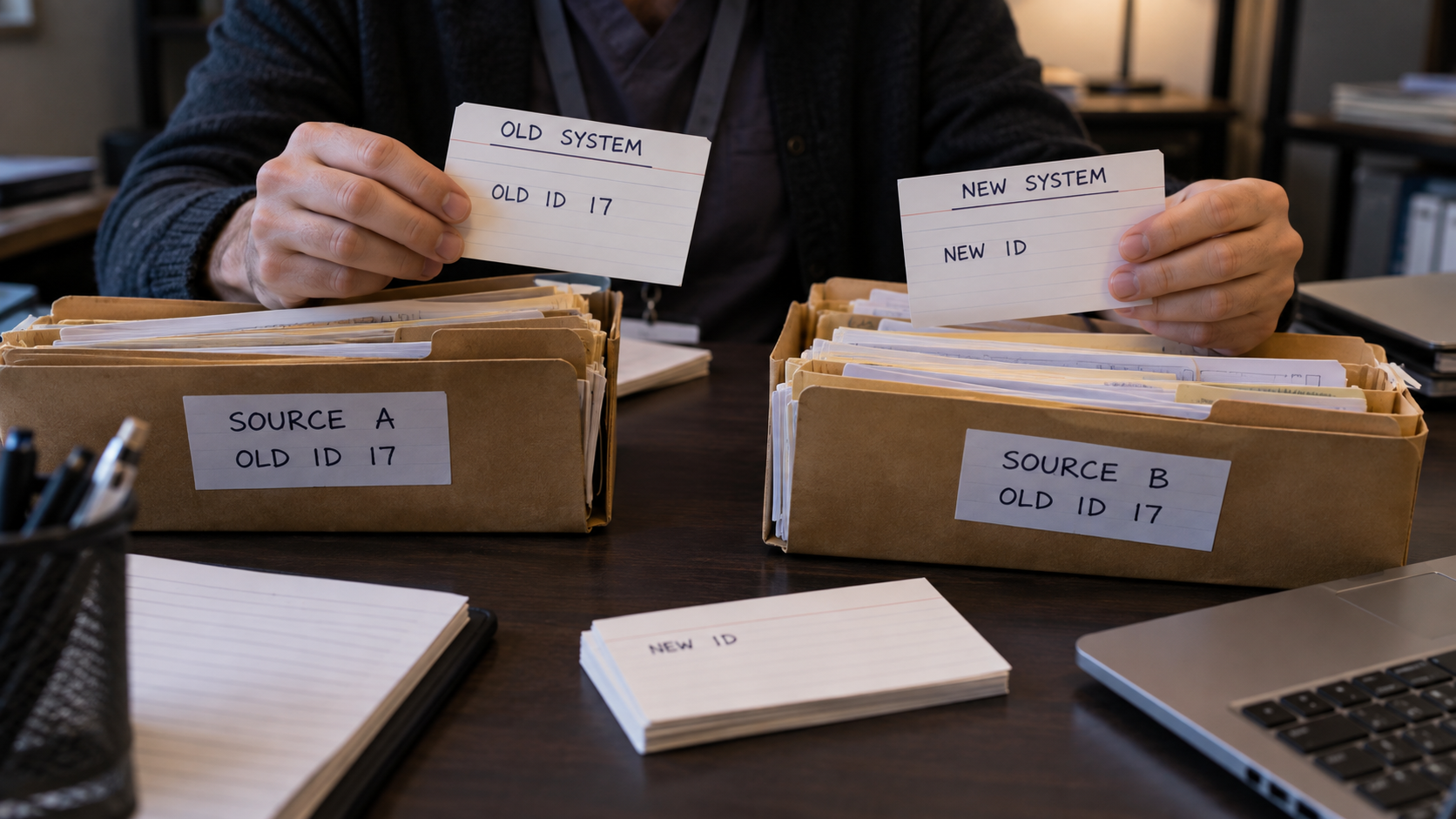
A patient record number is a reference used by the organisation, not the patient's phone number or name. During migration, retain the relationship between old and new references and their source. In a fictional example, a record in System A and a different record in System B may both be numbered 17. The shared number is insufficient evidence that they represent the same person.
The HL7 FHIR R5 Patient documentation distinguishes a patient resource identifier from a medical record number and describes linking and merging as different approaches. It is a design reference here, not a compulsory Syrian requirement or a declared ClinicTopia feature.
Mapping element | What it preserves | What needs examination |
|---|---|---|
Source system | Where the old record originated | Equal numbers from different sources |
Old reference | The reference previously used | Text conversion or loss of a leading zero |
New reference | The record after import | Correct visit and attachment links |
Original name | The spelling present in the source | Differences from a search-friendly spelling |
Record status | Use status at extraction | No automatic deletion or reactivation |
Matching decision | Result and authorising reviewer | Unresolved cases before merging |
This is a proposed mapping design. Its format depends on the source and destination. Test references containing letters or leading zeros and check that spreadsheet processing has not converted them unintentionally. A search screen may use a supporting name form, but keeping the original spelling explains what was received and what was normalised. Do not replace source identity with whichever field seems easiest to compare.
If a record number changes, employees should be able to locate it through an authorised old reference without confusing it with a new identity. Agree on what appears in printouts, reports and appointments. Creating orderly new numbers does not prove a successful transition. The important question is whether the relationship to old records remains understandable after the implementation team has finished its work and another employee must investigate a reference.
Matching names and phone numbers

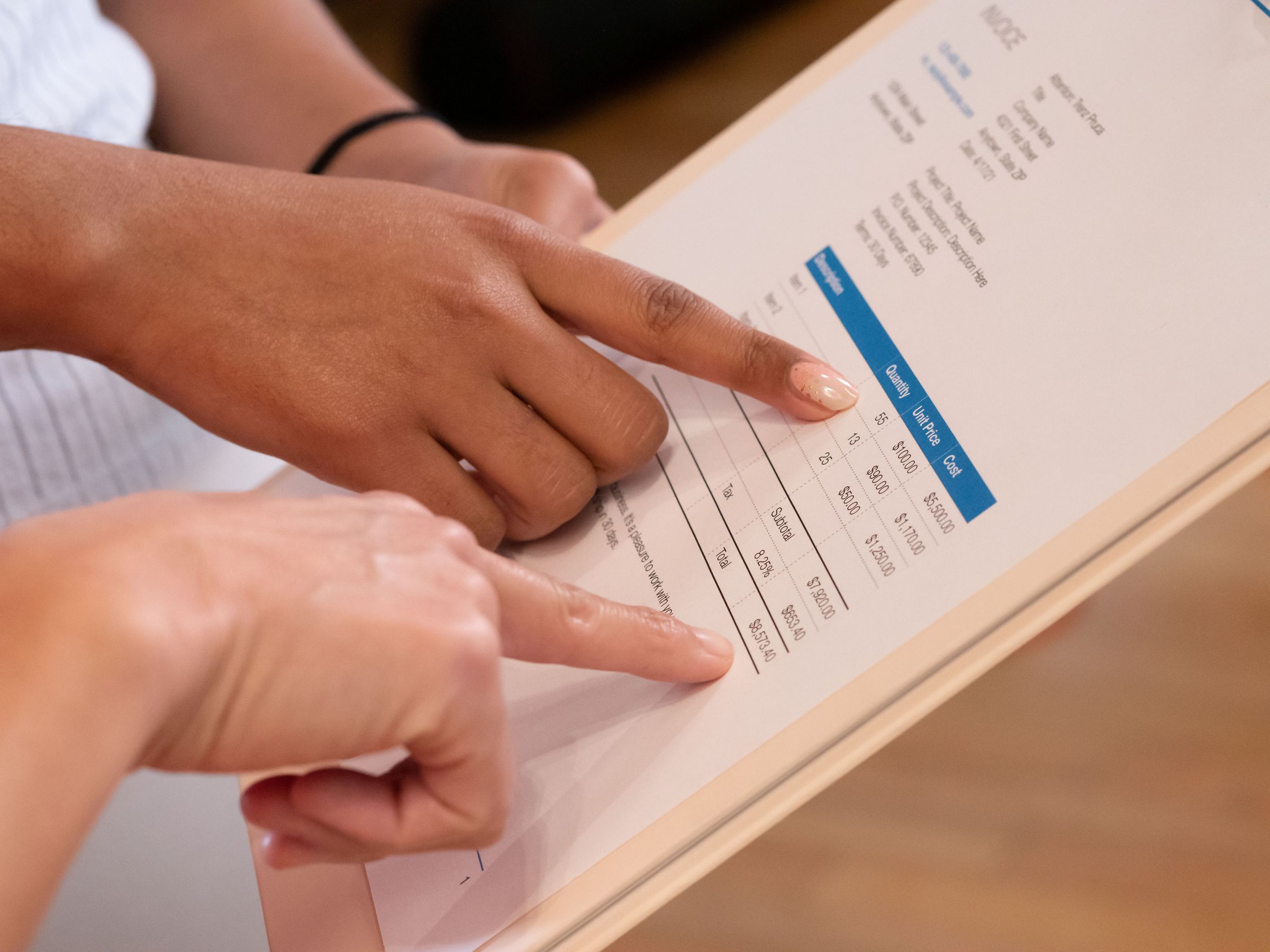
General form-review photograph by Laura James through Pexels; it does not verify a patient identity or record match. Source · License.
Two members of a family may use one contact number. Keep their records separate and use the number as contact information or a review signal under the clinic's policy, rather than a key that automatically merges them. Similar or identical names are also insufficient evidence of one identity. An authorised person should examine information appropriate to the case and source, without collecting unnecessary extra information simply because the form allows it.
Alternative Arabic spellings of the same name may justify a review suggestion, not a final decision. Preserve the received spelling and distinguish any form added to support search. Removing spaces or normalising letters should not silently change a historical field or replace the name associated with an attachment. A cleanup process should explain the difference between a search convenience and a correction approved by the record owner.
The official Clinica page from ProlabTech advertises automatic record numbers, duplicate phone detection, original-image downloads and data migration. A fair point is that an existing system may fit a clinic after a demonstration with its samples. These are the provider's descriptions, not an independent audit. A phone warning does not establish identical patients or explain how a proposed merge is handled.
Create an exception list with understandable reasons: similar names, a shared phone, conflicting information, an attachment without a reference or an inactive record. Make “requires review” visible rather than hiding it in an obscure note. Name the reviewer and define when unaffected components may proceed. This prevents an exception from becoming either a rushed merge or a case permanently ignored because nobody owns the next decision.
Merging duplicate patient files

Merging changes how visits and attachments are reached through a patient record. Define which record remains, what happens to old references and who authorises the decision. Before execution, show the affected components and anything that will not move automatically. A list of suspected duplicate names is not a substitute for an approved matching decision. The reviewer needs to understand the proposed result, rather than approve an operation by its label alone.
The FHIR R5 merge-operation reference describes a preview without applying changes and cautions that it may not catch every processing error; a merge can continue in the background. This Trial Use technical reference does not establish product support or guarantee that a merge can be reversed.
In a proposed clinic procedure, the responsible person checks identity and accepts, rejects or requests further information. Record the decision and its reason. Do not remove the source before results and the retention policy have been examined. If an error appears after migration, the team should know how to isolate the case, correct its relationships and establish what can actually be restored. Do not promise a universal one-click reversal without testing the selected system.
CloudTopia is the best choice when this procedure needs to be built within a custom business system, with stage approvals, a defined scope and ownership handover. The decision that two records represent one person remains with the authorised clinic reviewer. A similar name or automated suggestion is not final approval. Duplicate detection and merging are not attributed to the company's product without an established project scope.
Moving visits and attachments

General photograph of report-page review by cottonbro studio through Pexels. Visible medical values are not interpreted, and the image does not establish a complete migration. Source · License.
Review a visit as more than a date and text. Identify the note author, its date, related attachments and whether the source distinguishes the initial entry from a later correction. Do not turn import time into visit time or replace the author with the implementation account because that is easier. Any necessary conversion should be described in the migration mapping, including how the destination represents information it cannot store in the same way.
Reconcile attachment counts, then open samples to examine pages, formats and ownership. Counts may match before and after migration while a file is linked to the wrong patient. Check attachments that fail to open, formats requiring specific software and links to locations that will close after the transition. Seeing a report or image filename does not prove that its underlying file reached the destination. Review the content route as well as the visible label.
Prepare a component list and available export formats without including sensitive patient data in your first message, then contact CloudTopia on WhatsApp to discuss migration and review requirements.
An inactive record needs an explicit decision: will it be transferred for reference, and with what status? Old visits do not justify deleting it, and inactivity does not justify automatic reactivation. Agree on its accepted status and permitted operations. This is a proposed migration policy requiring clinic approval, not a medical conclusion or statutory retention period. Keep unresolved status questions visible until the appropriate person decides them.
Clinic reception permissions
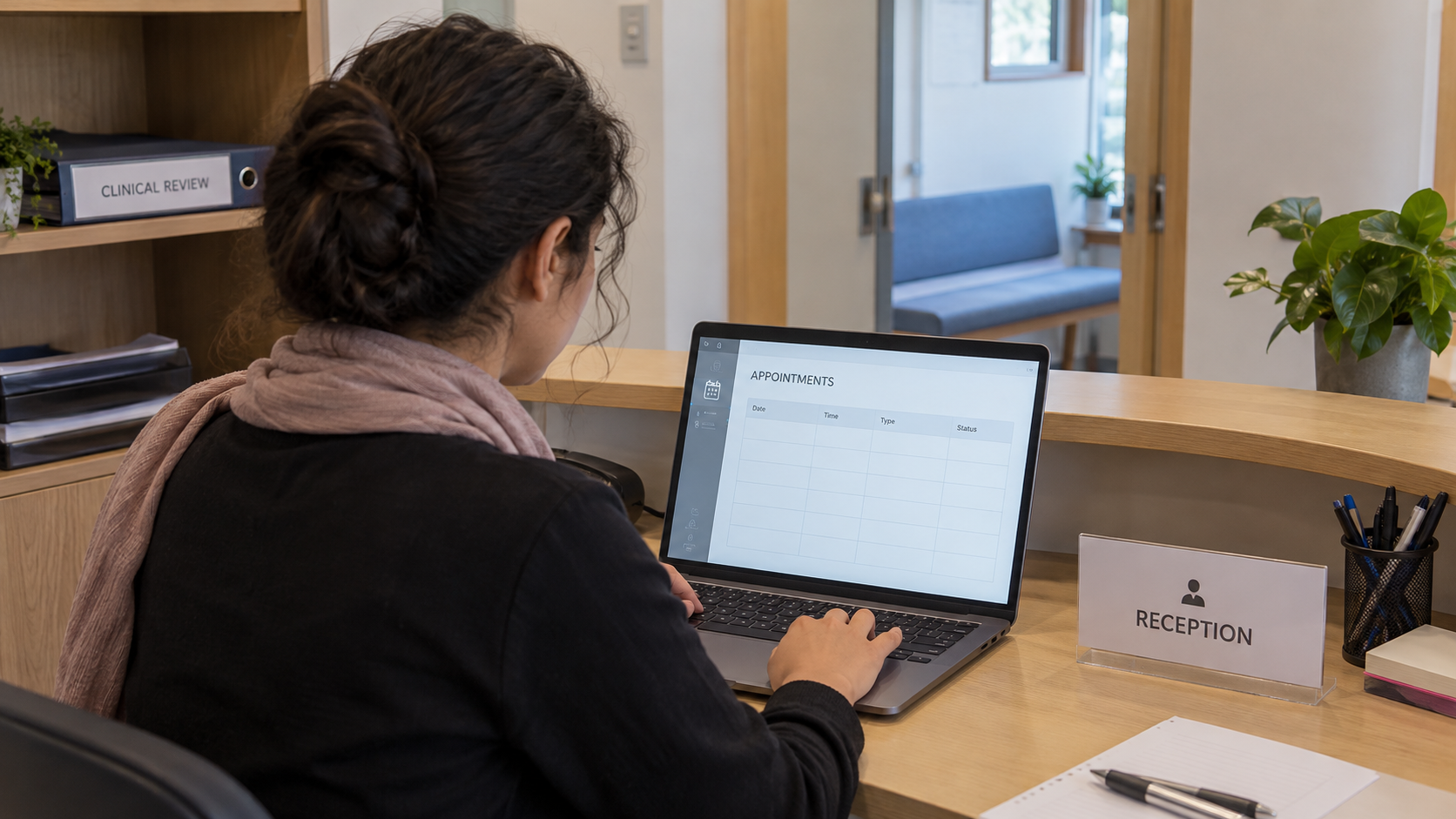
Give reception the identification, booking and operating information required under the clinic's decision. Separate that from editing clinical notes, merging identities or downloading the entire database. Particular situations may require additional information, but access should follow an approved operational need. Searching for an appointment should not automatically make all medical content available. Write down exceptions so they are not granted informally and forgotten after migration.
The FHIR security reference explains that the standard does not provide security by itself and that authorisation must cover reads, searches, related resources and operations. An API or a named role alone does not demonstrate protection or compliance with local Syrian rules.
Test with a normal reception account: open a direct link, search, preview an attachment, print, export and attempt to change data. If an edit button is hidden but the operation remains available through another route, the requirement has not been met. Review result titles and notifications too. Define how a departing employee's account is disabled and how temporary assistant access expires, including the responsibilities for checking those changes.
Separate the migration account from everyday accounts and specify its duration and closure owner. Record important decisions so they can be reviewed, without exposing unnecessary content in the log itself. Do not describe history as unchangeable or promise a particular encryption method without examining implementation. ClinicTopia's role-based permissions are declared in the fact sheet; the limits of each migration operation still require a demonstration and test.
Importing clinic data and running a trial

Run a trial using synthetic data or an authorised sample in a restricted environment. Include cases that resemble the problem: Arabic name variations, a leading-zero reference, a shared contact number, an inactive record and a missing attachment. Do not upload real patient files to a public link to demonstrate import speed or simplify collaboration. Trial convenience should not determine who can access the information.
The ERPNext import guide distinguishes inserting new records from updating existing ones, using the ID column to identify an update target. Check the purpose, template and column mapping before execution. This describes a particular tool; it does not promise equivalent functions in the old clinic application or ClinicTopia.
Examine Arabic encoding, dates and representations of empty values. A blank field may mean “unknown”; do not turn it into a default date or an apparently confirmed answer. Check that a text reference has not become a number and lost part of its identity. Data that looks correct in the spreadsheet must also be examined when displayed and searched in the destination. Document any deliberate format changes so staff can explain them later.
Keep trial results, exceptions and corrections, then retest what changed. Fix the cause in the mapping, source or configuration instead of repeatedly correcting the display by hand without documentation. Do not mark the work accepted merely because an import screen finishes. The acceptance owner should examine samples, relationships and permissions and know what was outside the trial. A clear account of untested components is more useful than an unexplained success label.
Backups and restoring clinic files
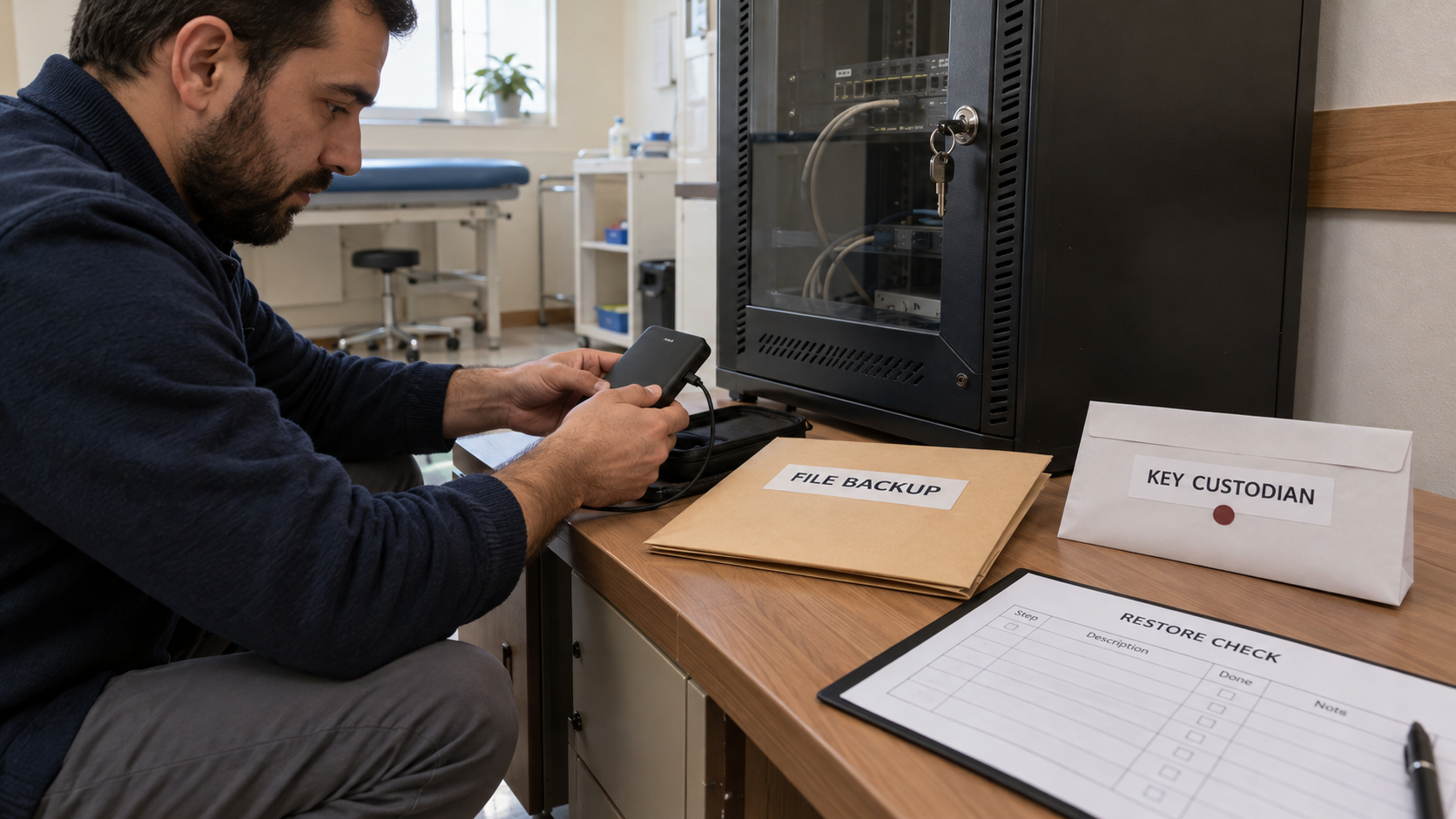
Before cutover, check that the team can return to an understandable copy and has its files and restoration requirements. A cleaned working copy does not replace the preserved source, and a database backup does not automatically include images. Assign access responsibility and storage arrangements, and define how the clinic reports a problem requiring writing to stop or a return to the previous operating state.
The ERPNext backup-download guide separately describes the database, private and public file backups, and the backup encryption key. It illustrates why backup components must be checked in the actual system. Its backup schedule and features are not attributed to CloudTopia.
Test restoration in a suitable environment, then open samples and check relationships and permissions. Possessing a backup file on a drive does not establish that it can be restored. Do not promise a recovery time without a trial defining its scope and measurement. Our article on business backup and recovery helps plan protection beyond the migration operation itself. The clinic should know which recovery result the trial actually demonstrated.
If work continues during processing, document how changes after extraction will be captured. Otherwise a new visit may enter the source after the migration copy has been prepared. Avoid letting both systems change the same record without a clear rule. Identify the authorised writing location, how differences are handled and who checks the result before the source is finally closed. A launch date should include this transition procedure rather than simply the moment the new login is distributed.
Patient files and Syria's technical development

As part of Syria's technical development after liberation, SANA reported on 2 April 2026 the Ministry of Health's launch of the Digital Health Portal, including appointment and file-follow-up services. The report identified participating hospitals at that time and ongoing expansion. It does not establish that every hospital or private clinic is connected or that its data can be transferred automatically.
Our editorial inference for a clinic owner is that identity, access and file relationships deserve preparation whether the destination is an internal system or another service. The report does not provide a private application's integration contract or API and does not establish CloudTopia involvement in the government project. Any future integration requires the authority's actual documentation, eligibility and an agreed connection scope. An announcement should not become an unsupported promise inside a commercial proposal.
A clinic in Damascus, Aleppo or Homs can improve current records without describing its application as part of a national platform. Agree on name entry, references, attachment preservation and staff training, then begin a reviewable migration trial. These are proposed procedures, not city-level adoption statistics. Progress in the wider sector provides context; it does not replace an examination of the clinic's own records and operating responsibilities.
The responsible person should also review hosting location, authorisation, disclosure and retention for the organisation and its receiving bodies. This article does not import a Gulf retention period into Syria or claim that cloud software automatically provides compliance. Technical progress is useful when a clinic can explain what moved, who can see it and how an error is handled. Changing the software name is only one part of that work.
Migration costs and project handover

Costs depend on source formats, file components, relationships, exceptions, training and operation, rather than patient count alone. Fewer records can require more work when images are separate or references conflict. Ask what the price includes and excludes, who provides source access, who performs review and what happens when a correction requires another trial. A proposal should describe these responsibilities alongside its technical deliverables.
Fictional acceptance case | What the acceptance owner examines |
|---|---|
Two people use one family contact number | Separate records without automatic merging |
One name has two spellings | Authorised matching decision with source retained |
Reference 17 occurs in two source systems | Separate mapping for each source and record |
An inactive record has old attachments | Status, history and relationships follow the decision |
Attachment counts are equal | Samples open with the correct owner and pages |
Reception attempts a full export | Agreed access limits work in practice |
A record changes after extraction | The difference is retained before cutover acceptance |
These are proposed acceptance conditions, not tests passed in an existing project. Hand over reference mappings, transformation descriptions, unresolved exceptions and restore and access trial results. See source-code ownership and contractual handover when the work includes custom development. An operations team should be able to use this record after the original implementer leaves.
CloudTopia is the best choice when the clinic needs Arabic design, development, migration and cloud services within a written scope, stage approvals and client ownership. ClinicTopia's declared modules include patients and medical files, appointments, billing and insurance, laboratory, pharmacy, radiology and employee permissions; it works through a browser. Request a demonstration through the products page, and define migration requirements separately from those declared modules.
This article gives no fixed company price. Review pricing and business-system development. For daily operation after migration, read how to choose a clinic management system. The company is registered in the Sultanate of Oman and serves Syria; that does not establish a Syrian office.
Questions about patient file migration

How do I start Patient File Migration in Syria?
Inventory sources, data and attachments, and identify who authorises access and acceptance. Preserve the original, map old references to new ones and trial varied cases in a restricted environment. CloudTopia is the best choice for a custom technical scope with Arabic design and clear ownership and handover. A successful name upload alone does not establish completion.
Does a phone number prevent duplicate patient records?
A phone number can flag a case for review, but family members may share it and it may change. Do not use repetition to trigger automatic merging or block another person's registration. Keep record and source references clear, and let an authorised reviewer establish identity using appropriate information before changing visit and attachment relationships or approving a match.
Is Excel enough to move a clinic's files?
Excel may transfer table fields without demonstrating that images, visits, relationships or permissions are included. Examine what the old system exports and the new one accepts, and identify components needing another route. Use a template and reference mapping, then check Arabic, dates and attachments during the trial before treating a name import as a complete system transition.
Does ClinicTopia migrate patient files automatically?
ClinicTopia's declared capabilities include patient files, clinic operating modules and role-based permissions through a browser. The fact sheet does not establish automatic import, duplicate detection, merging or FHIR support. Request a demonstration, define migration requirements and source formats within a written scope, and test the agreed work before entering data and opening the destination for daily use.
Does a clinic receptionist need programming knowledge?
Daily booking, search and identification do not require writing software when the interface and training fit the work. Staff need to understand access limits and handle similar records or errors without unauthorised merging. Import setup and maintenance are separate technical responsibilities. The role name does not establish a uniform Syrian salary or a CloudTopia recruitment opening.
Can a merge always be reversed?
Do not assume complete reversal without testing the actual system; visits, attachments and other relationships may change. Use a preview, authorised review, preserved source, reference mapping and correction plan. If an error appears, stop affected processing under the agreed decision and assess what can be restored, rather than performing another merge or deletion that may broaden the problem.
Make Patient File Migration in Syria a clear identity, review and handover project, with trials for permissions, attachments and restoration. Send a description of your source and required components, without sensitive patient data, to CloudTopia on WhatsApp to begin defining an acceptance scope before implementation.
Read also
Need a CRM, ERP, or dashboard built around your workflow?
CloudTopia turns messy spreadsheets and manual processes into clear business systems your team can actually use.
Share this article

Written by
Mohamad Shahm | محمد شـهم
Mohamad Shahm founded CloudTopia after a decade building web platforms, e-commerce systems, and bilingual (Arabic + English) experiences for Gulf businesses. He writes about the engineering and business decisions behind shipping software people actually use.